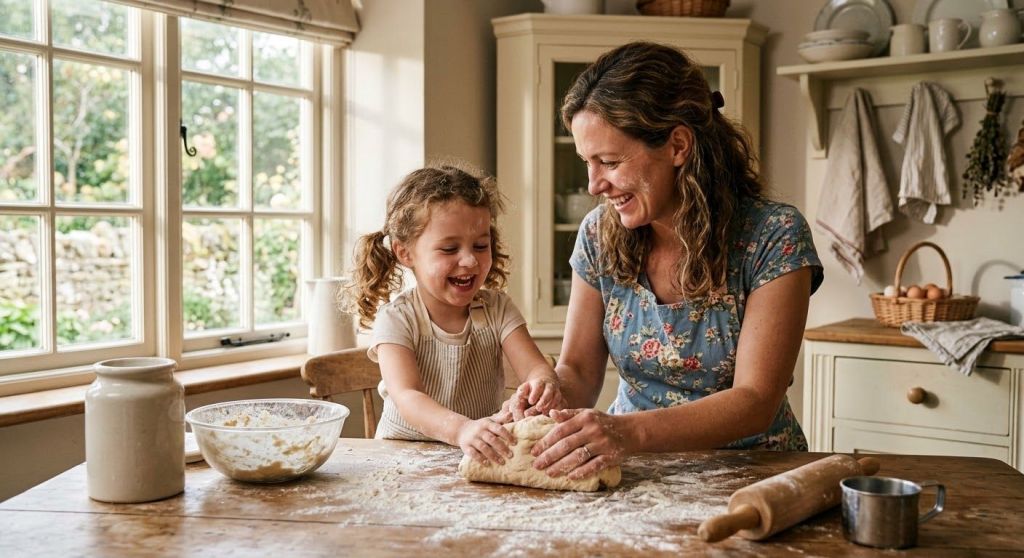
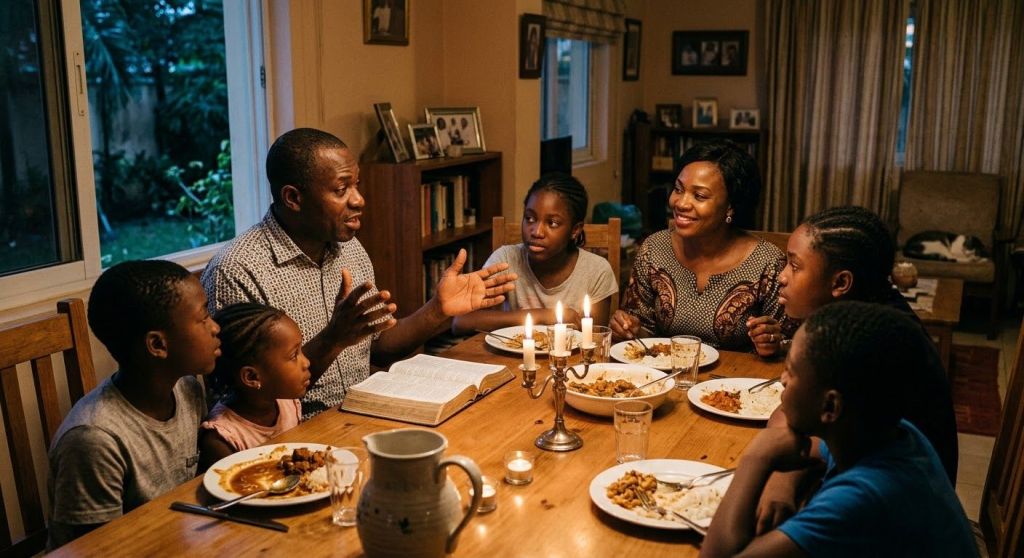
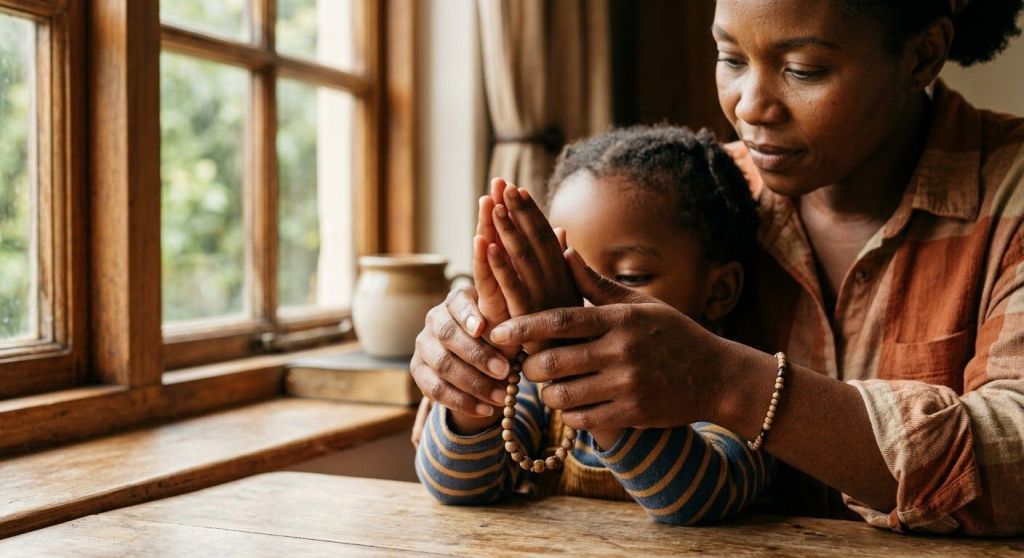
A house falls without a foundation, and so does parenting without God’s Word. See how Timothy, Samuel, and Daniel were raised on the rock, and how you can build the same foundation at home this week.
“For no one can lay any foundation other than the one already laid, which is Jesus Christ.” 1 Corinthians 3:11
Jesus Himself told us what happens when storms hit a home:
“Therefore everyone who hears these words of mine and puts them into practice is like a wise man who built his house on the rock. The rain came down, the streams rose, and the winds blew and beat against that house; yet it did not fall, because it had its foundation on the rock.” Matthew 7:24-25
The storms will come to every family. What decides whether the house stands is what it was built on. When we build on Scripture and put it into practice, we raise Timothys, Samuels, and Daniels. Here’s what that looks like:
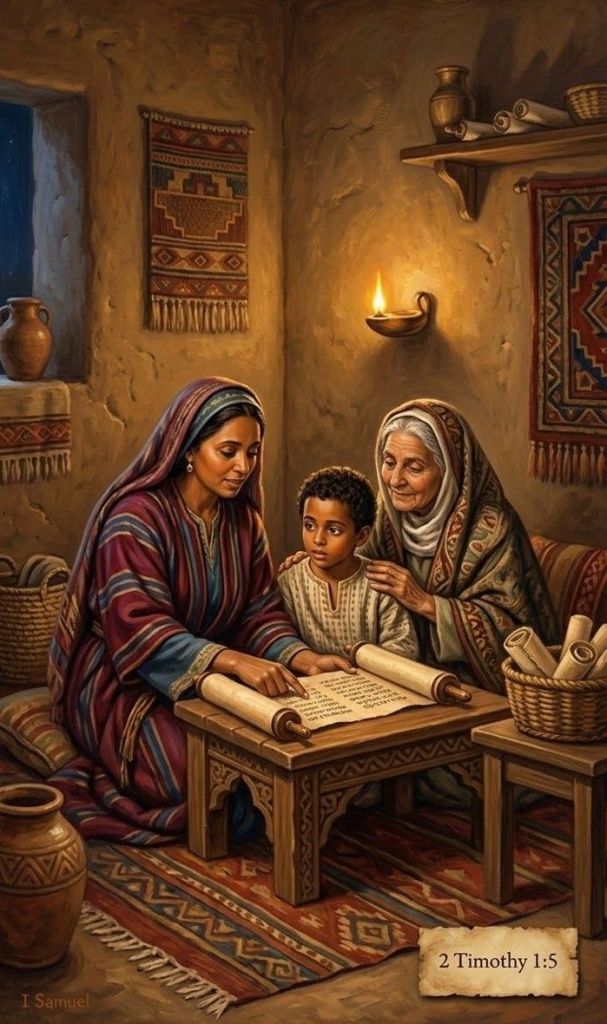
1. TIMOTHY: Raised on Scripture From Childhood “From infancy you have known the Holy Scriptures, which are able to make you wise for salvation.” 2 Timothy 3:15
Young boy Timothy sitting with his grandmother Lois and mother Eunice
His Foundation: · Lois & Eunice (2 Tim. 1:5) filled his early years with God’s Word · Outcome: He grew into Paul’s trusted partner in ministry
2. SAMUEL: Taught to Listen for God “Speak, Lord, for Your servant is listening.” 1 Samuel 3:10
Young boy Samuel lying in the temple at night, light shining down
His Foundation: · Hannah gave him to God (1 Sam. 1:28) · Eli showed him how to answer God’s call · Outcome: He led Israel with integrity
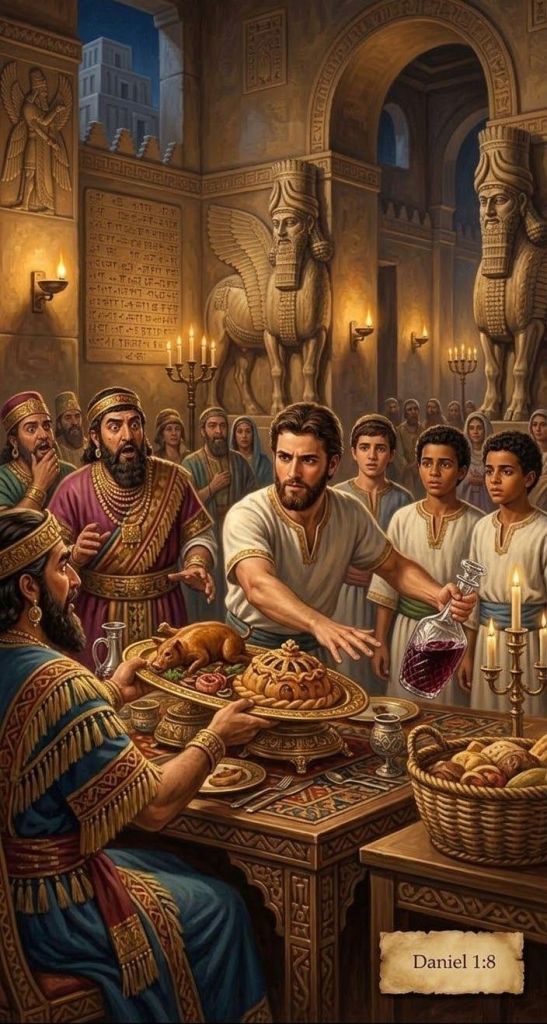
3. DANIEL: Steady in a Hostile Culture “Daniel resolved not to defile himself with the royal food and wine.” Daniel 1:8
Daniel standing firm at the king’s table in Babylon, pushing away royal food and wine
His Foundation: · His parents rooted him in God’s commands (Deut. 6:7) · Outcome: He held his ground in Babylon’s palace
Timothy, Samuel, and Daniel all stood firm because someone built on the rock, not the sand. The storms will come, but the home built on Christ will stand.
This Week’s Challenge: · Morning: Read a verse about who God is · Mealtime: Tell a story about a hero of the Bible · Bedtime: Pray a promise from Scripture over your child
A Prayer for Your Home: Lord, be the foundation of our family. Help us hear Your Word and put it into practice, so that when the storms come, our house stands on You. Amen.
Of these three examples (Timothy, Samuel, or Daniel), which speaks to you most, and why?
(I’ll start: Timothy’s story pushes me to be more intentional.)
Jemima, Abigail and Matilda learn kindness, sharing, patience and friendship after too many arguments in this fun Christian children’s story.
The Story
In a lively neighbourhood called Sunny Street lived three girls named Jemima, Abigail, and Matilda.
They lived close to one another.
They went to the same school.
They even played in the same playground.
But there was one tiny problem.
They did not get along.
Not a little bit.
They argued about almost everything.
Three young schoolgirls arguing humorously
“The answer is twelve!” Jemima would say.
“No, it’s fourteen!” Matilda would reply.
“Both of you are wrong!” Abigail would announce.
Then Jemima and Matilda would turn to her.
“What is your answer?”
Abigail would blink.
“I haven’t done the question yet.”
“ABIGAIL!”
Abigail had a special talent.
She loved knowing everybody else’s business.
If Jemima whispered to Matilda, Abigail wanted to know what they were whispering about.
If Matilda opened her schoolbag, Abigail wanted to know what was inside.
And if someone said, “This is a secret,” Abigail’s ears suddenly became bigger than two satellite dishes.
“What secret?” she would ask.
“Abigail, mind your business!” the girls would shout.
But that was not the only problem.
At school, they sometimes broke each other’s pencils during arguments.
Jemima impatiently talking to Abigail and Matilda who looked frustrated
At playtime, they argued over whose turn it was to use the slide.
“I was here first!”
“No, I was!”
“Move!”
“You move!”
Sometimes the teacher had to look over and say, “Girls!”
And immediately, all three would become as quiet as three sleeping kittens.
But one day, something different happened.
The teacher gave the class some difficult homework.
Matilda looked at the questions.
Then she looked at Jemima.
Jemima was very good at schoolwork. She was clever, but she never used her cleverness to make other children feel small.
Matilda walked over to her.
“Jemima, please, can you help me with this question?”
Abigail quickly joined them.
“Me too, please.”
Jemima smiled.
“Of course.”
Matilda looked at Abigail.
“You know, Jemima is actually the smartest of us.”
Abigail nodded.
“Yes. She’s a total nerd!”
Jemima laughed.
“Thank you… I think?”
They all laughed.
Jemima patiently explained the homework without showing off or making them feel silly.
Jemima patiently helping Abigail and Matilda with their homework at a school desk
For the first time in a long while, the three girls sat together without arguing.
They discovered something surprising.
They actually enjoyed being together.
A week later, the girls had a playdate.
They played games, shared snacks, told funny stories, and laughed until their cheeks hurt.
Abigail even tried to tell a joke and forgot the ending.
“Wait,” she said. “I know there was supposed to be something funny here.”
“Maybe the joke went on holiday,” Matilda said.
Everyone burst out laughing.
The next day at school, something had changed.
Jemima lent Matilda a pencil.
Matilda shared her ruler with Abigail.
Abigail gave Jemima some of her coloured pencils.
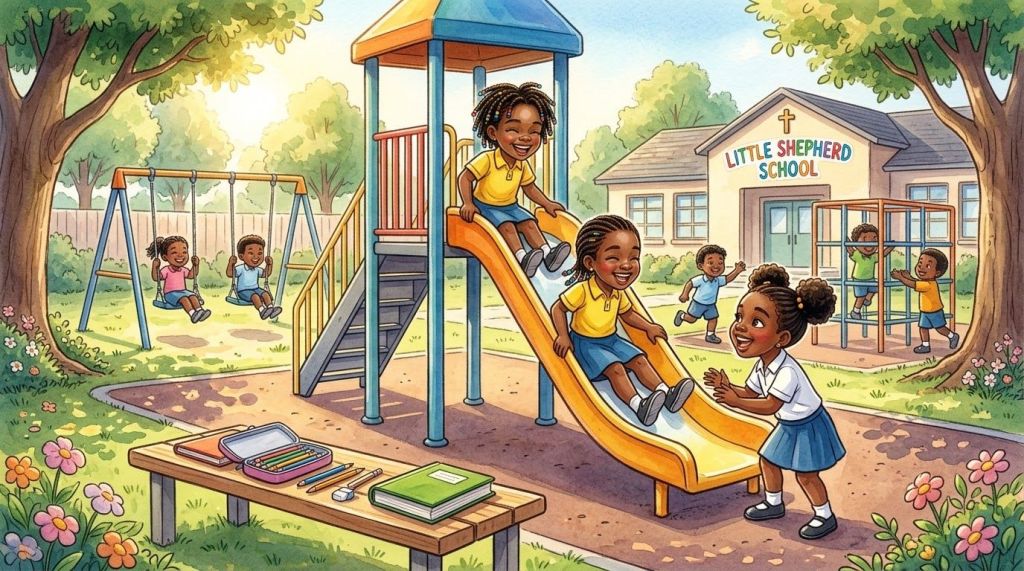
At playtime, they took turns on the slide.
Jemima, Abigail and Matilda happily taking turns on a playground slide.
“Your turn.”
“Then my turn.”
“Then Abigail’s turn.”
“Finally!” Abigail shouted. “A slide schedule!”
They laughed and played together.
There were no more broken pencils from angry arguments.
No more fighting over every little thing.
And Abigail learned that sometimes it was better to let other people’s matters remain their matters.
Of course, she still liked asking questions.
But now she was learning when to ask and when to simply mind her own business.
Jemima, Abigail, and Matilda soon became known as JAM.
J for Jemima.
A for Abigail.
M for Matilda.
Three girls.
Three different personalities.
One wonderful friendship.
And always remember Jesus Love You.
What We Can Learn
Kindness helps friendships grow.
We do not have to agree about everything to be friends.
Taking turns and sharing help everyone enjoy playing together.
Being clever is wonderful, but helping others without showing off is even better.
We should learn when something is our business and when it is better to give others space.
A Teaching Point for Parents
Friendships among children can sometimes involve arguments, teasing, competition, or difficulty taking turns. These moments can become opportunities to teach children practical kindness.
Help children learn simple habits such as listening, apologising when they hurt someone, taking turns, sharing appropriately, and respecting other people’s personal space and conversations.
Also remind children that being good at something is not a reason to look down on others. True knowledge should make us willing to help, not eager to show off.
Scripture to Remember
“And be ye kind one to another, tenderhearted, forgiving one another, even as God for Christ’s sake hath forgiven you.”Ephesians 4:32, KJV
Kindness, forgiveness, and a caring heart can help us build healthier friendships and relationships with others.
Bedtime Prayer
Dear Jesus,
Thank You for my friends and the people around me. Help me to be kind, patient, helpful, and willing to forgive. Teach me to share, take turns, listen to others, and know when to give people space. Help me to use what I know to help others and never to make them feel small. In Jesus’ name, Amen.
Talk About It
Why did Jemima, Abigail, and Matilda argue so much?
How did Jemima help the other girls?
What changed after their playdate?
Why is taking turns important?
What does it mean to mind your own business?
How can you show kindness to a friend this week?
One Little Thing to Remember
Kindness turns ordinary friendships into beautiful ones.
More Stories for Children
Enjoy more fun, faith-filled stories that help children grow in godly character.
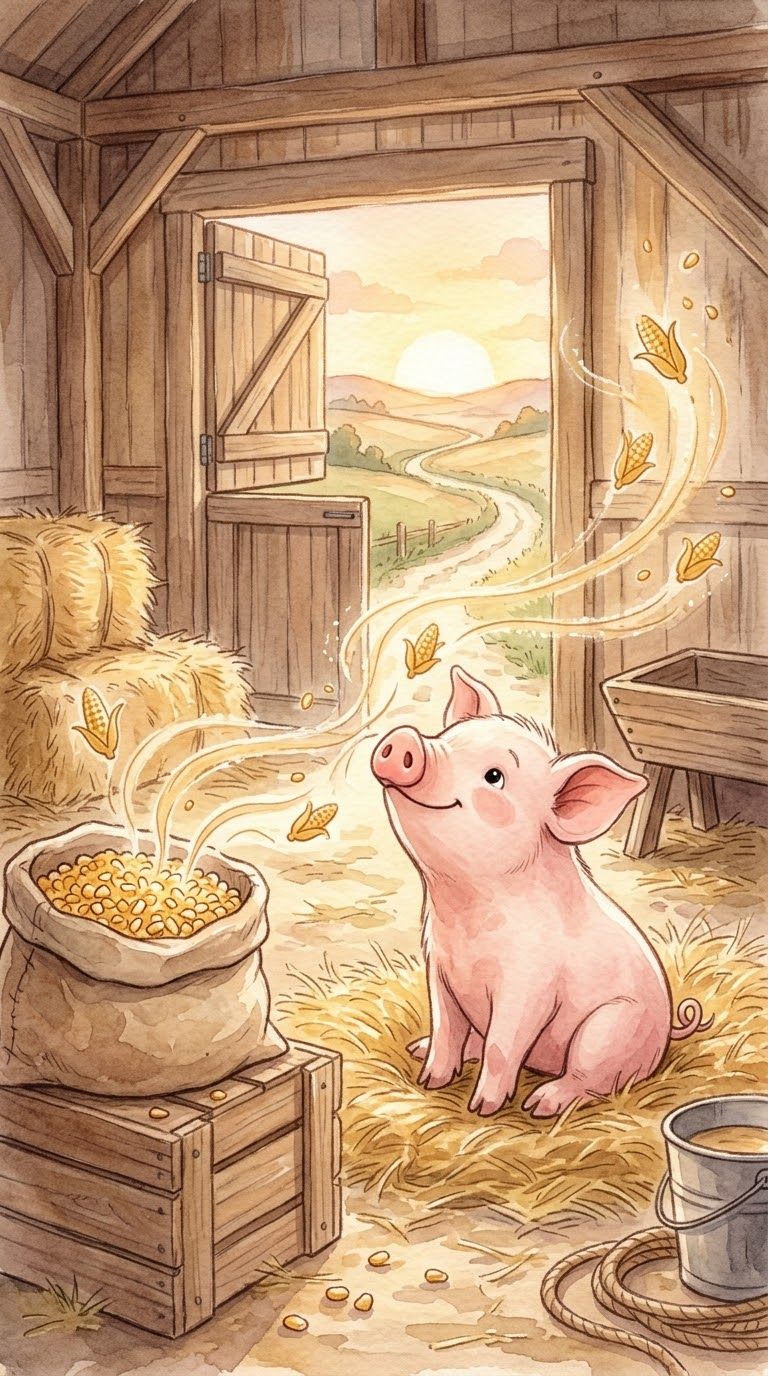
Pip the little pig sneaks out of the fence to follow a warm corn smell and soon gets lost. A short story that teaches children why obedience is a wall of love, with Bible verses, discussion questions, and a prayer.
Story
Pip was a curious little pig with a nose that led him everywhere. Every morning, Mama Pig gave the same rule: “Stay inside the fence, Pip. The road is dangerous.”
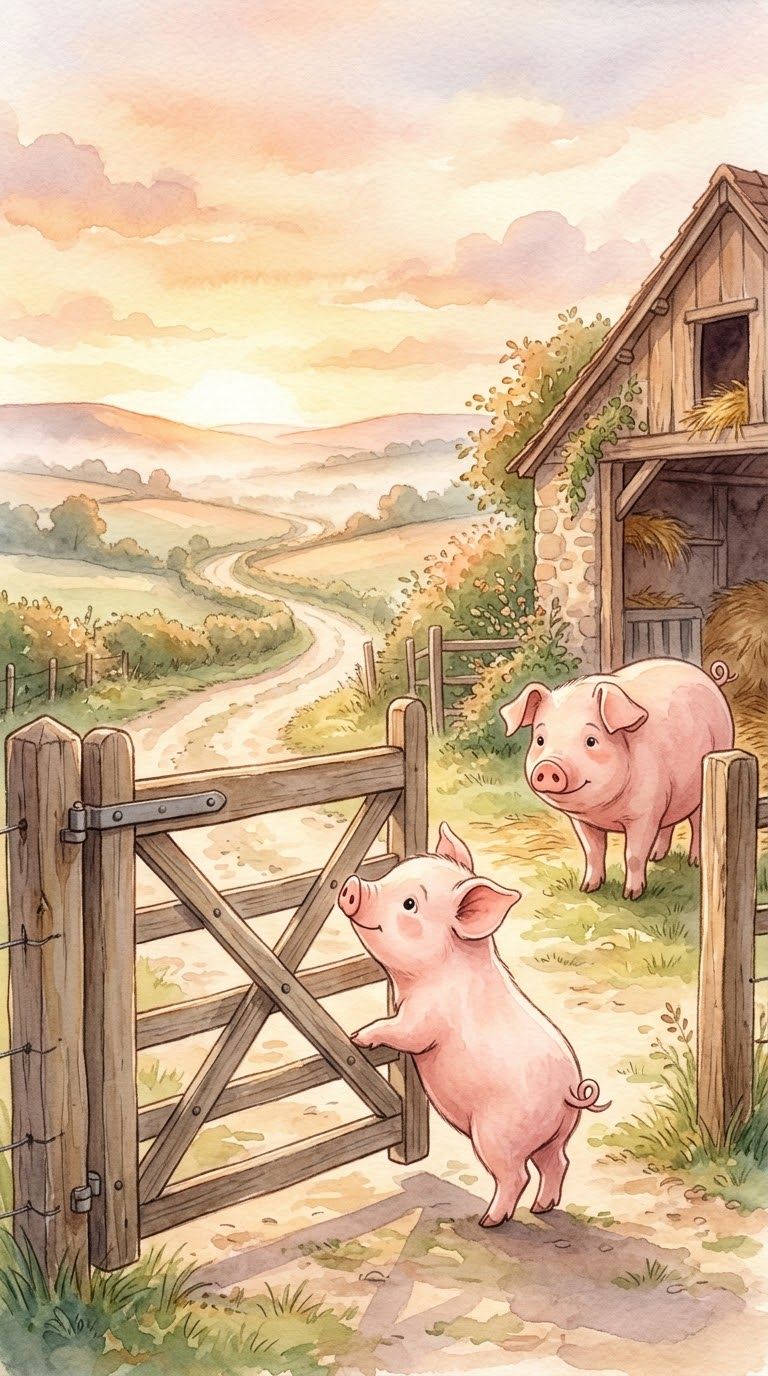
One day, Pip’s nose caught a wonderful smell drifting from beyond the gate. Warm corn! “Just a tiny sniff,” he whispered. He squeezed under the loose board and trotted down the road.
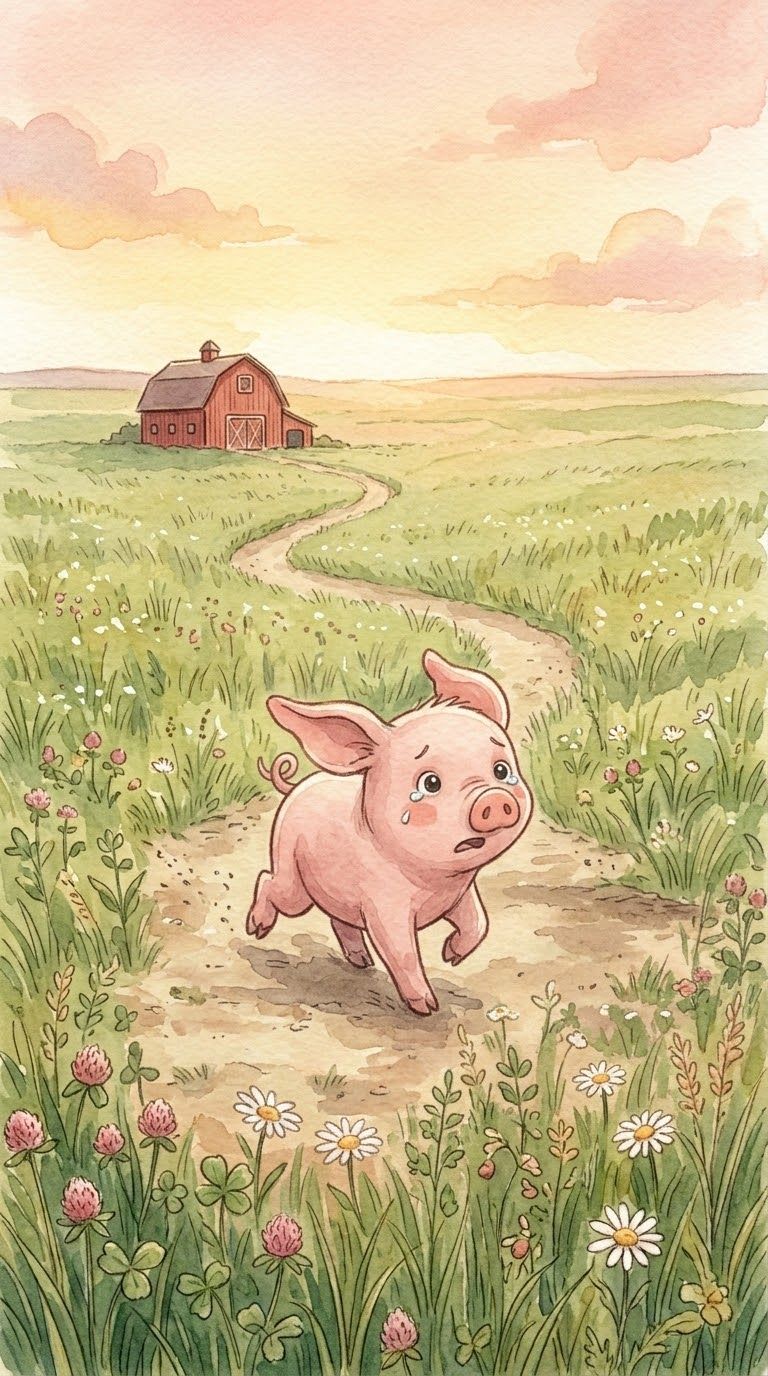
The smell led him to a field, but when he turned around, everything looked the same.
Pigs have poor eyesight, and Pip couldn’t see the farm anywhere. His nose, so clever a moment ago, was only full of strange smells. A tractor rumbled close, and Pip froze, shaking.
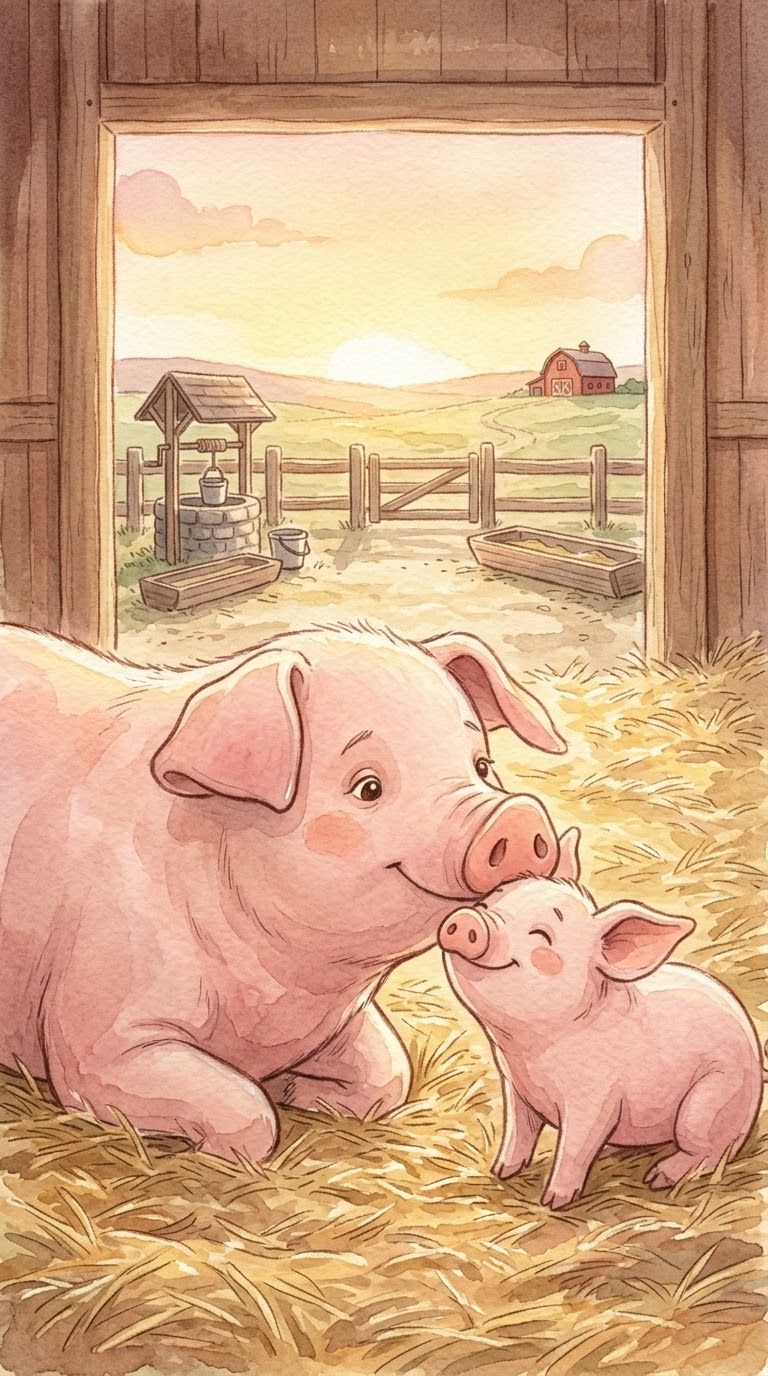
Then he heard a squeal in the distance. It was Mama Pig, calling his name. Pigs know their mothers’ voices, and Pip ran toward it as fast as his trotters could carry him.
“Oh, Mama, I’m sorry!” he cried. “I should have listened.”
“I made the rule because I love you,” Mama said, nuzzling him. “I could see the danger you couldn’t.”
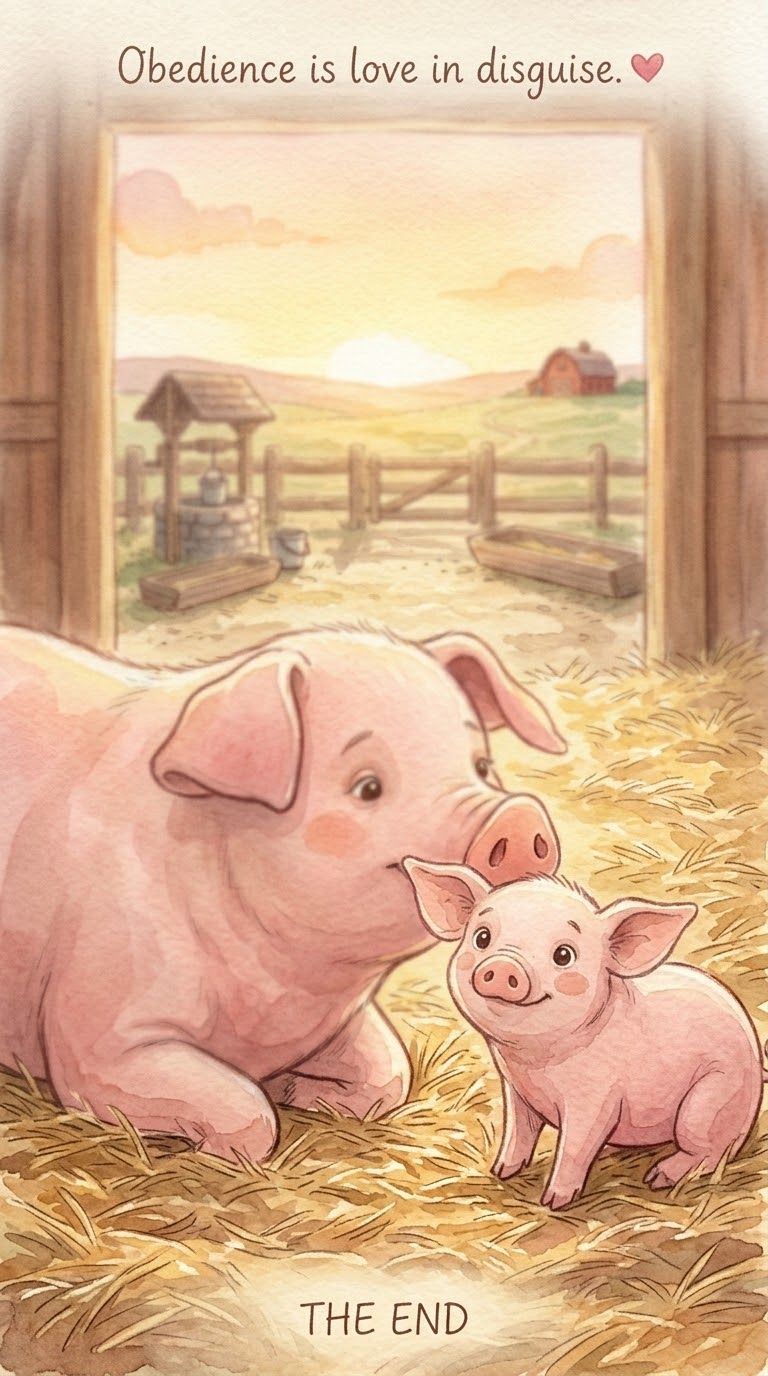
Pip never squeezed under the fence again. He learned that a rule is often a wall of love, put there by someone who can see farther than you can.
The moral: Obedience keeps us safe, because those who love us can often see dangers we cannot.
Pip snuggled close to Mama that night and whispered, “I’ll listen next time.” And Mama smiled, because she knew that a listening heart is a safe heart.
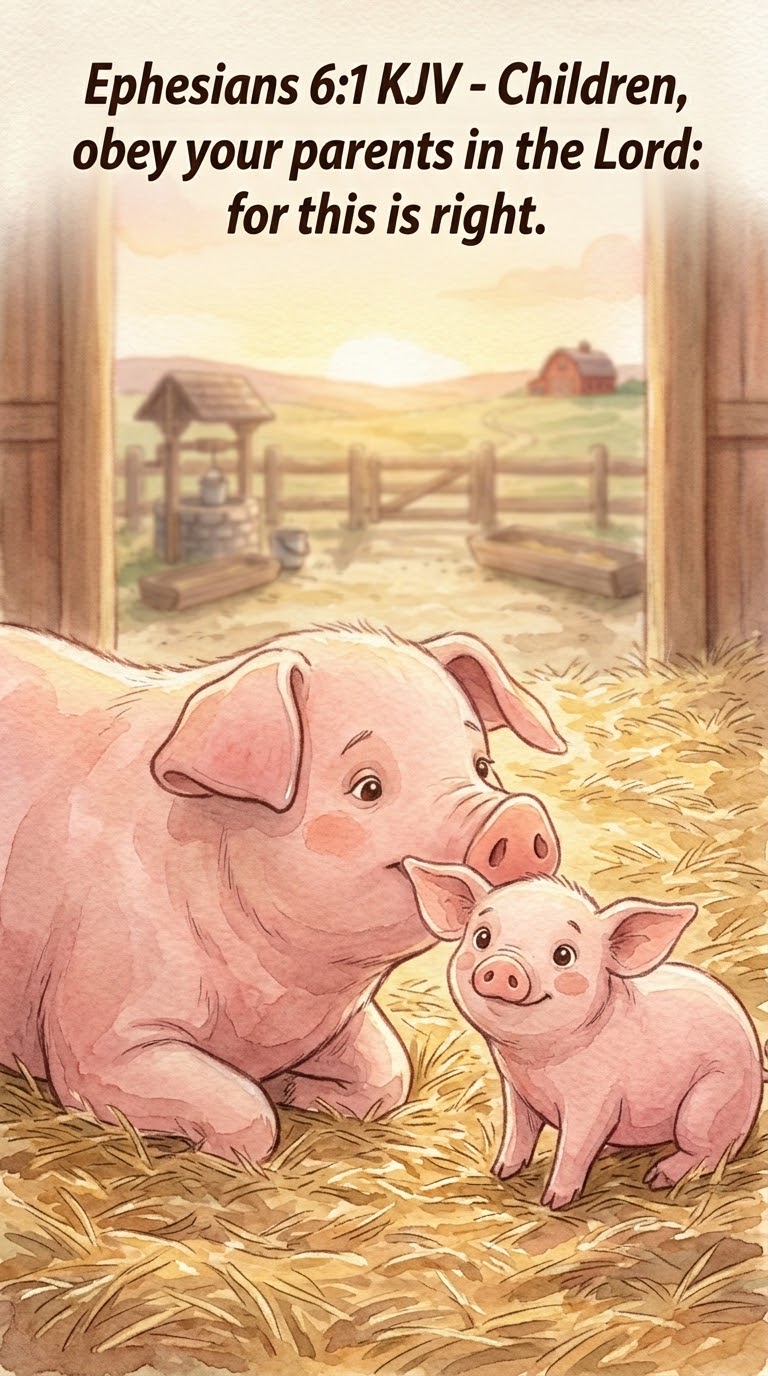
“Children, obey your parents in the Lord: for this is right.”
Ephesians 6:1, KJV
“My son, hear the instruction of thy father, and forsake not the law of thy mother.”
Proverbs 1:8, KJV
Pig traits used: a strong nose (temptation), poor eyesight (limited view), and recognizing a mother’s voice (being called back home).
Talk about it
Why did Mama Pig make the rule about the fence?
Can you think of a rule at home that keeps you safe?
Let us pray
Dear God, thank you for parents who love us and keep us safe. Help me to listen and obey, even when I don’t understand the rule. Thank you for always calling me back home when I wander. Amen.
Passing the Faith On: Guiding Your Child Toward God in a Screen-Filled World
“But Jesus said, ‘Let the little children come to Me, and do not forbid them; for of such is the kingdom of heaven.'” (Matthew 19:14)
Jesus had a special place in His heart for children. When His disciples tried to keep them away, He corrected the disciples and welcomed the children. He then taught that the kingdom of God belongs to those who receive it with a child’s simple faith (Mark 10:14-15).
Children are a precious gift from God, and also a responsibility. Speaking of Abraham, God said:
“For I have known him, in order that he may command his children and his household after him, that they keep the way of the Lord.” (Genesis 18:19)
Godly parenting is more than providing food, clothing, education, and opportunity. These matter, but a child’s spiritual development must never be an afterthought.
The 21st-Century Child Needs Spiritual Guidance
Parents rightly want their children to excel academically, thrive socially, stay healthy, and be equipped for a fast-changing world. Yet in pursuing these goals, we can easily neglect the most important one: a living relationship with God.
Today’s children have unprecedented access to information, entertainment, games, and social media. Technology is not the enemy. It can be a powerful tool for spreading the gospel. The challenge is to keep it from replacing God or consuming the attention that belongs to Him.
Scripture gives us real hope:
“A posterity shall serve Him. It will be recounted of the Lord to the next generation.” (Psalm 22:30)
“All your children shall be taught by the Lord, and great shall be the peace of your children.” (Isaiah 54:13)
But hope calls for partnership. “Train up a child in the way he should go, and when he is old he will not depart from it” (Proverbs 22:6). Training takes intentionality. Faith is not automatic just because a child is born into a Christian home. Children must see, hear, experience, and learn the ways of God.
Five Ways to Guide Your Child Toward God
1. Use technology to make God’s Word accessible.
Bible apps, worship music, age-appropriate Christian videos, podcasts, and educational resources can meet children where they live. Instead of only telling them to avoid technology, teach them to use it wisely and with purpose.
2. Teach them God’s Word at home.
God’s instruction to Israel is a model for every household:
“You shall teach them diligently to your children, and shall talk of them when you sit in your house, when you walk by the way, when you lie down, and when you rise up… You shall write them on the doorposts of your house and on your gates.” (Deuteronomy 6:7-9)
Scripture was to fill the home, visibly and audibly, from morning to night. Faith cannot be confined to Sunday services or children’s church. Talk to your children about God. Answer their questions, including the hard ones. Read the Bible together. Let them see you pray, forgive, serve, and worship.
The home is the foundation and the filter for a child’s choices. What is built there stays for many years.
3. Pray for them.
Parents cannot control every influence their children will meet, but they can bring them before God continually. Pray for their character, friendships, decisions, education, emotional wellbeing, spiritual growth, and future. The Bible says, “Pray without ceasing” (1 Thessalonians 5:17). And when you lack wisdom for the task, remember the promise: “If any of you lacks wisdom, let him ask of God, who gives to all liberally and without reproach, and it will be given to him” (James 1:5).
Prayer does not replace responsible parenting. It expresses our dependence on God.
4. Involve children in God’s work.
Give children opportunities to serve, give, worship, help those in need, and take part in age-appropriate outreach. When they see themselves as part of God’s work, faith becomes something they live, not merely something they learn.
5. Depend on the Holy Spirit.
No parent can produce faith in a child’s heart by technique or effort. Jesus promised that the Holy Spirit “will teach you all things” (John 14:26) and “guide you into all truth” (John 16:13). Invite Him into your home, your teaching, and your parenting decisions. He can reach your child in places you cannot.
Let Us Raise a Godly Generation
The 21st-century child faces pressures earlier generations did not face in the same way. But the answer is not fear. It is intentional, Christ-centered parenting.
We must not surrender our children to the culture, the internet, or peer pressure. Neither should we raise them in isolation from the world. We equip them with biblical truth, wisdom, discernment, and a genuine relationship with Christ.
Our children are not only the next generation. They are a generation that needs our investment today. Let us teach them, listen to them, model Christ before them, and pray for them. Let us build homes where they can encounter the love and truth of God.
The responsibility of raising godly children belongs to all of us. Let us arise, take our place, stand in the gap, and faithfully nurture the children God has entrusted to us.
If you are not sure you have a relationship with Christ, the final section of Part 2 is for you.
Passing on the faith is more than teaching verses. It is also about the atmosphere of the home. In Part 2, we look at how our words and attitudes shape the hearts of our children and spouses.
Words can wound or heal. Discover what Scripture teaches about anger, discipline, and gentleness, and how to build a home where every family member feels safe and valued.
Psychological Abuse and Godly Parenting: Creating Homes Where Children and Spouses Feel Safe
“With all lowliness and gentleness, with longsuffering, bearing with one another in love.” (Ephesians 4:2)
The Bible does not use the modern expression “psychological abuse,” but Scripture is full of principles that teach us to treat one another with dignity, gentleness, and respect.
God cares not only about what we do to people physically, but also about how our words and attitudes affect them emotionally and spiritually. The home should be a place of safety, love, and acceptance. Sadly, it can become a place where emotional wounds are inflicted.
Godly parenting therefore asks more than what we provide for our families. It asks how we speak to, and treat, the people God has entrusted to us.
It Can Begin at Home
A good place to begin is marriage. Peter instructs husbands:
“Husbands, likewise, dwell with them with understanding, giving honour to the wife…” (1 Peter 3:7)
Marriage calls for understanding, honour, patience, and respect. Constant insults, humiliation, threats, ridicule, belittling, or deliberately degrading a spouse can cause deep emotional harm.
Such behaviour is often dismissed as “just words” or blamed on anger. But anger does not make hurtful behaviour acceptable. Our emotions may explain why we reacted as we did, but they do not excuse behaviour that damages another person.
How We Treat Our Children Matters
Children are especially vulnerable to emotional harm. Needless threats, constant name-calling, humiliation, negative comparisons with others, insults, and degrading language can deeply affect how a child sees themselves and relates to others.
“Fathers, do not provoke your children to anger, lest they become discouraged.” (Colossians 3:21)
Genesis 33 gives us a picture of what this looks like in practice. When Esau urged Jacob to hurry on with the journey, Jacob refused to push his household beyond what they could bear:
“But Jacob said to him, ‘My lord knows that the children are frail, and that the flocks and herds, which are nursing, are a care to me; and if they are overdriven for one day, all the flocks will die.'” (Genesis 33:13)
Jacob understood that the young and tender cannot be driven at any pace, and that pushing them too hard, even for a day, can do lasting damage. The same is true of our children. Harsh words, unrealistic demands, and constant pressure can overdrive a child’s heart. A wise parent, like Jacob, considers what the child can bear and sets the pace with care.
Discipline is an important part of parenting, but discipline must never become humiliation or cruelty. There is a difference between correcting a child’s behaviour and attacking a child’s identity.
A parent can say, “What you did was wrong, and there are consequences,” without saying, “You are useless,” or “You will never amount to anything.” The first corrects. The second wounds the child’s sense of worth.
Our children need correction. They also need reassurance, affection, guidance, and the knowledge that they are loved.
Anger Is Not an Excuse
Many hurtful words are spoken in anger. Parents may regret them quickly, but the impact can stay with a child for years. That is why Scripture calls us to self-control and gentleness:
“A soft answer turns away wrath, but a harsh word stirs up anger.” (Proverbs 15:1)
“Let no corrupt word proceed out of your mouth, but what is good for necessary edification, that it may impart grace to the hearers.” (Ephesians 4:29)
Godly parenting does not mean parents never get angry. Parents are human. It means learning to handle anger in ways that do not crush the dignity and emotional wellbeing of our families.
And when we get it wrong, we should apologise. Saying, “I was wrong to speak to you that way; please forgive me,” does not weaken parental authority. It teaches children humility, accountability, and the value of reconciliation.
Everyone Has a Responsibility
Conversations about abuse should never become a chance to blame one gender while excusing another. Scripture gives specific instructions to husbands, wives, parents, and children, but the wider call to love, respect, self-control, and kindness applies to all of us.
Men can be perpetrators. Women can be perpetrators. Children can be deeply affected by harmful patterns in the home. Our goal is a home where every member is treated with dignity.
Building Emotionally Healthy, Godly Homes
Godly parenting involves more than taking children to church or teaching them Bible verses. It means showing the character of Christ in everyday relationships.
Our children are watching how we speak to our spouses. They hear how we respond when we are angry. They learn from how we handle conflict, apologise, forgive, and show affection. If we want them to become loving, respectful adults, we must give them examples worth following.
Let our homes be places where truth is spoken in love, discipline is given with wisdom, correction comes with compassion, and every family member knows they are valued.
A godly home is not a perfect home. It is a home where people are continually learning to love, forgive, grow, and reflect the character of Christ.
A note for readers: if you are living with ongoing verbal or emotional abuse, or you fear for your safety, please speak to a trusted pastor, counsellor, or a local support service. Seeking help is not a lack of faith.
Where It All Begins: A Relationship with Christ
Everything in this series rests on one foundation: every gift and calling of God begins at salvation. We cannot lead our children to a Saviour we have not received ourselves. Godly parenting begins not with technique, but with a relationship with Christ.
“For by grace you have been saved through faith, and that not of yourselves; it is the gift of God.”
Ephesians 2:8
“If you confess with your mouth the Lord Jesus and believe in your heart that God has raised Him from the dead, you will be saved.”
Romans 10:9
You cannot earn this by being a perfect parent, and no past mistake disqualifies you. Salvation is a free gift.
If you have never given your life to Jesus, or you want to come back to Him, pray this from your heart:
Lord Jesus, I come to You just as I am. I confess that I am a sinner, and I believe You died for my sins and rose again. Today I turn from my sins and receive You as my Lord and Saviour. Make me new, fill me with Your Holy Spirit, and help me raise my household in Your ways. Thank You for saving me. In Jesus’ name, Amen.
“Therefore, if anyone is in Christ, he is a new creation; old things have passed away; behold, all things have become new.”
2 Corinthians 5:17
If you prayed this prayer, welcome to the family of God. Tell a trusted Christian friend or pastor, find a Bible-believing church, and begin reading the Gospel of John.
Apps update, AI evolves, and technology never stops changing. But God’s Word stands forever. Godly parenting isn’t software to install. It’s a manual for living.
Introduction: A Changing World, an Unchanging Word
Every few weeks, our phones ask us to update. New apps replace old ones. Software that felt cutting-edge last year is outdated today. Artificial intelligence is reshaping how we work, learn, and communicate, and our children are growing up in the middle of it all. Parents can feel as though they’re always a step behind.
In a world that never stops changing, it is tempting to think parenting must be reinvented with every new trend, device, and platform.
But some things do not change.
“The grass withers, the flower fades, but the word of our God stands forever.”
“Jesus Christ is the same yesterday, today, and forever.”
The technology our children use will keep evolving. The God they need will not. His truth was sufficient for the parents of every past generation, and it is sufficient for us.
Godly parenting is not software to be installed. There is no download, no upgrade, no quick fix. It is a manual for living, drawn from a Word that is living and active, and it is worked out daily through prayer, example, patience, and love.
“All Scripture is given by inspiration of God, and is profitable for doctrine, for reproof, for correction, for instruction in righteousness, that the man of God may be complete, thoroughly equipped for every good work.”
His Word is enough for His work.
In this series, we will look at how to pass the faith on in a screen-filled world, and how to build homes where children and spouses feel safe, valued, and loved. The tools around us will change, but the foundation will not.
Genesis 18 holds one of Scripture’s most overlooked parenting models — not a list of rules, but a rhythm. Discover how Abraham’s morning watch, daytime service, and evening honesty with his family offer a simple, three-part pattern for directing your children toward God every single day.
We often look to the Proverbs for parenting advice, or to the epistles of Paul for household instructions. But tucked away in the narrative of Genesis 18 is one of the most profound models for parenting in all of Scripture. It is a model built not on rules, but on rhythm.
In this chapter, we find Abraham sitting at the door of his tent. He is not just hosting guests; he is modeling a lifestyle of faith that is meant to be replicated by his children. God Himself acknowledges this in verse 19: “For I have chosen him, so that he will direct his children and his household after him to keep the way of the Lord by doing what is right and just.”
Here is how we can apply the Abraham Parenting Model to our daily lives.
MORNING: “SEE God First”
“I saw the Lord at my tent door” (v.2)
A father sitting at the entrance of a tent at sunrise
Abraham’s day began with availability. He was sitting at the entrance of his tent, the threshold between his private sanctuary and the public world. He was watching. He was waiting. Before the heat of the day hit, before the tasks of the day piled up, he saw the Lord.
In our modern age, the “tent door” of our morning is usually a glowing screen. The first thing we see is usually an email, a headline, or a social media feed. This sets our internal compass for the day.
The Practice: To parent like Abraham, we must establish a morning boundary. Before the world rushes in, we must look out for the Lord.
Scripture First: Aim for 5 minutes of Scripture before you check your phone. This doesn’t require a seminary degree, just a verse.
The Handoff: As parents, we set the spiritual temperature of the home. If our children see us prioritizing God in the morning, they learn that God is the source of our day, not just a Sunday accessory.
DAYTIME: “SERVE as Worship”
“Abraham hurried to prepare bread” (v.6)
A mother and child baking bread together in a rustic kitchen
When the visitors arrived, Abraham didn’t just point them to the kitchen. He ran. He hurried. He involved his household in the preparation. He told Sarah to bake bread, and he ran to the herd to select a calf. This was messy, physical, and mundane work.
Yet, in this moment, making a meal was a sacred act. Abraham was entertaining angels (and the Lord Himself) without knowing it.
The Practice: Parenting is largely made up of repetitive, mundane tasks. Laundry, dishes, homework, and taxi driving can feel like a distraction from “spiritual” things. But the Abrahamic model turns the mundane into the divine.
Turn Chores into Holy Work: When you cook, cook for the glory of God. When you fold laundry, pray for the person who wears the clothes.
Model Service: Let your children see you serving your spouse, your neighbors, and your church with the same “hurry” and enthusiasm Abraham showed. As Colossians 3:23 says, “Whatever you do, work at it with all your heart, as working for the Lord.”
EVENING: “SHARE Reflections”
“Shall I hide from Abraham what I do?” (v.17)
A family gathered around a dinner table at dusk
As the day turned to evening, the dynamic shifted. The meal was finished, and the Lord looked at Abraham and decided to reveal His plans for Sodom and Gomorrah. Why? Because God viewed Abraham as a partner, a friend, and He knew Abraham would teach his children.
The evening is a time for intimacy and transparency. It is when the “table talk” happens.
The Practice: Don’t let the day end without connecting the dots between life and faith.
The Question: Instead of asking, “How was school?” (which yields “Fine”), ask a deeper question: “Where did we see God today?”
The Prophetic Role: Like God shared His heart with Abraham, share your heart with your children. Talk about how you saw God provide, how you struggled, and how you prayed. When we share our reflections, we model a living faith, not just a historical religion.
CENTRAL VERSE
“I have chosen him to direct his children…” (Gen 18:19)
This entire model hinges on the phrase “I have chosen him.” The Abraham Parenting Model is not about perfect behavior; it is about direction.
God said Abraham would “direct” his children. The Hebrew word implies a command, a guarding, and a pointing of the way. Abraham didn’t just save his children from the world; he directed them toward the Lord.
You cannot change your children’s hearts, that is the Holy Spirit’s job. But you can set the direction. You can point the car toward the Kingdom every morning, every afternoon, and every evening.
Challenge: Try the Abraham Model for one week.
See God first before looking at a screen.
Serve in your chores as if you were serving the Lord Himself.
Share your reflections on His faithfulness at the dinner table.
He has chosen you to direct your children. Walk in that high calling today.
A Closing Call: Start Your Journey Today
Two hands reaching toward each other with a glowing cross of light
Friend, before you can walk in any of these truths, before you can parent with purpose or lead your home with intention, there is a first step. Every benefit, every promise, and every principle found in Scripture begins with one thing: being born again.
Jesus said in John 3:3, “Unless one is born again, he cannot see the kingdom of God.” Without this foundational experience, the Word of God remains a closed book and its promises remain out of reach. But the moment you surrender your life to Christ, everything changes. You are made new. You are adopted into God’s family. You receive the Holy Spirit as your Teacher, your Comforter, and your Guide.
If you have never taken this step, or if you want to rededicate your life to Him today, say this prayer with me to start your journey:
Heavenly Father, I come to You just as I am. I acknowledge that I am a sinner and that I cannot save myself. I believe that Jesus Christ is Your Son, that He died on the cross for my sins, and that He rose again on the third day. Today, I confess with my mouth that Jesus is Lord and I believe in my heart that God raised Him from the dead. I repent of my sins and I turn away from my old life. I ask You, Lord Jesus, to come into my heart. Be my Savior and my Lord. Fill me with Your Holy Spirit. I am Yours now and forever. Thank You for saving me. In Jesus’ mighty name, Amen.
If you prayed that prayer sincerely, heaven is rejoicing over you right now! You are now a child of God, born again by His Spirit. The same power that raised Christ from the dead now lives in you. Now, the journey begins, a journey of daily walking with Him, discovering His Word, and yes, even parenting according to His perfect model.
Find a Bible-believing church. Get baptized. Surround yourself with other believers. And let the Holy Spirit lead you every step of the way.
Godly parenting isn’t just about correction, it’s about the heart behind it. In part two, we look at daily instruction, the spiritual battle behind Revelation twelve, and the beautiful promise that we’re never parenting alone, the Holy Spirit is our Helper every step of the way.
Anchor Scripture: 2 Timothy 3:16-17
Yesterday, in Part 1, we looked at the foundational mandate to teach and model faith, the goal of raising godly offspring, and the role of loving discipline. Today, in Part 2, we turn to the posture of the parent’s heart, the daily rhythm of instruction, the urgent spiritual battle revealed in Revelation 12, and the promise of the Holy Spirit as our divine Helper in this sacred calling.
Part Four: Heart Posture and Daily Walk
Godly parenting is as much about the parent’s heart as it is about the child’s behavior. The tone, patience, and compassion of the parent shape the child’s view of God.
“Fathers, do not provoke your children, lest they become discouraged.”
Colossians 3:21
Harshness, neglect, or favoritism can crush a child’s spirit. Parents must guard against discouraging their children.
“A soft answer turns away wrath, but a harsh word stirs up anger.”
Proverbs 15:1
Gentleness is a powerful tool in parenting. The way we speak to our children matters.
“As a father shows compassion to his children, so the Lord shows compassion to those who fear him.”
Psalm 103:13
Earthly fathers are meant to mirror the compassion of our Heavenly Father. When parents show compassion, children learn to trust God’s mercy.
Part Five: Ongoing Instruction and Conversation
Godly parenting is not a one-time event but a daily rhythm. Children learn best when truth is woven into the ordinary moments of life.
“Teach them to your children, talking about them when you sit at home and when you walk along the road, when you lie down and when you get up.”
Deuteronomy 11:19
Every moment is a teaching opportunity. Parents are called to make God’s Word a constant topic of conversation.
“And when your children ask you, ‘What does this ceremony mean to you?’ then tell them, ‘It is the Passover sacrifice to the Lord…'”
Exodus 12:26-27
Children are naturally curious. Godly parents welcome their questions and use them as opportunities to declare God’s mighty acts.
“In days to come, when your son asks you, ‘What does this mean?’ say to him, ‘With a mighty hand the Lord brought us out of Egypt, out of the land of slavery.'”
Exodus 13:14
The story of redemption is to be told and retold. Parents are the primary storytellers of God’s faithfulness.
Part Six: The Urgent Battle — The Reason for Godly Parenting (Revelation 12)
Why is godly parenting so urgent? Revelation 12 pulls back the curtain on the cosmic battle raging for the souls of children. The enemy is not passive, he is actively seeking to devour.
“Then the dragon stood before the woman about to give birth, to devour her child when she gave birth.”
Revelation 12:4
The dragon, Satan, positions himself to destroy children from birth. This reveals that godly parenting is spiritual warfare. The enemy targets the youngest among us.
“Then the dragon became angry with the woman and went off to wage war against the rest of her offspring, those who keep God’s commandments and bear witness to Jesus.”
Revelation 12:17
When the dragon could not destroy the Christ child, he turned his fury on all who follow Jesus. Your children are born into a war zone. Raising them in the fear of God is raising soldiers for this battle.
“The huge dragon, the ancient serpent, who is called the Devil and Satan, who deceived the whole world.”
Revelation 12:9
The enemy arrayed against your family is the ancient deceiver, the accuser of the brethren. He has been waging war against God’s people since Eden. Neglecting godly parenting leaves children undefended in this ancient conflict.
“But woe to you, earth and sea, for the Devil has come down to you in great fury, for he knows he has but a short time.”
Revelation 12:12
The intensity of the enemy’s attacks is proportional to his desperation. He knows his time is short. This should awaken urgency in every parent, the window to establish children in the fear of the Lord is not indefinite.
“The woman fled into the wilderness to a place prepared for her by God, where she might be taken care of… The woman was given the two wings of a great eagle, so that she might fly to the place prepared for her in the wilderness, where she would be taken care of.”
Revelation 12:6, 14
While the dragon pursues, God provides. When you raise your children in the fear of the Lord, you place them under the covering of the One who prepares a place of protection. The dragon may rage, but he cannot snatch those who belong to the Lamb.
“They triumphed over him by the blood of the Lamb and by the word of their testimony.”
Revelation 12:11
Victory over the dragon comes through the blood of Jesus and the testimony of His people. Godly parenting raises children who know the power of the Cross and who bear witness to Jesus with their lives.
Part Seven: The Promise of the Holy Spirit — Our Divine Helper
The call to raise children in the fear of God is daunting. No parent has the wisdom, patience, or strength to fulfill it perfectly. But Jesus did not leave us to accomplish this task alone. Before His ascension, He promised the Holy Spirit, the Helper, the Teacher, the Comforter, who would guide us into all truth and empower us for every good work.
“But the Advocate, the Holy Spirit, whom the Father will send in my name, will teach you all things and will remind you of everything I have said to you.”
John 14:26
The Holy Spirit is our divine Teacher. When we lack wisdom in parenting, He reminds us of God’s Word and teaches us how to apply it. He brings to remembrance the Scriptures we have hidden in our hearts, equipping us to instruct our children in the moment of need.
“But when he, the Spirit of truth, comes, he will guide you into all the truth. He will not speak on his own; he will speak only what he hears, and he will tell you what is yet to come.”
John 16:13
The Spirit guides us into all truth. In the complexities of parenting, decisions about discipline, education, relationships, and faith, the Holy Spirit leads us into God’s will. He is not silent; He speaks through the Word and through His still, small voice.
“If you then, though you are evil, know how to give good gifts to your children, how much more will your Father in heaven give the Holy Spirit to those who ask him!”
Luke 11:13
Jesus assures us that the Father delights to give the Holy Spirit to those who ask. Parents should pray daily for the Spirit’s filling, for He is the source of love, joy, peace, patience, kindness, goodness, faithfulness, gentleness, and self-control (Galatians 5:22-23), the very fruits needed to parent well.
“In the same way, the Spirit helps us in our weakness. We do not know what we ought to pray for, but the Spirit himself intercedes for us through wordless groans.”
Romans 8:26
There are moments in parenting when we do not know how to pray. The Spirit intercedes for us. He knows the needs of our children better than we do and prays according to the will of God.
“But you will receive power when the Holy Spirit comes on you; and you will be my witnesses in Jerusalem, and in all Judea and Samaria, and to the ends of the earth.”
Acts 1:8
The Holy Spirit gives power to be witnesses. The first mission field is the home. Parents filled with the Spirit become powerful witnesses to their children, demonstrating the reality of the Gospel in word and deed.
“But the fruit of the Spirit is love, joy, peace, forbearance, kindness, goodness, faithfulness, gentleness and self-control. Against such things there is no law.”
Galatians 5:22-23
The fruit of the Spirit is the character of godly parenting. No amount of technique or discipline can produce these qualities, they are the supernatural work of the Spirit in a yielded heart. When parents walk in the Spirit, their children encounter the living God through them.
“‘Not by might nor by power, but by my Spirit,’ says the Lord Almighty.”
Zechariah 4:6
Godly parenting is not accomplished by human strength, perfect strategies, or sheer willpower. It is accomplished by the Spirit of God. When we feel inadequate, and we will, we must remember that the same Spirit who raised Christ from the dead lives in us (Romans 8:11) and is more than sufficient for the task.
“All your children will be taught by the Lord, and great will be their peace.”
Isaiah 54:13
This is a precious promise: God Himself teaches our children. When we faithfully instruct them in His Word, the Holy Spirit works in their hearts, drawing them to Himself. We plant and water, but God gives the increase (1 Corinthians 3:6).
Conclusion: Equipped, Empowered, and Never Alone
The task of raising children in the fear of God is overwhelming, but it is not ours to accomplish alone. The same Scripture that commands us to teach, correct, and train is the Scripture that equips us for every good work (2 Timothy 3:16-17). And the same God who calls us to this sacred task has given us His Holy Spirit, the Helper, the Teacher, the Comforter, to guide us every step of the way.
From Genesis to Revelation, God calls parents to raise a godly offspring, children who know Him, love Him, and stand firm in the faith. The enemy rages, the dragon pursues, but the Lamb has overcome. And we do not face this battle in our own strength. Jesus promised, “I will ask the Father, and he will give you another advocate to help you and be with you forever, the Spirit of truth” (John 14:16-17). The Holy Spirit is our ever-present Helper, teaching us all things, reminding us of God’s Word, guiding us into truth, interceding for us in our weakness, and producing His fruit in our lives.
When we hide God’s Word in our hearts, teach it diligently to our children, discipline them in love, and cover them in prayer, we participate in the victory of the Lamb. We are not perfect parents, but we serve a perfect Father who has given us a perfect Helper. The Spirit empowers us to love when we are weary, to be patient when we are frustrated, to correct with gentleness, and to point our children to Jesus in every season.
May every parent take up this sacred calling with urgency and joy, relying not on their own strength but on the Spirit of the living God. May we be found faithful, raising arrows aimed at the heart of the enemy and destined for the glory of God, arrows that will fly straight and true, carried by the wind of the Holy Spirit.
“Train up a child in the way he should go; even when he is old he will not depart from it.”
Proverbs 22:6
“But the Advocate, the Holy Spirit, whom the Father will send in my name, will teach you all things and will remind you of everything I have said to you.”
John 14:26
If this article encouraged you, explore more practical biblical insights for raising children in God’s Word, character and purpose at Godly Parenting Insights.
Every parent stands between a sacred calling and a cosmic battle. In part one of this two part series, we explore the biblical mandate to teach and model faith, God’s desire for godly offspring, and why loving discipline is an act of hope, not harm.
“All Scripture is God-breathed and is useful for teaching, rebuking, correcting and training in righteousness, so that the servant of God may be thoroughly equipped for every good work.”
2 Timothy 3:16-17
Introduction
Every parent stands at the intersection of a sacred calling and a cosmic battle. The task of raising children in the fear of God is not merely a cultural tradition or a moral duty, it is a divine mandate woven throughout the entirety of Scripture. From the opening chapters of Genesis to the closing visions of Revelation, God consistently reveals His heart for the next generation and the serious responsibility He places upon parents.
The apostle Paul, writing to young Timothy, reminds us that all Scripture, every command, every warning, every promise, is God-breathed and profitable for equipping God’s people. This includes the call to godly parenting. The Word of God is sufficient to teach us how to raise children who know, love, and fear the Lord. It rebukes our negligence, corrects our errors, and trains us in the righteousness needed to shepherd the souls entrusted to our care.
This is Part 1 of a two-part series compiling some biblical foundations for godly parenting. Today we’ll look at the foundational mandate to teach and model faith, the goal of raising godly offspring, and the role of discipline. Part 2, coming tomorrow, will cover the posture of the heart, the rhythm of daily instruction, the spiritual battle revealed in Revelation 12, and the promise of the Holy Spirit as our Helper.
Part One: The Foundational Mandate — Teaching and Modeling Faith
The primary responsibility of godly parenting is not merely to tell children about God but to embody a life of faith before them. Scripture calls parents to weave the knowledge of God into the fabric of everyday life.
“Love the Lord your God with all your heart and with all your soul and with all your strength. These commandments that I give you today are to be on your hearts. Impress them on your children. Talk about them when you sit at home and when you walk along the road, when you lie down and when you get up.”
Deuteronomy 6:5-7
This is the foundational text for godly parenting. Before parents can impress God’s truth on their children, it must first be on their own hearts. Faith is not a Sunday event, it is a daily conversation, a constant walk.
“Only be careful, and watch yourselves closely so that you do not forget the things your eyes have seen or let them fade from your heart as long as you live. Teach them to your children and to their children after them… so that they may learn to fear me as long as they live, and so that they may teach their children to do the same.”
Deuteronomy 4:9-10
The call to teach is generational. What we receive from God, we must pass to our children, and they to theirs. The fear of the Lord is not inherited automatically, it is taught and modeled.
“We will not hide these truths from our children; we will tell the next generation about the glorious deeds of the Lord, about his power and his mighty wonders… so the next generation might know them, even the children not yet born, and they in turn will teach their own children.”
Psalm 78:4-6
The psalmist resolves to declare God’s works to the next generation. Godly parenting is intentional, forward-looking, and committed to preserving the testimony of God’s faithfulness.
“For I have chosen him, so that he will direct his children and his household after him to keep the way of the Lord by doing what is right and just.”
Genesis 18:19
God’s commendation of Abraham reveals His expectation: fathers are to direct their households in the way of the Lord. This is not passive, it requires deliberate instruction, leadership, and example.
“Fathers, do not provoke your children to anger, but bring them up in the discipline and instruction of the Lord.”
Ephesians 6:4
Paul balances correction with nurture. Godly parenting avoids exasperating children while providing both discipline and instruction rooted in the Lord.
Part Two: The Goal — Godly Offspring and a Legacy of Faith
God’s desire is not merely that children behave well but that they become a godly offspring, a generation that belongs to Him and carries His covenant forward.
“Has not the one God made you? You belong to him in body and spirit. And what does the one God seek? Godly offspring.”
Malachi 2:15
This verse reveals God’s heart: He seeks godly offspring. The marriage covenant and parenting are designed to produce children who fear and serve the Lord.
“Train up a child in the way he should go; even when he is old he will not depart from it.”
Proverbs 22:6
This is a promise and a principle. Early, consistent training in the fear of God shapes the trajectory of a child’s entire life.
“From infancy you have known the Holy Scriptures, which are able to make you wise for salvation through faith in Christ Jesus.”
2 Timothy 3:15
Timothy’s mother and grandmother began teaching him Scripture from infancy. The Word of God is the primary means by which children are made wise unto salvation.
“Behold, children are a heritage from the Lord, the fruit of the womb a reward. Like arrows in the hand of a warrior are the children of one’s youth.”
Psalm 127:3-5
Children are not a burden but a heritage. They are arrows, meant to be aimed, shaped, and sent into the world for God’s purposes.
Part Three: Discipline, Correction, and the Rod
Godly parenting includes loving discipline. Scripture is clear that correction is an expression of love, not cruelty.
“Whoever spares the rod hates his son, but he who loves him is diligent to discipline him.”
Proverbs 13:24
Love and discipline are not opposites, they are partners. To neglect correction is to neglect the child’s wellbeing.
“Folly is bound up in the heart of a child, but the rod of discipline drives it far from him.”
Proverbs 22:15
Children are not born morally neutral, they are born with folly bound in their hearts. Discipline is the God-ordained means of driving it out.
“Discipline your son, for there is hope; do not set your heart on putting him to death.”
Proverbs 19:18
Discipline is an act of hope. It declares that change is possible and that the child’s future matters.
“Do not withhold correction from a child, for if you beat him with a rod, he will not die.”
Proverbs 23:13
This proverb corrects the fear that discipline will harm a child. Rightly applied, discipline brings life, not death.
“For the moment all discipline seems painful rather than pleasant, but later it yields the peaceful fruit of righteousness to those who have been trained by it.”
Hebrews 12:11
The fruit of discipline is righteousness and peace. Parents must endure the temporary discomfort of correction for the eternal benefit of their children.
Discipline shapes behavior, but it is only half the picture. The heart behind the correction matters just as much as the correction itself, and that is where we turn next.
This is Part 1 of a two-part series on the biblical foundation for godly parenting. Part 2, covering heart posture, daily instruction, the spiritual battle of Revelation 12, and the promise of the Holy Spirit, will be posted tomorrow.
Growing children in God’s Word, character and purpose.
If this article encouraged you, explore more practical biblical insights for raising children in God’s Word, character and purpose at Godly Parenting Insights.
Sammy the puppy learns an important lesson about obedience after stealing a red sock. A funny Christian children’s story about listening and self-control.
The Story
Sammy was a little puppy with a very big love for socks.
Clean socks.
Dirty socks.
Big socks.
Tiny socks.
If it was a sock, Sammy wanted it!
Every morning, Sammy waited beside the laundry basket.
As soon as someone looked away…
ZOOM!
Sammy would grab a sock and run.
Sammy sneaking toward the laundry basket
“Sammy!” Mum would call. “Leave the socks alone!”
Sammy would stop.
He would drop the sock.
Then he would look at Mum with his biggest, most innocent puppy eyes.
But the moment Mum turned around…
ZOOM!
There went another sock.
One afternoon, Sammy spotted something very interesting.
It was a bright red sock lying on the floor.
Sammy’s tail began to wag.
“Don’t even think about it,” Mum said.
Sammy looked at the sock.
Then he looked at Mum.
Then he looked at the sock again.
His nose twitched.
His ears stood up.
His paws moved closer.
“Sammy…” Mum warned.
Mum telling Sammy to leave the red sock
Sammy froze.
For once, he walked away.
“Good boy!” Mum said.
Sammy’s tail wagged proudly.
But that evening, he saw the red sock again.
There was nobody around.
Sammy looked left.
He looked right.
Then he whispered to himself, “Just one little sock.”
CHOMP!
Off he ran.
But this time, the sock got stuck.
It wrapped around his paw.
Sammy pulled.
Nothing.
He pulled harder.
Still nothing.
He tried to run.
THUMP!
Down he went.
“YIP!”
Mum came running.
She carefully removed the sock.
Sammy discovering the sock stuck around his paw,
Sammy sat quietly.
He knew exactly what had happened.
Mum had told him not to take the sock.
He had known the rule.
He had simply chosen not to obey it.
Mum gently patted his head.
Sammy peacefully leaving the socks alone
“Sammy, rules are not always there to spoil your fun. Sometimes they are there to protect you, protect others, or help things work properly.”
Sammy lowered his head.
He looked at the red sock.
It suddenly didn’t seem nearly as exciting.
From that day on, Sammy still loved socks.
But he learned to leave them where they belonged.
And whenever he felt tempted to disobey, he remembered the day his favourite red sock became his very own paw trap.
And always remember Jesus Loves You.
What We Can Learn
Sammy learned that knowing the right thing is not enough. We must also choose to do it.
Obedience means listening to instructions and following them, especially when we understand that those instructions are meant for our good.
Sometimes we may not understand why a parent gives us a particular instruction. But learning to obey appropriate instructions helps us develop self-control, responsibility, and respect.
A Teaching Point for Parents
Children often understand a rule before they are willing to follow it. That makes obedience an important character skill to teach, not simply a behavior to demand.
Where appropriate, explain the reason behind an instruction. This helps children gradually understand that boundaries are not merely about control. They can provide safety, order, and guidance.
When correcting disobedience, remain firm without humiliating the child. The goal is not simply to make the child afraid of breaking a rule, but to help them develop a heart that chooses what is right.
Scripture to Remember
Colossians 3:20
“Children, obey your parents in everything, for this pleases the Lord.”
God cares about obedience. Learning to respond rightly to godly instruction is part of growing in character and learning to please Him.
Bedtime Prayer
Dear God,
Thank You for the people You have placed around me to guide and protect me.
Please help me to listen carefully and obey good instructions.
Give me self-control when I want to do something I have been told not to do.
Help me to grow into a wise, responsible, and obedient child.
In Jesus’ name, amen.
Talk About It
What did Sammy love taking?
What did Mum tell Sammy to do?
Why did Sammy take the red sock even after being warned?
What happened when Sammy disobeyed?
Why are some rules important?
What can you do when you really want to do something you have been told not to do?
One Little Thing to Remember
Knowing what is right is good. Choosing to do what is right is better.
More Stories for Children
Looking for more stories that nurture faith and build godly character?










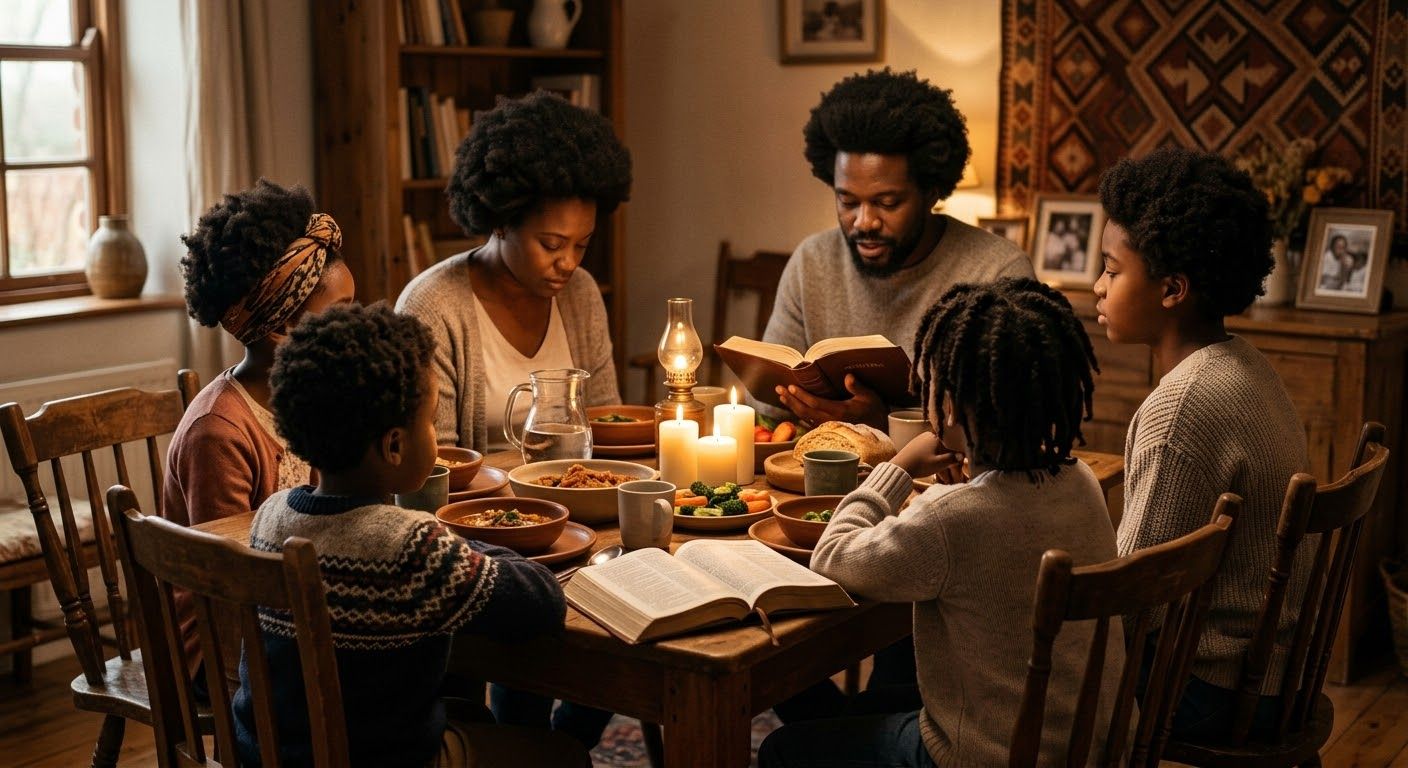



 Children are especially vulnerable to emotional harm. Needless threats, constant name-calling, humiliation, negative comparisons with others, insults, and degrading language can deeply affect how a child sees themselves and relates to others.
 Godly parenting involves more than taking children to church or teaching them Bible verses. It means showing the character of Christ in everyday relationships.