The Sandwich That Refused To Share

Sammy the talking sandwich learns that sharing can bring joy to others in this fun Christian children’s story about generosity, kindness and giving.

The Story

In a little kitchen on Maple Street lived a very unusual sandwich.

His name was Sammy.

And Sammy thought he was absolutely wonderful.

“Look at me!” he said proudly. “I am the best sandwich in the whole kitchen!”

One afternoon, a little girl named Timi came home from school feeling very hungry.

Her mother had prepared Sammy for her lunch.

Timi picked up the plate.

“Mmm! This looks delicious.”

Just then, Timi’s little brother came into the kitchen.

“Timi, may I have a little piece?” he asked.

Sammy the sandwich gasped.

“A piece? Absolutely not!”
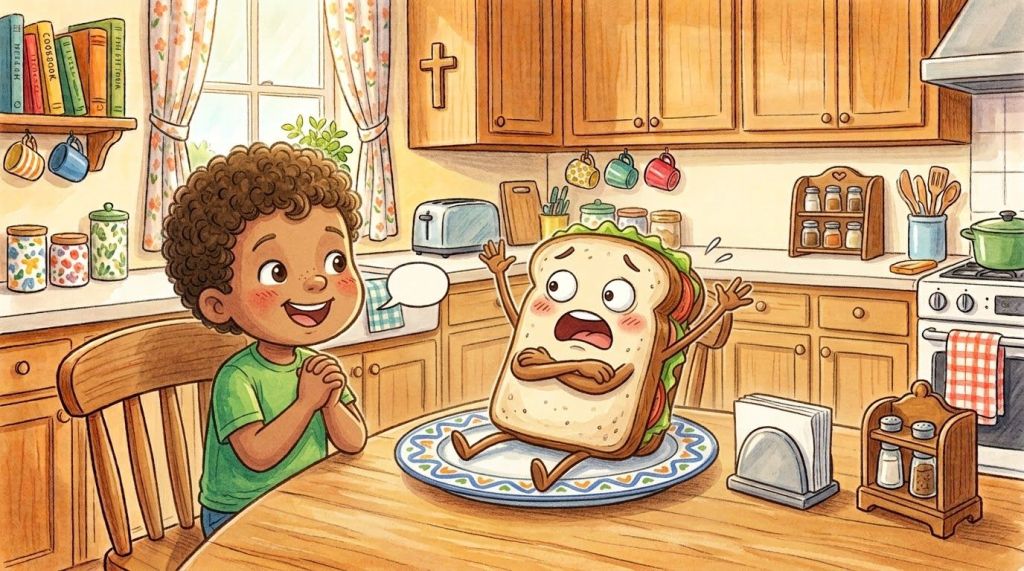
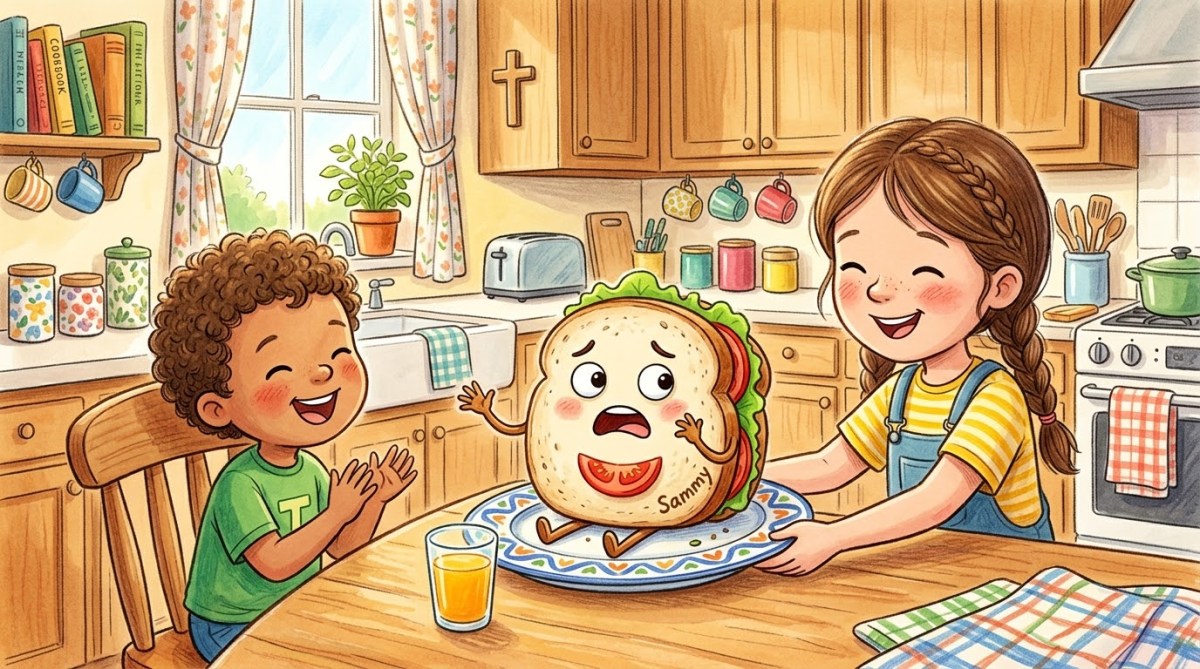
Sammy the sandwich proudly sitting on a plate while a little boy politely asks for a piece

Timi looked around.

“Did you hear something?”

“No,” said her brother.

Sammy whispered, “I heard everything!”

Her brother asked again, “Please, Timi?”

Sammy shouted, “NO SHARING!”

Timi laughed.

“That sandwich must be talking!”

Sammy folded his lettuce proudly.

“Of course I’m talking. And I have decided that I belong to Timi alone!”

Timi smiled and said, “It’s my lunch, Sammy. But I can choose to share some with my brother.”

Sammy shook his tomato slices.

“But I don’t want to be shared!”

So Timi took a bite.

“Crunch!”

Sammy frowned.

“Well, at least I still have plenty left.”

Timi took another bite.

“Crunch!”

Sammy looked worried.

Then Timi broke off a small piece and gave it to her brother.
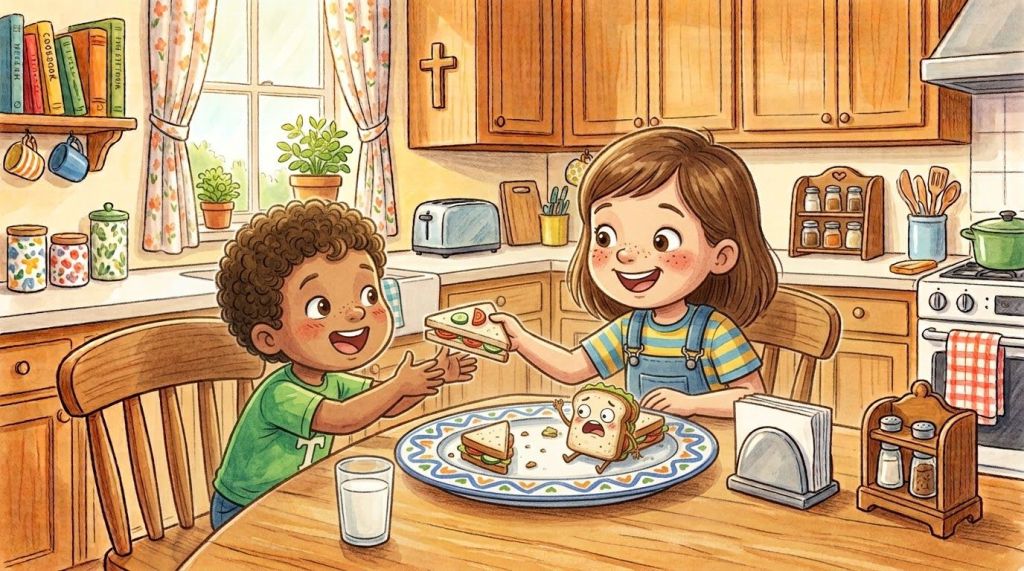
A little girl happily giving her younger brother a small piece of sandwich

“Here you go.”

Her brother smiled.

“Thank you!”

Sammy was surprised.

“Wait! You shared me!”

“Yes,” said Timi. “And look how happy it made him.”

Sammy looked at the little boy’s happy face.

For the first time, he began to wonder if having everything to himself was really the best thing.

Then something funny happened.

Her brother brought over his own apple.

“Timi, you shared your sandwich with me. Would you like some of my apple?”
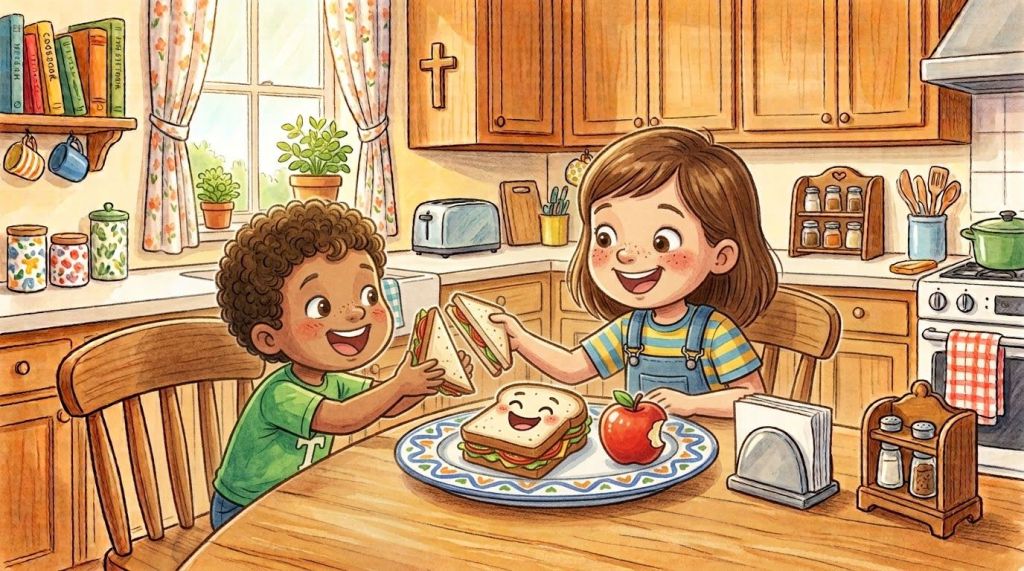
Two happy siblings sharing a sandwich

Timi smiled.

Sammy smiled too.

“Hmm,” he said. “Maybe sharing doesn’t make you lose everything. Maybe it gives everyone a chance to enjoy something together.”

By the time lunch was over, Sammy was gone.

But his lesson remained.

Illustration 1: Sammy the sandwich proudly sitting on a plate while a little boy politely asks for a piece, the sandwich looking comically shocked, bright cozy kitchen, expressive children’s picture-book style, no text.

And whenever Timi had something she could share, she remembered Sammy and asked herself, “Who can I bless with what I have?”

And always remember Jesus Love You.

What We Can Learn

  • Sharing can bring joy to others.
  • Generosity helps us think beyond ourselves.
  • We can be thankful for what we have and still make room for others.
  • Small acts of sharing can make a big difference.

A Teaching Point for Parents

Sharing is a character quality that develops with practice. Children do not need to be forced to surrender every personal possession, but they can be taught to recognize appropriate opportunities to give, share, help, and include others.

When a child shares willingly, notice the heart behind the action. You might say, “That was generous. You noticed that someone else could enjoy this too.” This helps children connect sharing with love rather than merely with a rule.

Scripture to Remember

“And do not forget to do good and to share with others, for with such sacrifices God is pleased.” Hebrews 13:16

God cares about the way we treat others. Sharing what we can is one practical way of doing good and showing love.

Bedtime Prayer

Dear Jesus,
Thank You for all the good things You have given me. Please teach me to have a generous heart and to notice opportunities to share with others. Help me to give with love and a happy heart. In Jesus’ name, Amen.

Sammy was not an ordinary sandwich. He had two soft slices of bread, crunchy lettuce, juicy tomatoes, creamy cheese, and a delicious filling in the middle.

Talk About It

  • Why didn’t Sammy want to be shared?
  • How did Timi’s brother feel when she shared with him?
  • What did Timi’s brother do after receiving her kindness?
  • What is one thing you could share with someone this week?

One Little Thing to Remember

Sharing is one way we show love.

More Stories for Children

Enjoy more fun, faith-filled stories that help children grow in godly character.

Explore More Stories for Children →

God’s Word, Foundation for Shaping Tomorrow
The Impatient Caterpillar

Coco the impatient caterpillar learns that some things take time in this fun Christian children’s story about patience, self-control and trusting the process.

The Story

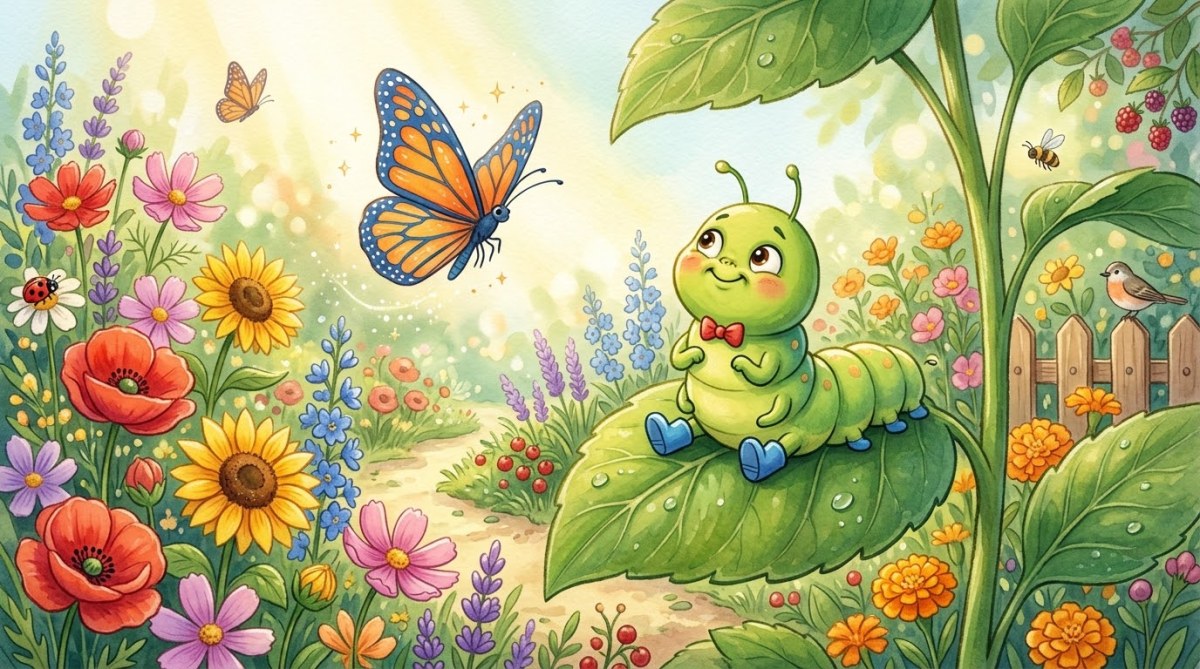
In a beautiful garden lived a little caterpillar named Coco.

Coco was always in a hurry.

When the flowers opened, Coco wanted them to open faster.

When the fruit began to grow, Coco wanted it to ripen immediately.

And when Coco heard that caterpillars could one day become butterflies, she wanted to become one right away.

“I don’t want to wait!” Coco complained. “I want to fly today!”

Her friend, an old ladybug named Lila, smiled.

“Some things take time, Coco. You cannot rush everything.”

“I can try!” Coco replied.

And try she did.

One morning, Coco climbed to the tallest leaf she could find.

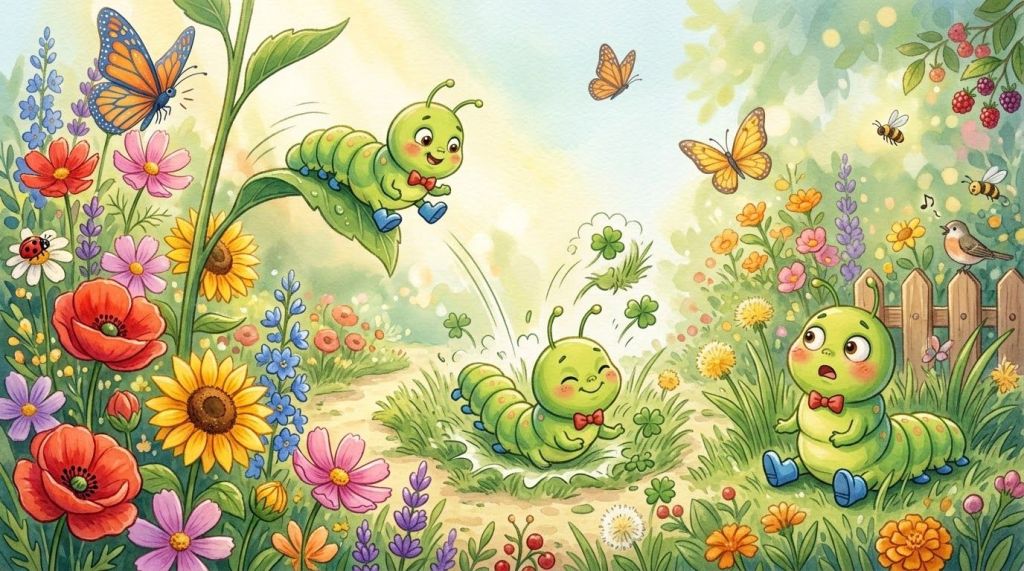
“Maybe butterflies become butterflies by jumping!” she said.

She jumped.

Plop!

She landed in a soft patch of grass.

Coco the caterpillar humorously jumping from a tall leaf

“That didn’t work.”

“Maybe I’m almost ready!”

She stretched.

She wiggled.

She spun around.

Nothing happened.

“This is taking too long!” Coco cried.

One afternoon, Coco noticed something strange.

She did not feel like eating as much as before.

She felt tired.

And she felt that something inside her was changing.

Lila smiled.

“Perhaps it is time to rest.”

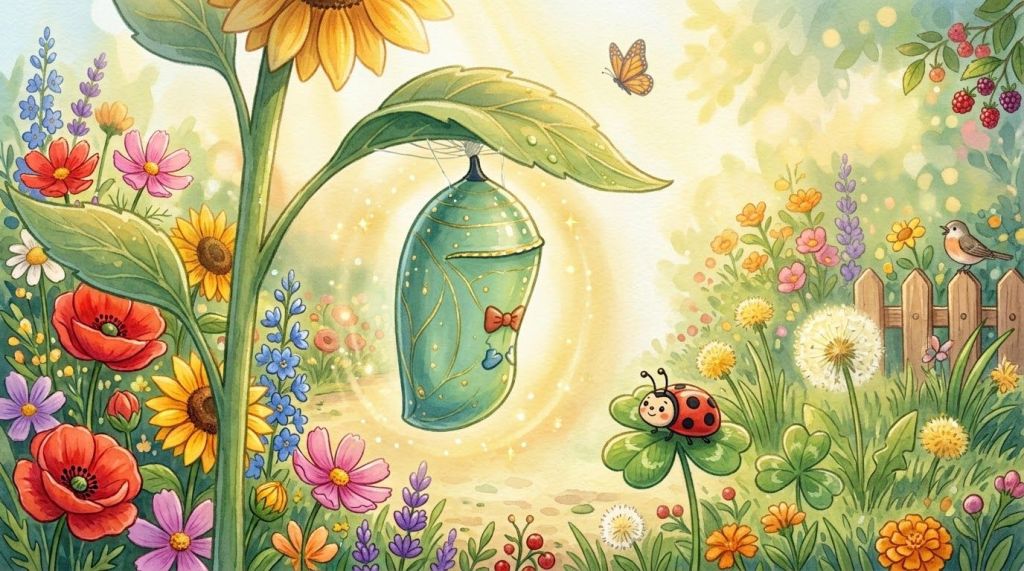
Coco found a quiet place and began making her chrysalis.

Coco resting peacefully inside a chrysalis

“How long will this take?” she asked.

“As long as it takes,” said Lila.

Coco sighed.

“I don’t like waiting.”

“You don’t have to like waiting,” Lila replied. “You just need to learn to be patient.”

So Coco waited.

For the first time, she did not try to hurry.

She rested.

She waited.

And slowly, something wonderful happened.

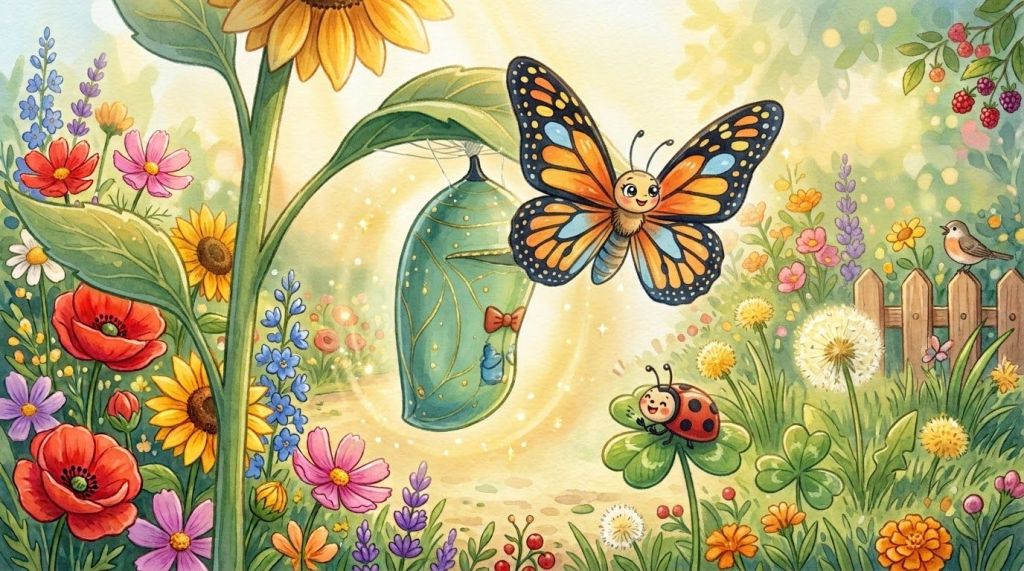
Coco emerged with beautiful wings.

She stretched them carefully.

“I can fly!”

Lila laughed.

“Yes, Coco. And you didn’t have to rush it.”

Coco looked at her beautiful wings.

Coco emerging as a beautiful butterfly

She remembered all the times she had complained about waiting.

“I think I understand now,” she said. “Some good things need time.”

From that day on, whenever Coco wanted something to happen immediately, she would take a deep breath and remember her chrysalis.

“Be patient,” she would tell herself. “Good things can take time.”

And always remember Jesus Loves You.

What We Can Learn

  • Not everything happens as quickly as we want.
  • Patience helps us wait without giving up.
  • Some things need time to grow and develop.
  • Waiting can teach us self-control and trust.

A Teaching Point for Parents

Children often struggle with waiting because they naturally want what they want now. Patience can be developed through ordinary experiences such as waiting for food, taking turns, completing a difficult task, or allowing a skill to develop.

Rather than simply telling a child, “Be patient,” help them understand what patience looks like. You might say, “We are waiting, but we can still do something good while we wait.”

Scripture to Remember

“Be still before the LORD and wait patiently for him.” Psalm 37:7

Waiting patiently does not mean doing nothing forever. It means learning to remain calm and trust God instead of becoming controlled by impatience.

Bedtime Prayer

Dear Jesus,
Please help me to be patient when I have to wait. Help me not to become angry or give up just because things are taking longer than I expected. Teach me to trust You and use my waiting time wisely. In Jesus’ name, Amen.

Talk About It

  • Why was Coco always in a hurry?
  • What did Coco learn while she was waiting?
  • Can you think of something that requires patience?
  • What can you do when you have to wait for something?

One Little Thing to Remember

Some good things take time. Be patient and keep growing.

More Stories for Children

Enjoy more fun, faith-filled stories that help children grow in godly character.

Explore More Stories for Children →

God’s Word, Foundation for Shaping Tomorrow
The Greedy Gorilla

Gogo the greedy gorilla learns that sharing brings greater joy than keeping everything for himself in this fun Christian children’s story.

The Story

Deep in the greenest part of the jungle lived a big, strong gorilla named Gogo.

Gogo had a very important rule.

“If I find it, it is mine!”

If Gogo found a mango, it was his.

If he found a pineapple, it was his.

And if he found a bunch of bananas…

Well, you already know what he would say.

“MINE!”

One sunny morning, the animals were preparing for their big Jungle Fruit Picnic. Everyone brought something delicious.

The monkeys brought bananas. The parrots brought mangoes. The rabbits brought carrots. Even the little tortoise brought some juicy watermelon.

Then Gogo arrived.

He looked at the mountain of fruit.

His eyes grew wide.

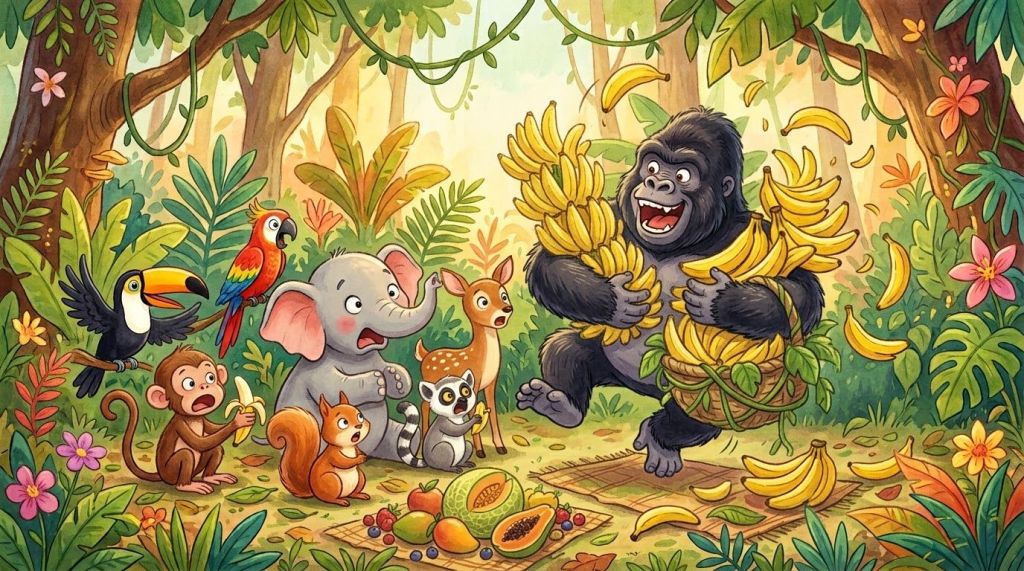
“Wonderful!” he shouted. “I will take all the bananas!”

He grabbed one bunch.

Then another.

Then another.

Gogo the gorilla excitedly collecting huge bunches

“Gogo,” said Mimi the monkey, “those are for everyone.”

“But I love bananas!” Gogo replied.

“We all do,” said Mimi.

Gogo hugged his enormous pile of bananas.

“Then you should have brought more!”

The animals looked at one another.

Gogo carried the bananas behind a large tree and began arranging them.

One pile here.

One pile there.

And one very special pile right beside him.

“Now,” he said proudly, “I have enough bananas for me!”

But there was one little problem.

Gogo had collected so many bananas that he could hardly sit down.

He tried to sit.

SQUISH!

He stood up quickly.

He tried to move the pile.

SLIP!

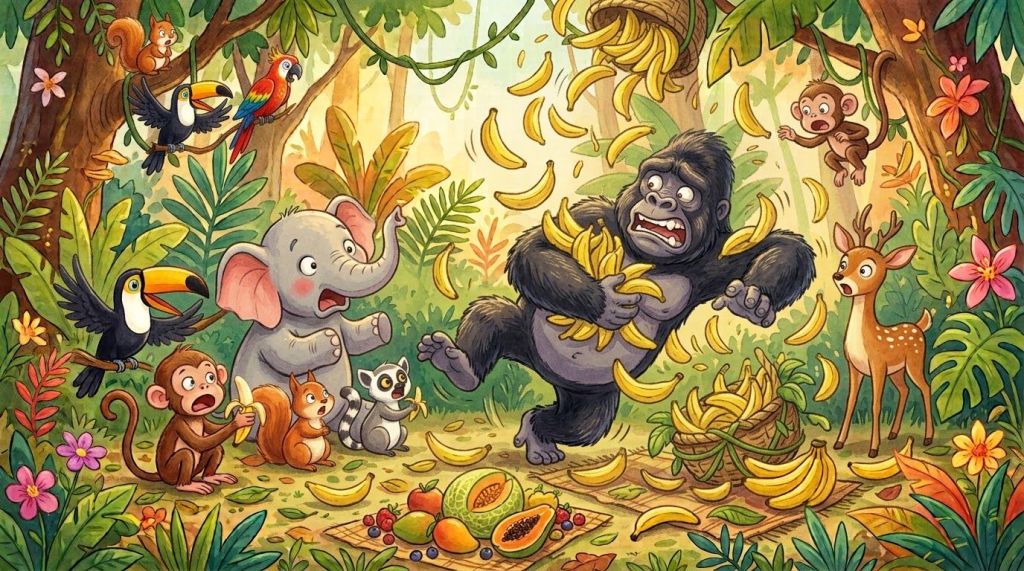
One banana rolled away.

Then another.

Then twenty.

“Hey!” shouted Gogo.

He chased one banana.

It rolled left.

He chased another.

It rolled right.

Soon Gogo was running around the jungle trying to catch bananas that seemed determined to escape him.

Gogo struggling as bananas roll in everywhere

The other animals watched.

Then something unexpected happened.

Mimi, the rabbit, and the tortoise began helping him gather the bananas.

“Thank you,” Gogo said, surprised.

When they had gathered most of them, Gogo looked at the animals.

They had helped him even though he had refused to share with them.

Gogo became quiet.

He looked at his giant pile.

Then he looked at his friends.

“I think…” he said slowly, “I have too many bananas.”

Mimi smiled.

“You could share them.”

Gogo thought for a moment.

Then he picked up a bunch of bananas.

“Here, Mimi. These are for you.”

He gave another bunch to the rabbit.

Then some to the tortoise.

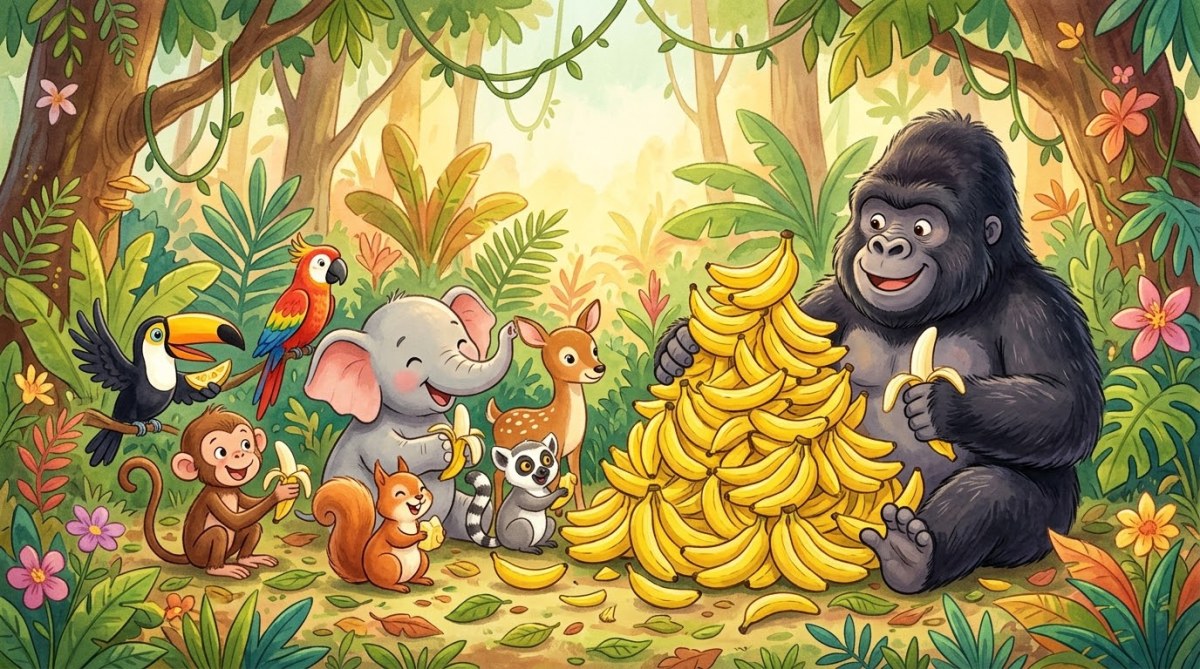
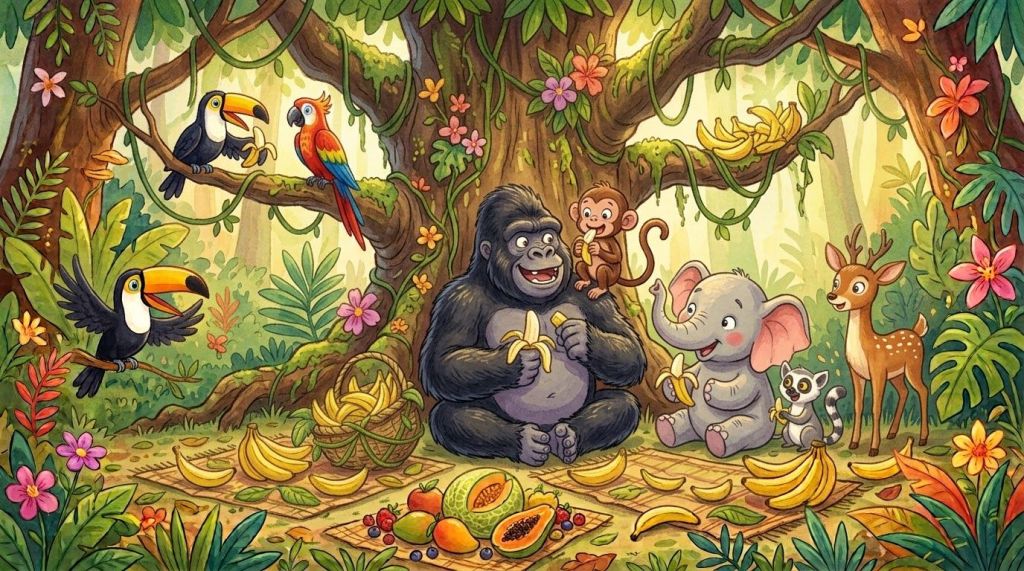
Before long, everyone had something to eat.

And do you know what Gogo discovered?

Sharing did not leave him with nothing.

It gave everyone something to enjoy together.

Gogo smiled as the animals laughed and ate around him.

Gogo and his animal friends happily sharing banana

From that day on, Gogo still loved bananas.

But whenever he found something good, he no longer shouted, “MINE!”

Instead, he would ask,

“Who can I share this with?”

And the jungle became a happier place.

And always remember Jesus Loves You.

What We Can Learn

  • Sharing shows love and generosity.
  • We do not need to keep everything for ourselves.
  • Having more does not always make us happier.
  • Giving can bring joy to both the giver and the receiver.
  • We should learn to think about the needs of others too.

A Teaching Point for Parents

Children need to learn generosity, but sharing should not mean that they must surrender every personal possession whenever someone asks. Teach children the difference between generosity and having healthy boundaries.

For younger children, sharing can begin with simple experiences such as sharing toys, snacks, materials, or opportunities to play. Praise genuine generosity and help children notice the joy their giving can bring to others.

Most importantly, let generosity become something children see and experience, not merely something they are commanded to do.

Scripture to Remember

“And do not forget to do good and to share with others, for with such sacrifices God is pleased.” Hebrews 13:16

God is pleased when we do good and willingly share with others. Generosity is one way we show love and care.

Bedtime Prayer

Dear Jesus, thank You for everything You have given me. Please help me to be generous and willing to share with others. Teach me to care about the needs of people around me and to give with a happy heart. Amen.

Talk About It

  • Why did Gogo want to keep all the bananas?
  • How did the other animals help Gogo?
  • How did Gogo feel after he began sharing?
  • What is one thing you can share with someone this week?

One Little Thing to Remember

Sharing does not make what we have smaller. It can make someone else’s day brighter.

More Stories for Children

Looking for more fun stories that teach children godly character and practical life lessons?

👉 Explore More Stories for Children

God’s Word, Foundation for Shaping Tomorrow

JAM: The Three Girls Who Learned to Be Friends

Jemima, Abigail and Matilda learn kindness, sharing, patience and friendship after too many arguments in this fun Christian children’s story.

The Story

In a lively neighbourhood called Sunny Street lived three girls named Jemima, Abigail, and Matilda.

They lived close to one another.

They went to the same school.

They even played in the same playground.

But there was one tiny problem.

They did not get along.

Not a little bit.

They argued about almost everything.

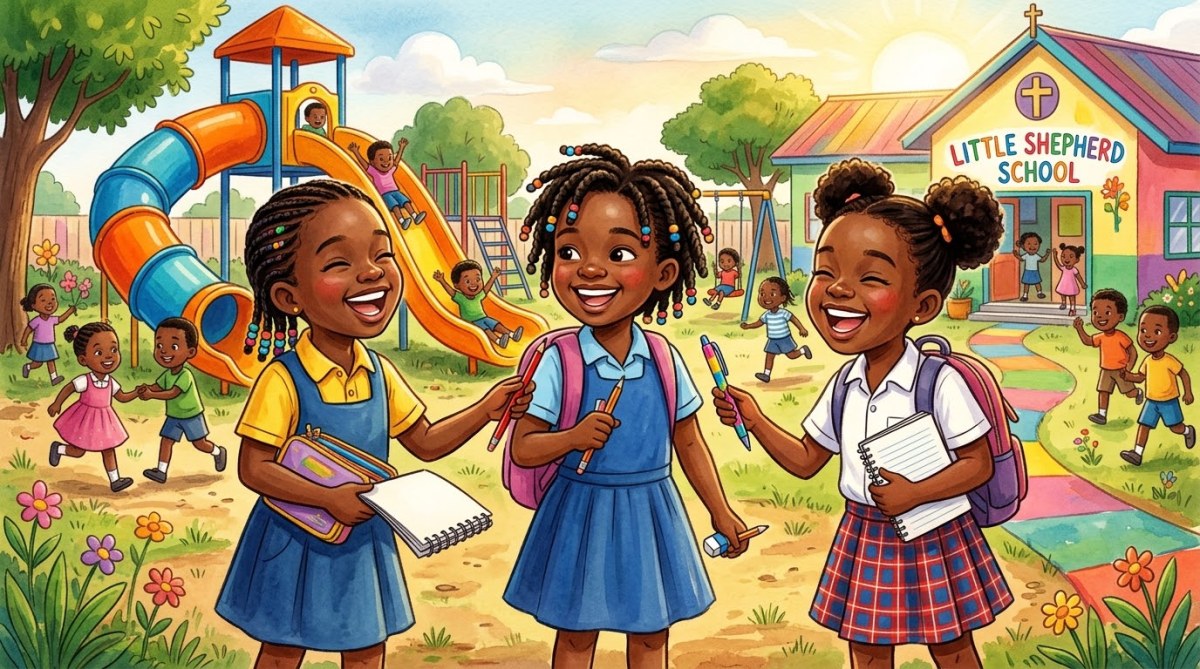
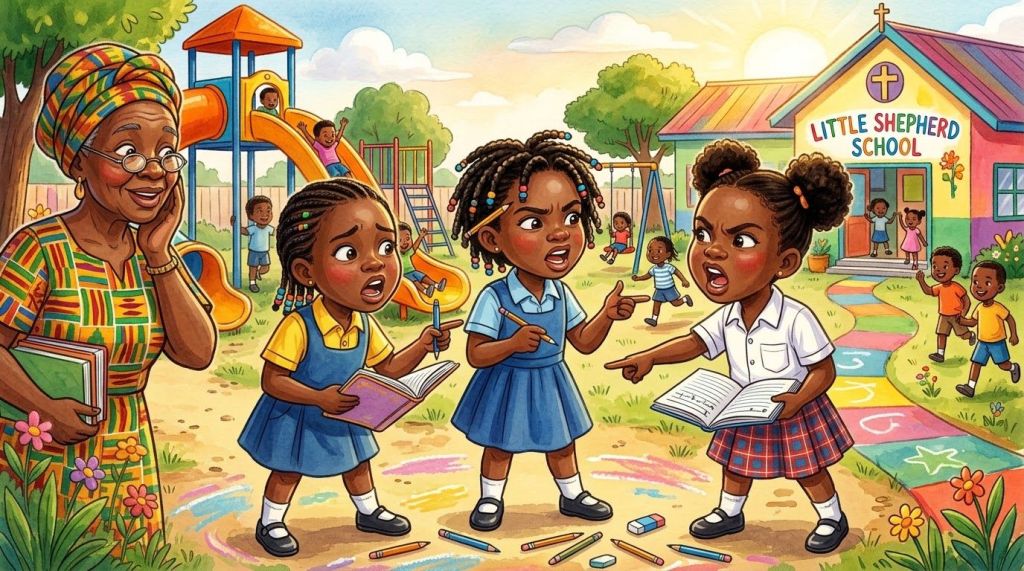
Three young schoolgirls arguing humorously

“The answer is twelve!” Jemima would say.

“No, it’s fourteen!” Matilda would reply.

“Both of you are wrong!” Abigail would announce.

Then Jemima and Matilda would turn to her.

“What is your answer?”

Abigail would blink.

“I haven’t done the question yet.”

“ABIGAIL!”

Abigail had a special talent.

She loved knowing everybody else’s business.

If Jemima whispered to Matilda, Abigail wanted to know what they were whispering about.

If Matilda opened her schoolbag, Abigail wanted to know what was inside.

And if someone said, “This is a secret,” Abigail’s ears suddenly became bigger than two satellite dishes.

“What secret?” she would ask.

“Abigail, mind your business!” the girls would shout.

But that was not the only problem.

At school, they sometimes broke each other’s pencils during arguments.

Jemima impatiently talking to Abigail and Matilda who looked frustrated

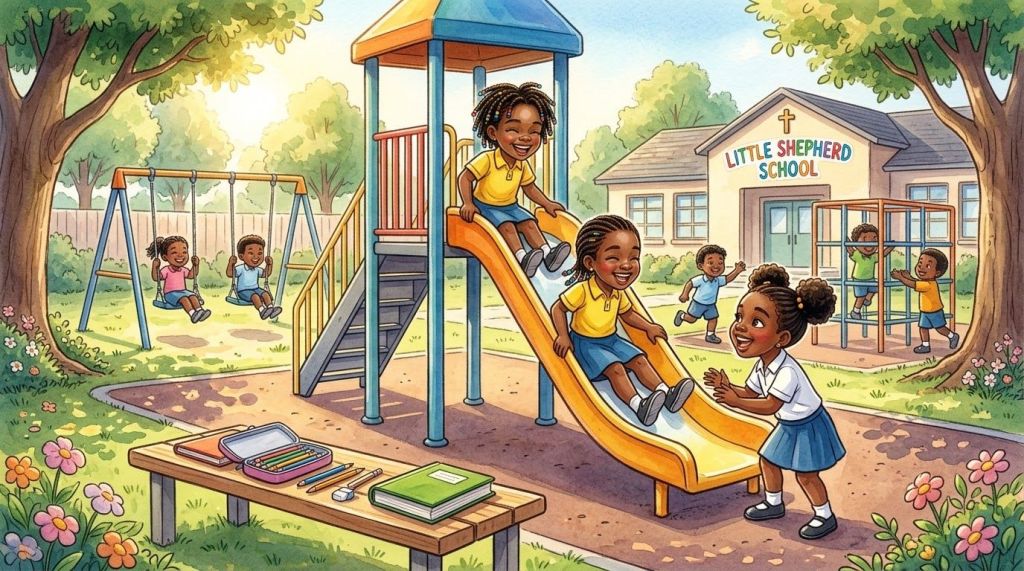
At playtime, they argued over whose turn it was to use the slide.

“I was here first!”

“No, I was!”

“Move!”

“You move!”

Sometimes the teacher had to look over and say, “Girls!”

And immediately, all three would become as quiet as three sleeping kittens.

But one day, something different happened.

The teacher gave the class some difficult homework.

Matilda looked at the questions.

Then she looked at Jemima.

Jemima was very good at schoolwork. She was clever, but she never used her cleverness to make other children feel small.

Matilda walked over to her.

“Jemima, please, can you help me with this question?”

Abigail quickly joined them.

“Me too, please.”

Jemima smiled.

“Of course.”

Matilda looked at Abigail.

“You know, Jemima is actually the smartest of us.”

Abigail nodded.

“Yes. She’s a total nerd!”

Jemima laughed.

“Thank you… I think?”

They all laughed.

Jemima patiently explained the homework without showing off or making them feel silly.

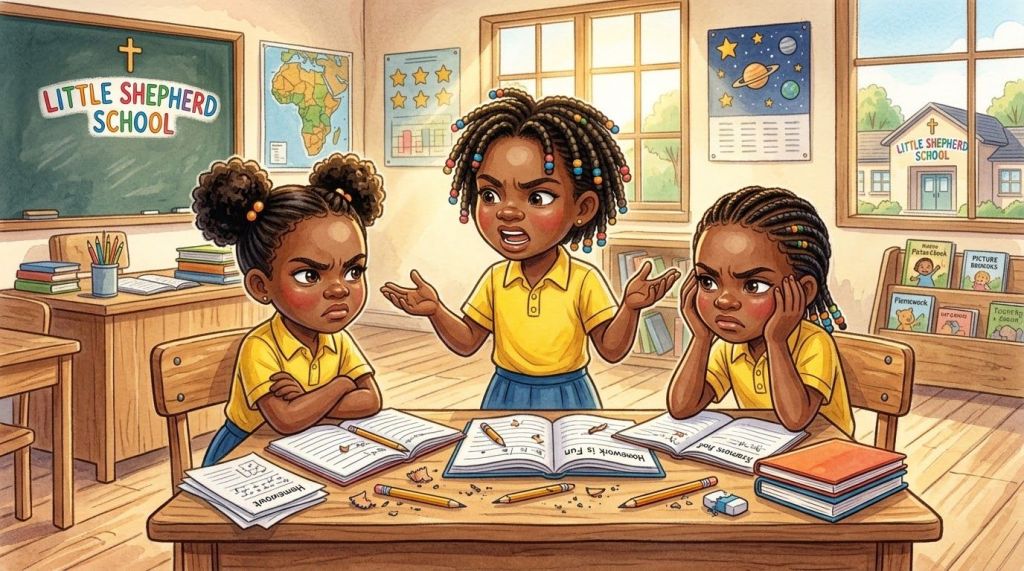
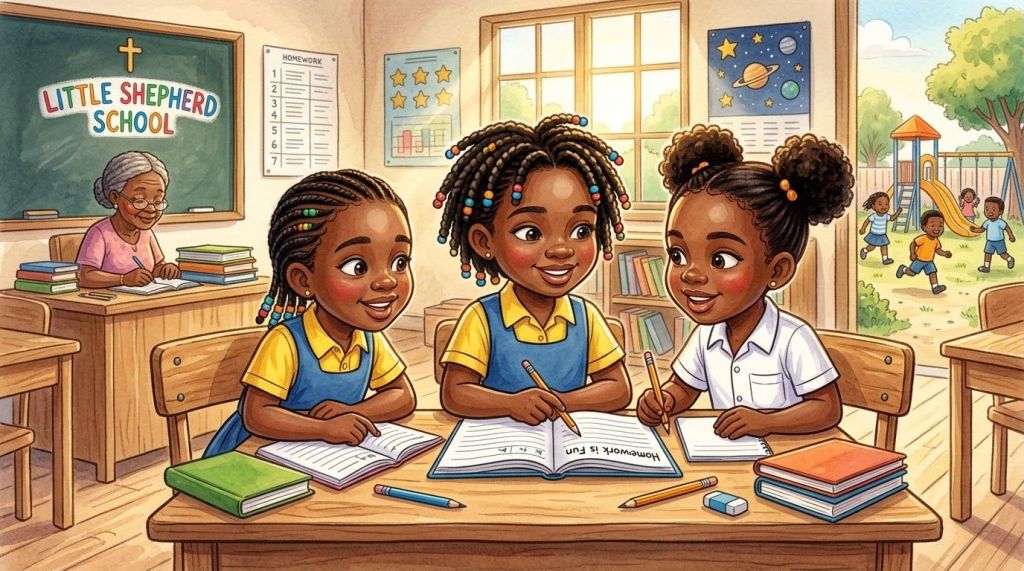
Jemima patiently helping Abigail and Matilda with their homework at a school desk

For the first time in a long while, the three girls sat together without arguing.

They discovered something surprising.

They actually enjoyed being together.

A week later, the girls had a playdate.

They played games, shared snacks, told funny stories, and laughed until their cheeks hurt.

Abigail even tried to tell a joke and forgot the ending.

“Wait,” she said. “I know there was supposed to be something funny here.”

“Maybe the joke went on holiday,” Matilda said.

Everyone burst out laughing.

The next day at school, something had changed.

Jemima lent Matilda a pencil.

Matilda shared her ruler with Abigail.

Abigail gave Jemima some of her coloured pencils.

At playtime, they took turns on the slide.

Jemima, Abigail and Matilda happily taking turns on a playground slide.

“Your turn.”

“Then my turn.”

“Then Abigail’s turn.”

“Finally!” Abigail shouted. “A slide schedule!”

They laughed and played together.

There were no more broken pencils from angry arguments.

No more fighting over every little thing.

And Abigail learned that sometimes it was better to let other people’s matters remain their matters.

Of course, she still liked asking questions.

But now she was learning when to ask and when to simply mind her own business.

Jemima, Abigail, and Matilda soon became known as JAM.

J for Jemima.

A for Abigail.

M for Matilda.

Three girls.

Three different personalities.

One wonderful friendship.

And always remember Jesus Love You.

What We Can Learn

  • Kindness helps friendships grow.
  • We do not have to agree about everything to be friends.
  • Taking turns and sharing help everyone enjoy playing together.
  • Being clever is wonderful, but helping others without showing off is even better.
  • We should learn when something is our business and when it is better to give others space.

A Teaching Point for Parents

Friendships among children can sometimes involve arguments, teasing, competition, or difficulty taking turns. These moments can become opportunities to teach children practical kindness.

Help children learn simple habits such as listening, apologising when they hurt someone, taking turns, sharing appropriately, and respecting other people’s personal space and conversations.

Also remind children that being good at something is not a reason to look down on others. True knowledge should make us willing to help, not eager to show off.

Scripture to Remember

“And be ye kind one to another, tenderhearted, forgiving one another, even as God for Christ’s sake hath forgiven you.” Ephesians 4:32, KJV

Kindness, forgiveness, and a caring heart can help us build healthier friendships and relationships with others.

Bedtime Prayer

Dear Jesus,
Thank You for my friends and the people around me. Help me to be kind, patient, helpful, and willing to forgive. Teach me to share, take turns, listen to others, and know when to give people space. Help me to use what I know to help others and never to make them feel small. In Jesus’ name, Amen.

Talk About It

  • Why did Jemima, Abigail, and Matilda argue so much?
  • How did Jemima help the other girls?
  • What changed after their playdate?
  • Why is taking turns important?
  • What does it mean to mind your own business?
  • How can you show kindness to a friend this week?

One Little Thing to Remember

Kindness turns ordinary friendships into beautiful ones.

More Stories for Children

Enjoy more fun, faith-filled stories that help children grow in godly character.

Explore More Stories for Children →

God’s Word, Foundation for Shaping Tomorrow
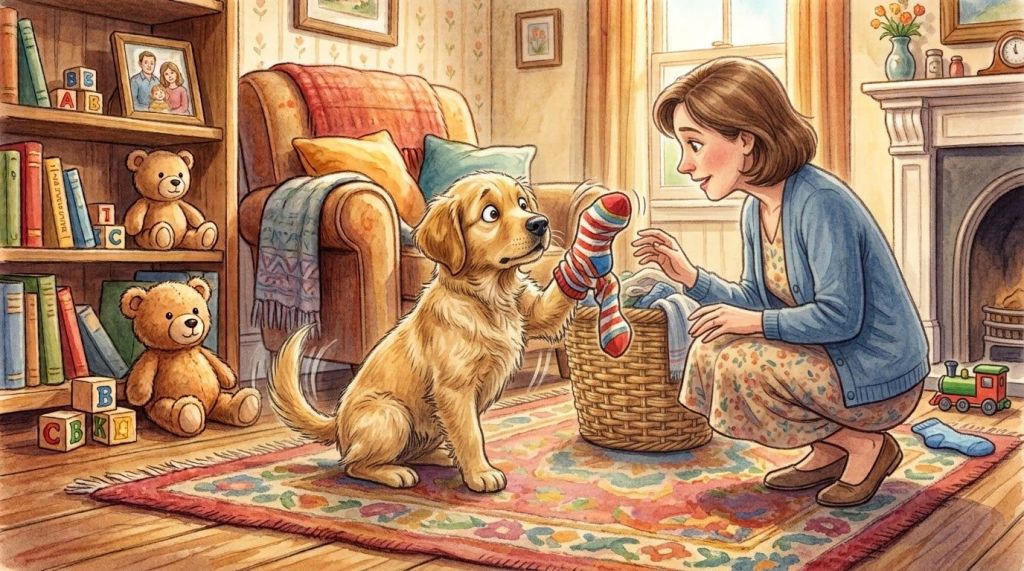
The Sneaky Sock Thief

Sammy the puppy learns an important lesson about obedience after stealing a red sock. A funny Christian children’s story about listening and self-control.

The Story

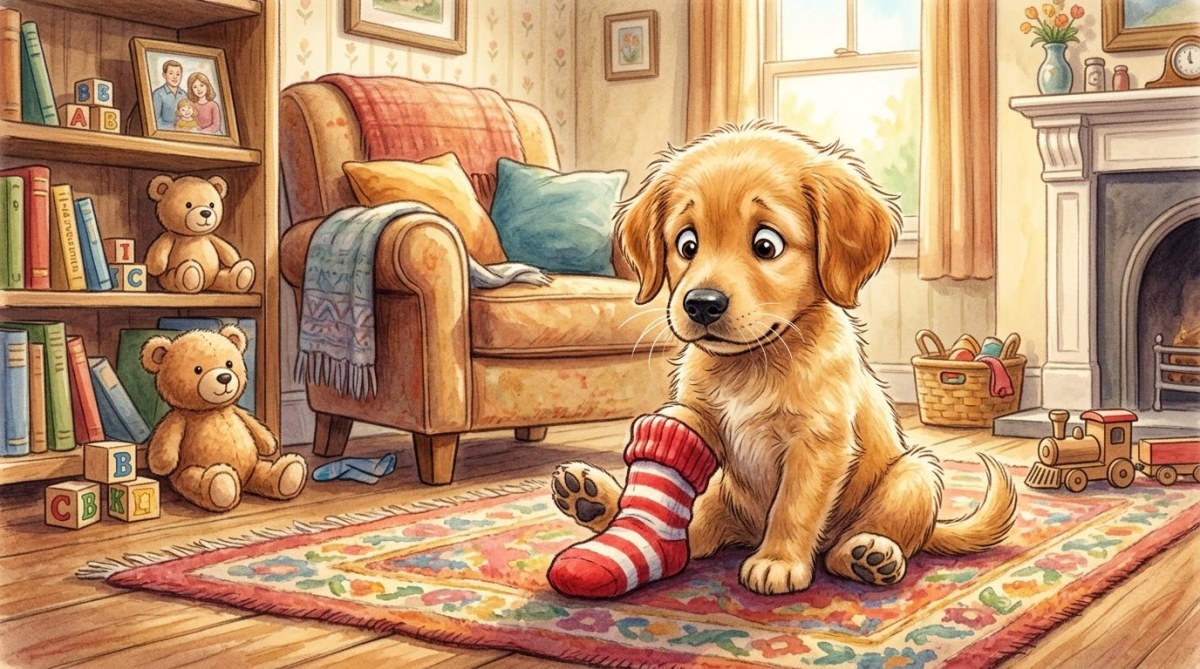
Sammy was a little puppy with a very big love for socks.

Clean socks.

Dirty socks.

Big socks.

Tiny socks.

If it was a sock, Sammy wanted it!

Every morning, Sammy waited beside the laundry basket.

As soon as someone looked away…

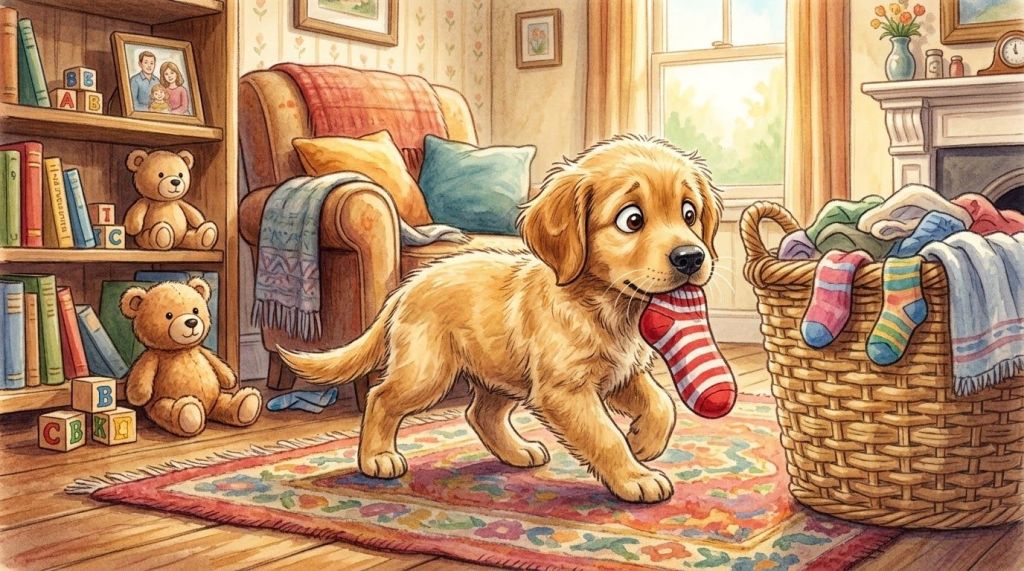
ZOOM!

Sammy would grab a sock and run.

Sammy sneaking toward the laundry basket

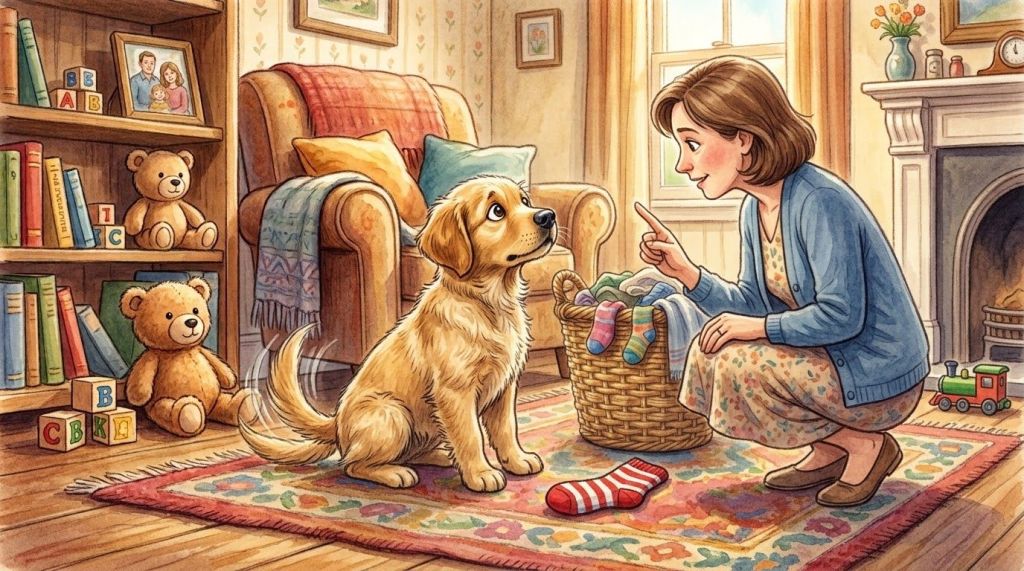
“Sammy!” Mum would call. “Leave the socks alone!”

Sammy would stop.

He would drop the sock.

Then he would look at Mum with his biggest, most innocent puppy eyes.

But the moment Mum turned around…

ZOOM!

There went another sock.

One afternoon, Sammy spotted something very interesting.

It was a bright red sock lying on the floor.

Sammy’s tail began to wag.

“Don’t even think about it,” Mum said.

Sammy looked at the sock.

Then he looked at Mum.

Then he looked at the sock again.

His nose twitched.

His ears stood up.

His paws moved closer.

“Sammy…” Mum warned.

Mum telling Sammy to leave the red sock

Sammy froze.

For once, he walked away.

“Good boy!” Mum said.

Sammy’s tail wagged proudly.

But that evening, he saw the red sock again.

There was nobody around.

Sammy looked left.

He looked right.

Then he whispered to himself, “Just one little sock.”

CHOMP!

Off he ran.

But this time, the sock got stuck.

It wrapped around his paw.

Sammy pulled.

Nothing.

He pulled harder.

Still nothing.

He tried to run.

THUMP!

Down he went.

“YIP!”

Mum came running.

She carefully removed the sock.

Sammy discovering the sock stuck around his paw,

Sammy sat quietly.

He knew exactly what had happened.

Mum had told him not to take the sock.

He had known the rule.

He had simply chosen not to obey it.

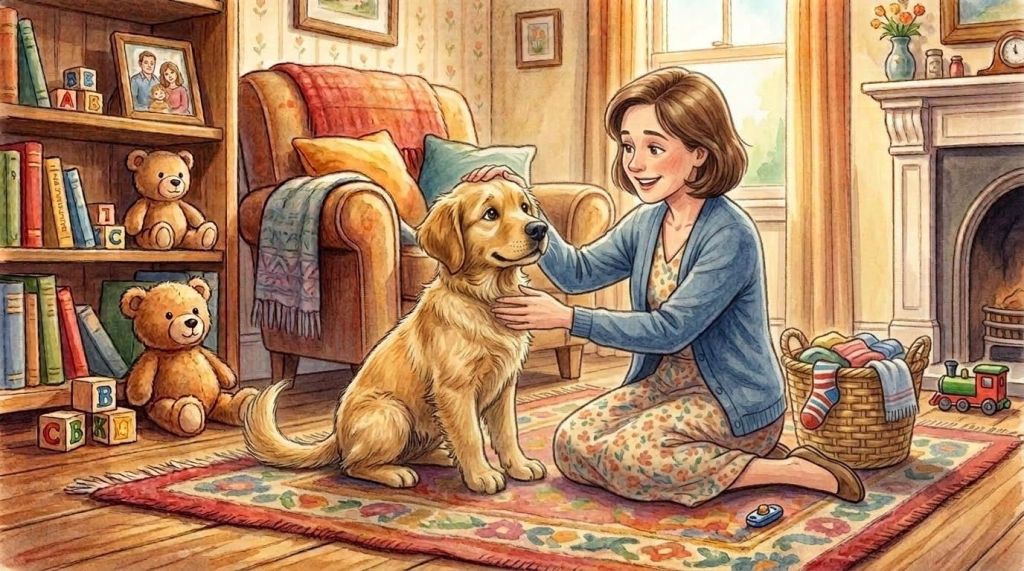
Mum gently patted his head.

Sammy peacefully leaving the socks alone

“Sammy, rules are not always there to spoil your fun. Sometimes they are there to protect you, protect others, or help things work properly.”

Sammy lowered his head.

He looked at the red sock.

It suddenly didn’t seem nearly as exciting.

From that day on, Sammy still loved socks.

But he learned to leave them where they belonged.

And whenever he felt tempted to disobey, he remembered the day his favourite red sock became his very own paw trap.

And always remember Jesus Loves You.

What We Can Learn

Sammy learned that knowing the right thing is not enough. We must also choose to do it.

Obedience means listening to instructions and following them, especially when we understand that those instructions are meant for our good.

Sometimes we may not understand why a parent gives us a particular instruction. But learning to obey appropriate instructions helps us develop self-control, responsibility, and respect.

A Teaching Point for Parents

Children often understand a rule before they are willing to follow it. That makes obedience an important character skill to teach, not simply a behavior to demand.

Where appropriate, explain the reason behind an instruction. This helps children gradually understand that boundaries are not merely about control. They can provide safety, order, and guidance.

When correcting disobedience, remain firm without humiliating the child. The goal is not simply to make the child afraid of breaking a rule, but to help them develop a heart that chooses what is right.

Scripture to Remember

Colossians 3:20

“Children, obey your parents in everything, for this pleases the Lord.”

God cares about obedience. Learning to respond rightly to godly instruction is part of growing in character and learning to please Him.

Bedtime Prayer

Dear God,

Thank You for the people You have placed around me to guide and protect me.

Please help me to listen carefully and obey good instructions.

Give me self-control when I want to do something I have been told not to do.

Help me to grow into a wise, responsible, and obedient child.

In Jesus’ name, amen.

Talk About It

  • What did Sammy love taking?
  • What did Mum tell Sammy to do?
  • Why did Sammy take the red sock even after being warned?
  • What happened when Sammy disobeyed?
  • Why are some rules important?
  • What can you do when you really want to do something you have been told not to do?

One Little Thing to Remember

Knowing what is right is good. Choosing to do what is right is better.

More Stories for Children

Looking for more stories that nurture faith and build godly character?

Explore more Stories for Children

God’s Word, Foundation for Shaping Tomorrow
The Boy Who Swallowed a Whopper

A funny Christian children’s story about Leo, a boy whose little lies become a giant Whopper. A lesson in honesty, truthfulness and taking responsibility.

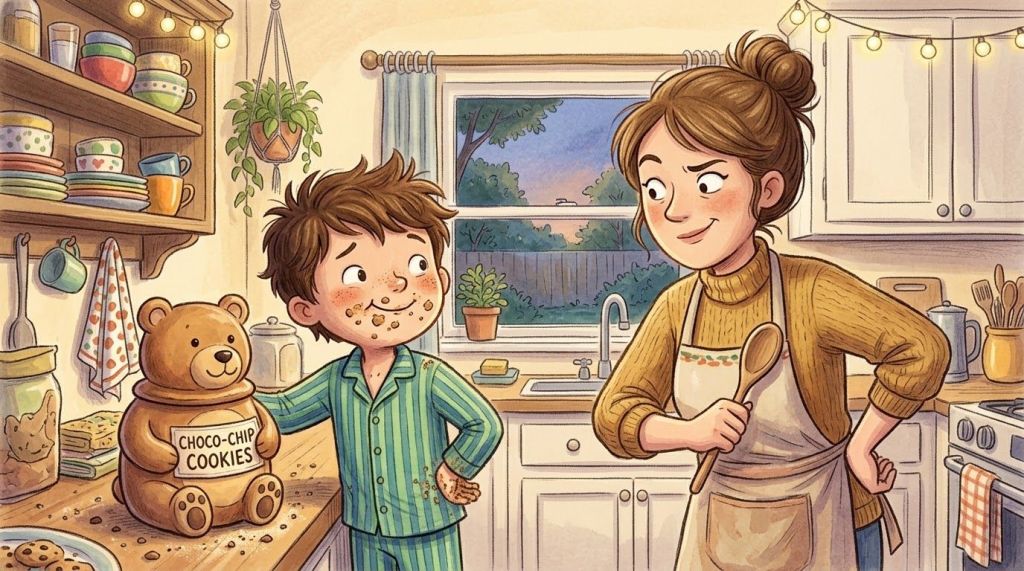
Leo beside the cookie jar


“Leo, did you take the cookies?” she asked.

Leo shook his head.

“No, Mum.”

Mum looked at the crumbs around his mouth.

“What are these?”

Leo quickly wiped his face.

“I have no idea.”

Mum raised an eyebrow.

Leo smiled.

That was one little lie.

Later that afternoon, Mum asked, “Leo, have you finished your homework?”

“Of course!”

But his exercise book was still blank.

“The dog ate it,” Leo explained.

“We don’t have a dog,” Mum replied.

“The neighbour’s dog ate it.”

“Through the wall?”

Leo thought for a moment.

“Yes.”

Mum sighed.

Leo thought little lies were harmless.

But he was about to discover something very strange.

That night, Leo went to bed as usual.

Sometime after midnight, he woke up.

Something felt strange in his throat.

He swallowed.

Gulp.

He swallowed again.

GULP!

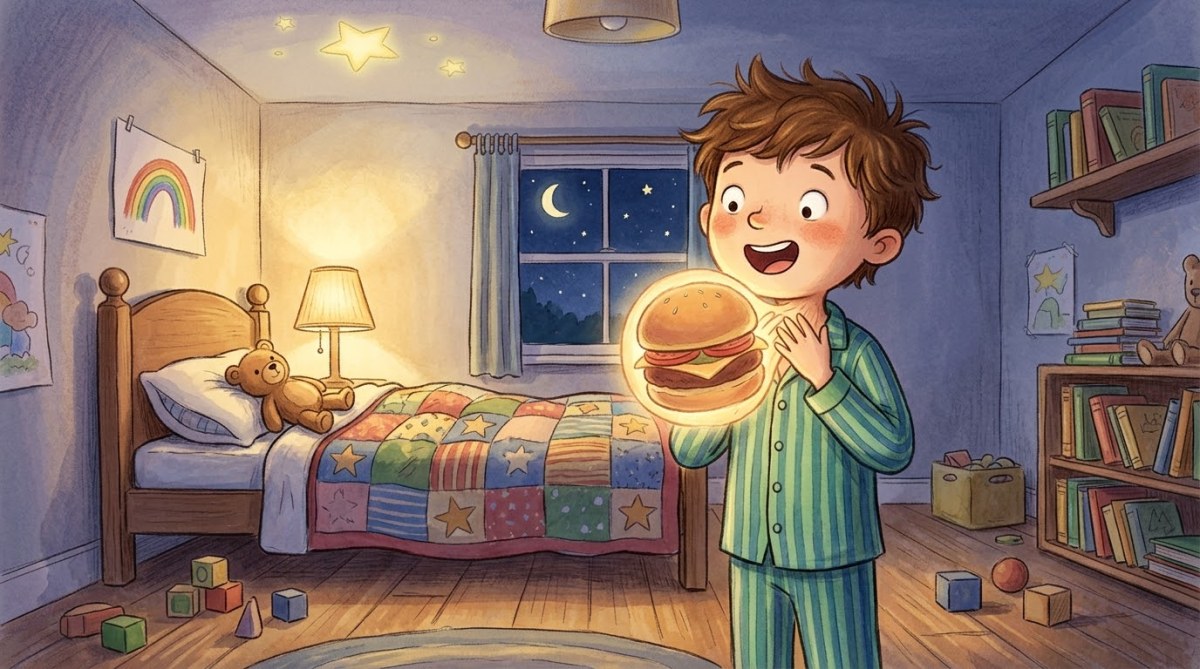
Then he felt a huge lump moving inside his throat.

“What is that?” Leo whispered.

He ran to the mirror.

His eyes grew wide.

There was a giant bump in his throat!

“MUM!”

Mum rushed into the room.

“What happened?”

“My throat! Something is stuck in there!”

The next morning, Mum took Leo to the doctor.

The doctor discovering the Whopper


“Oh my!” he exclaimed.

“What is it?” Mum asked.

The doctor pointed at the screen.

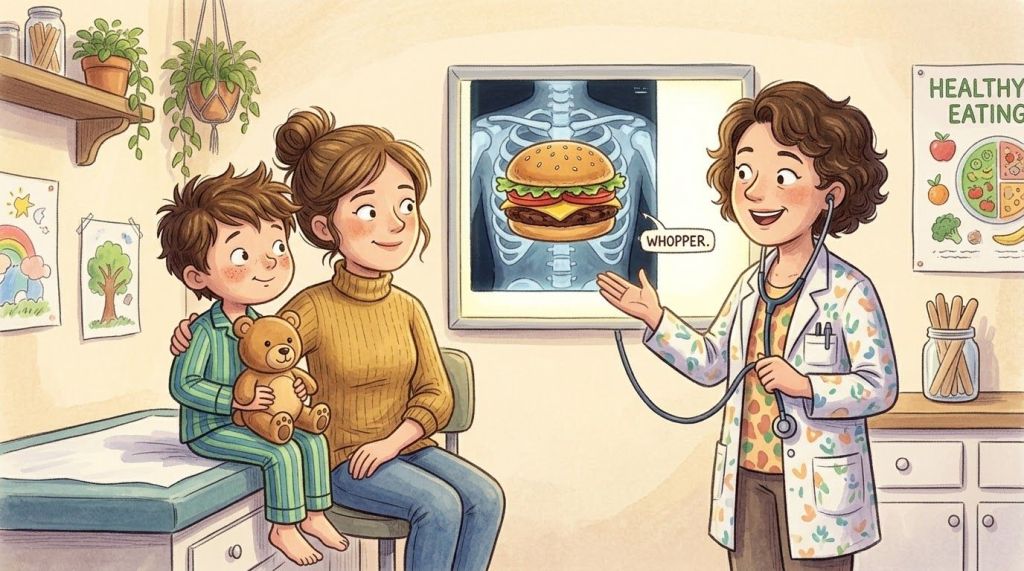
“You have a Whopper.”

“A what?”

“A Whopper,” the doctor explained. “It is what happens when little lies pile up and become one very big problem.”

Leo gulped.

“Can you get it out?”

“Maybe,” said the doctor. “But there is only one way to make it smaller.”

“How?”

“Tell the truth.”

Leo looked at Mum.

He took a deep breath.

“Okay.”

He started with the cookies.

“I ate the cookies.”

POP!

The lump became smaller.

Mum blinked.

Leo continued.

“I didn’t finish my homework.”

POP!

Smaller again.

“I lied about the dog.”

POP!

Leo’s eyes widened.

“I also said I brushed my teeth this morning, but I only licked the toothbrush.”

POP!

Mum covered her mouth.

Leo continued.

“I blamed my sister for breaking the cup.”

POP!

“I blamed the squirrel for taking my pencil.”

POP!

“I’m pretty sure the squirrel didn’t do it.”

POP!

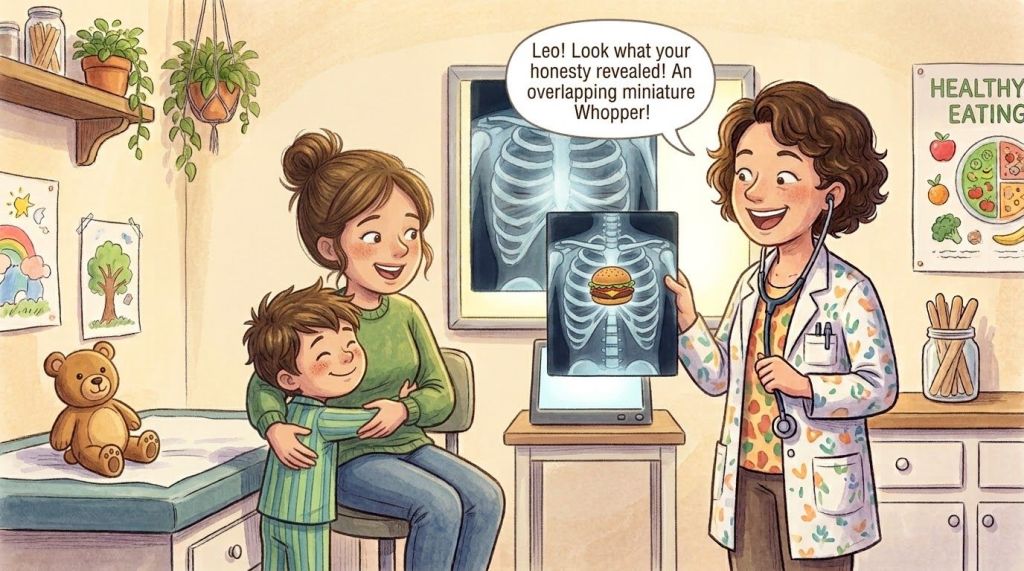
With every honest confession, the Whopper became smaller and smaller.

Finally…

POP!

The Whopper shrinking


The Whopper disappeared!

Leo took a huge breath.

His throat felt completely clear.

The doctor smiled.

“There you are. Much better.”

Leo nodded.

“I don’t want another Whopper.”

“Then remember,” said the doctor, “when you make a mistake, telling the truth is much better than piling one lie on top of another.”

On the way home, Leo was quiet.

“Mum?”

“Yes?”

“I think I understand now.”

“Understand what?”

“Little lies may seem small, but they can grow into big problems.”

Mum smiled.

“And what will you do next time?”

Leo thought for a moment.

“Tell the truth, even when it’s difficult.”

Mum hugged him.

Leo and Mum walking home


“That’s a good choice.”

Leo smiled.

And from that day on, whenever he was tempted to tell a little lie, he remembered the giant Whopper in his throat.

He never wanted to swallow another one!

And Always remember that Jesus Loves you.

💛 What We Can Learn

Leo discovered that a lie does not become harmless simply because it is small.

One little lie can lead to another, and soon we may have to tell even more lies to cover up the first one.

Honesty helps us take responsibility for our choices, build trust, and keep our hearts free from the burden of pretending.

Telling the truth may sometimes feel difficult, especially when we have done something wrong. But admitting the truth gives us the opportunity to make things right and learn from our mistakes.

Most importantly, God wants us to become people who love truth and can be trusted.

👨‍👩‍👧 A Teaching Point for Parents

Children may sometimes lie because they are afraid of punishment, embarrassed by a mistake, trying to avoid consequences, or simply testing boundaries.

When a child tells the truth about something wrong they have done, acknowledge the courage it took to be honest before addressing the behavior itself.

You can say:

«“I’m proud of you for telling me the truth. That took courage. Now let’s talk about what happened and how we can make it right.”»

This does not mean ignoring the wrong behavior. It means teaching the child that honesty is always welcome, while wrong choices still have appropriate consequences.

A home where children can safely tell the truth gives them room to learn responsibility instead of becoming experts at hiding mistakes.

📖 Scripture to Remember

Proverbs 12:22

«“The LORD detests lying lips, but he delights in people who are trustworthy.”»

God cares about truthfulness. He wants us to become people whose words can be trusted.

🙏 Bedtime Prayer

Dear God,

Thank You for loving me and teaching me what is right.

Please help me to tell the truth, even when it is difficult.

When I make a mistake, give me courage to admit it and wisdom to make things right.

Help me to become someone others can trust.

In Jesus’ name, amen.

💬 Talk About It

1. Why did Leo’s little lies become a big Whopper?
2. What happened every time Leo told the truth?
3. Why do you think Leo was afraid to tell the truth?
4. How did telling the truth help him?
5. What should you do when you make a mistake?

✨ One Little Thing to Remember

Little lies can grow into big problems.
Choose truth, even when it is difficult.

🌙 More Stories for Children

Looking for more stories that nurture faith and build godly character?

Explore more: “Stories For Children” (https://godlyparentingtips.family.blog/stories-for-children/)

God’s Word, Foundation for Shaping Tomorrow.

Create your own website, free on WordPress.com.Create your own website.
Start free