Parenting Cannot Wait, Part 2: Lessons from Eli and Hannah

Many parents expect the results of good parenting without doing the work. Learn from Eli and Hannah, and four reasons the urgency cannot be ignored.

This is Part 2 of the “Parenting Cannot Wait” series. In Part 1, we saw that the greatest deception in parenting is believing there will be time later. Now let us look at what Scripture says about why the time is now.

“A little sleep, a little slumber…” (Proverbs 6:10, 24:33)

A parent asleep on a sofa while a child’s small shoes wait by the door
A parent asleep on a sofa in a quiet living room, a closed Bible on the armrest.

This scripture comes to my mind so often when I see how many parents take their responsibility for granted and still expect the best results in their children. The Bible puts it this way: “Woe to you who are at ease in Zion” (Amos 6:1).

Salvation Comes with a Duty

Salvation is God’s free gift to all. However, it is accessible only to whoever makes the choice to believe and confess Jesus as their Lord and Savior (Romans 10:8-10).

Here is the parallel. Salvation is a free gift that must be received, and children are a free gift that must be raised. God hands us both with an instruction attached, and for parents that instruction is clear: every redeemed child of God has a covenant duty to train up their household in the fear of God (Proverbs 22:6; Deuteronomy 6:1-9).

If we claim to be children of the promise, seeds of Abraham and joint heirs with Christ, we must be ready to do the works of Abraham so that we can enjoy the benefits of Abraham (Galatians 3:26-29; Genesis 18:19). And as we saw in Part 1, God always gives us something to do before we receive His benefits.

Therefore, the question for all parents and future parents is: “What is required of me?”

Parenting Starts Now

“Jotham became mighty, because he prepared his ways before the Lord his God.” (2 Chronicles 27:6)

That describes someone who has resolved to change and is ready for a new beginning. His faith was in the now, not later. Scripture says, “Behold, now is the day of salvation” (2 Corinthians 6:2), and “This is the day the Lord has made” (Psalm 118:24; Isaiah 25:9).

God’s way of solving problems is now. He desires our salvation now, and He wants our response to parenting to be now. Not when we are free, not when we have more money, a better job or a bigger house, and not when we have run out of excuses.

The old proverbs say the same thing: “A stitch in time saves nine,” and “Don’t put off until tomorrow what can be done today.” The best time to start is now.

Why the Urgency?

An hourglass with a child’s hands reaching toward it in golden light
A wooden hourglass on a table with a young child’s hands reaching toward it.

1. The days are evil (Ephesians 5:16)

Paul urges us to redeem the time because the days are evil. That is not a small warning. Evil is almost predominant in our society today, and it is no longer hiding. It is loud, attractive and everywhere our children look. If we refuse to take responsibility, and we do not consciously and deliberately shape our children, the ways and culture of the world will do it for us. The world will dominate them and infect them. Parenting is not optional in an evil age. It is the shield.

2. The world needs righteous people, and our children are the answer (Romans 8:19)

“For the earnest expectation of the creation eagerly waits for the revealing of the sons of God.” The world is waiting, and God’s answer is a generation of righteous sons and daughters. Parenting is one of the platforms through which the world is filled with righteousness. When we train children from a tender age and ground them well in the Word of God, they grow up to rise and shine. The righteous people the world is waiting for are not going to fall from the sky. They are sitting at our dinner tables today.

3. We must understand the season we are in (Proverbs 10:5; 1 Chronicles 12:32)

“He who gathers in summer is a wise son; he who sleeps in harvest is a son who causes shame.” Every season has its work. The sons of Issachar are remembered because they “had understanding of the times, to know what Israel ought to do.” They knew the season, so they knew the action. The season for parenting is now, while our children are young, teachable and still within our reach. A parent who sleeps through this season will face a very different harvest later.

4. Obedience is the proof of our allegiance

Obedience is the only proof of our allegiance to the commandment of parenting. We cannot claim to love God and ignore what He has told us to do with the children He gave us. Deuteronomy 6:6-7 does not say to teach our children when it is convenient. It says to teach them diligently, when we sit, when we walk, when we lie down and when we rise. Obeying that command now is how we show whose side we are on.

These are just a few of the many reasons urgency is required of us.

The Lesson of Eli

A mother’s hands folding a small child’s robe in soft window light
A woman’s hands folding a child-sized linen robe.

Whatever we leave untended today soon demands our attention tomorrow. Consider Eli the priest, who failed to correct his sons (1 Samuel 2:12-34). Perhaps he felt too busy to attend to them. In the end, he lost both his sons and the priestly grace on his family. His story shows that no one is exempt from parental duty. The highest calling of a parent is their own children, their own house.

Hannah makes a striking contrast. Having dedicated her son Samuel to God, she did not stop there. She came every year to bring him a little robe and to guide him in how he ought to live (1 Samuel 2:19). She understood that dedicating a child is only the beginning of the work.

Take Responsibility Through God’s Word

Let us learn from Eli’s mistake and be willing to take responsibility, so we avoid the same fate. Romans 15:4 reminds us, “Whatever things were written before were written for our learning.”

God’s Word is the only true source of godly parenting. According to 2 Timothy 3:16, it is profitable for:

  • Doctrine (teaching us what is true and what to believe)
  • Reproof (showing us where we are wrong)
  • Correction (putting us back on the right path)
  • Instruction in righteousness (training us for right living, day by day)

With these four, we have what we need to fulfill our parenting duties. Let us therefore take hold of the grace for responsibility.

Grace is the benefit of the redeemed. If you haven’t yet accepted Jesus, or you are unsure of your salvation, please say this prayer:

Lord Jesus, I come to You today. I believe that You died for my sins and that God raised You from the dead. I confess You as my Lord and Savior. Forgive me of my sins and make me a new creation. Give me the grace to live for You and to raise my family in Your ways. Thank You for saving me. In Jesus’ name, Amen.

Remain ever blessed.
JESUS IS LORD.

Parenting Cannot Wait, Part 1: A Little Sleep, a Little Slumber

One of the greatest deceptions in parenting is believing there will be time later. Here is why the window is small and why we must train now.

“Yet a little sleep, a little slumber, a little folding of the hands to sleep: so shall thy poverty come as one that travelleth…” (Proverbs 6:10-11)

“Train up a child in the way he should go…” (Proverbs 22:6)

One of the greatest deceptions in parenting is that there will be time later.

We say, “Let him grow a little.” “Let her be small for now, we will correct it later.” “I am busy now, I will teach them when I have time.”

A young sapling tied to a wooden stake beside an old tree.

But Scripture warns us: a little sleep, a little slumber, and poverty comes.

In parenting, poverty does not first come as lack of money. It comes as lack of character, lack of discipline and lack of reverence for God. It comes as a child who grows up without instruction, and later we wonder why.

Why Parenting Cannot Wait

1. The Window Is Small

The heart of a child is most tender in the early years. What you put in at 3, you will harvest at 13 and at 30. If you wait until they are grown to start training, you will be trying to bend a tree that has already hardened.

2. Nature Abhors a Vacuum

If you do not train your child, someone else will. Culture will. Social media will. Friends will. “A child left to himself brings shame to his mother” (Proverbs 29:15). There is no neutral ground.

3. Instruction Precedes Blessing

In the Kingdom, God never blesses what He has not instructed. Before the benefit, there is always a responsibility. Our children are a heritage from the Lord, but stewardship is required before enjoyment.

Parenting is not a casual assignment. It is warfare. It is discipleship. It is destiny shaping.

We must understand the times we are in. This is not a time to sleep. The world is not sleeping on our children, so why should we?

A child’s face lit by a phone screen in a dark bedroom, a parent’s shadow in the doorway.

Do not postpone what God has put in your hands today.

Train now.
Correct now.
Pray now.
Model Christ now.

Because tomorrow, that child will be gone, and what you did not do today will speak louder than what you try to do then.


Continue the series: In Part 2 (coming soon), we look at Eli, Hannah and four reasons the urgency cannot be ignored.

Read Part 2: Lessons from Eli and Hannah.

Remain ever blessed.
JESUS IS LORD.

Parenting That Points Beyond the Home

Is well-behaved the goal? Insights from Dr. Brian Cosby on raising covenant children and making your home a witness for Christ.

Most of us want well-behaved kids. But is that the goal?

In Colossians 3:18–4:1, Paul moves from who we are in Christ to how we live for Christ, and he starts with the household. It’s easy to miss how significant that is. Christians sometimes borrow family advice from the culture around us, then add “in Jesus’ name” on top. Paul isn’t doing that. Faith isn’t a coat of paint on ordinary parenting. It changes the foundation.

Dr. Brian Cosby, senior minister at Wayside Presbyterian Church in Signal Mountain, Tennessee, explores this in his essay Godly Parenting as a Witness to the World. A few of his thoughts stayed with me.

We’re raising covenant children

Our kids aren’t just future adults who need to succeed. They belong to God’s story, and our parenting has a purpose beyond getting through the day.

It’s daily, not occasional

Deuteronomy 6 describes teaching God’s Word when we sit at home, when we walk, when we lie down and when we rise. Faith gets passed on in ordinary moments, not only on Sundays.

Discipline and instruction go together

Ephesians 6:4 warns fathers not to provoke their children, but to raise them in the Lord’s discipline and instruction. Correction without teaching crushes. Teaching without correction leaves gaps. Children need both, wrapped in grace.

Our homes are a witness

According to Cosby, when parents raise children God’s way, the watching world sees something about God’s truth, love and wisdom. Christ is Lord of heaven and earth, so He is Lord of our homes too.

If you’re feeling the weight of it all, take heart. Cosby points to Philippians 1:6: the God who began a good work in our children will carry it on to completion. We rely on His grace, not our perfection.

A question for you this week: Where could you weave God’s Word into an ordinary moment with your child?

Inspired by Dr. Brian Cosby’s essay “Godly Parenting as a Witness to the World.” Please read the full piece for his complete thoughts.


A Prayer of Grace

Remember, every grace for parenting begins with the experience of the new birth. You cannot pour out what you have not received. Pray with me:

Father, I take personal responsibility for the home You have entrusted to me. I cannot raise my children in my own strength. Forgive me where I have been careless, impatient or prayerless. Give me grace to teach Your Word daily, to correct with love, and to model Christ before my children. Let my home bear witness to Your truth. In Jesus’ name, Amen.

Prayer of Salvation

If you have never given your life to Christ, or you are not sure where you stand with God, you can begin right now. Pray this from your heart:

Lord Jesus, I come to You as a sinner. I believe You died for my sins and rose again on the third day. I repent and turn from my sins. Come into my heart, be my Lord and Savior, and make me a new creation. Thank You for saving me. In Jesus’ name, Amen.

If you prayed that prayer sincerely, welcome to the family of God! Find a Bible-believing church and begin to grow in His Word.

Remain ever blessed.

Jesus is Lord.

Stewardship and Steadfastness in Godly Parenting: Don’t Give Up Yet

Tired of the nagging child and the weight of parenting? Don’t give in yet. Discover why steadfast stewardship, backed by Proverbs 22:6, brings a reward now and after.

Are you tired of that nagging child?

Does the weight of parenting feel so heavy that it seems to crush you to your knees? Does it seem as if your struggles are peculiar to you alone? Are you worn down by the endless cycles of your child’s rebellion, and by the midnight hours spent on the altar of prayer and searching the Scriptures?

Tired looking mother kneeling in prayer beside a bed at night

If that’s you, I have good news today: don’t give in yet. Tarry a little longer. (1 Corinthians 9:24-25; Habakkuk 2:3)

Pull up a chair, because today we’re talking about stewardship and steadfastness in godly parenting.

First, what do these words mean?

Understanding the terms will give us clarity.

Steadfastness means being firm, resolute, and unyielding, staying loyal to a course, a belief, or a person without compromise.

Stewardship means being a servant, someone who serves the interest of another.

Put them together and you get a parent who trusts, receives, and believes what Scripture teaches about parenting, then puts it to work without compromise. (James 1:22-25; Genesis 18:19)

Proverbs 22:6 is a commandment, not a suggestion

Let me say this plainly. Proverbs 22:6 is a commandment to every believer, whether you’re a practising parent or still finding your feet. It isn’t an option, a tip, or a piece of advice. It’s a priority, and it must be obeyed if we want to raise godly children who will carry the banner of Christ tomorrow.

And because it’s a priority, we are called to be steadfast in our stewardship. In fact, where our steadfastness stops is where our stewardship stops. (Matthew 24:45-47)

The mark of a steadfast steward: endurance

A thousand small checkmarks. One quiet yes after another.

Scripture calls us to endure hardness (2 Timothy 2:3). Endurance is:

  • the ability to keep doing something difficult for a long time to reach a goal;
  • the ability to bear discomfort and suffering over the long haul for that goal;
  • the discipline of keeping your body under subjection again and again, which is self-denial (1 Corinthians 9:24-25);
  • refusing to faint while doing the work of God.

Your labour is not in vain

Here is the encouraging part. Every steadfast parental steward has a two-way reward, now and hereafter. (Habakkuk 2:3; Luke 18:28-30)

What you’re going through is training with purpose, not suffering without meaning, and the reward far outweighs the labour. So let’s stay unmovable in our duties, serving with joy and delight as unto the Lord. God didn’t give us children to stress us or burden us. He gave them to bless us.

Pray for grace to be a steadfast steward of the children God has placed in your hands. (Hebrews 4:16)

Where it all begins

Salvation is the first step to becoming a steadfast steward. If you’ve never given your life to Christ, or you want to renew your commitment, pray this with me:

Dear Heavenly Father, I come to You today. I know I am a sinner, and I acknowledge my sins. I believe You died for me and rose again on the third day to cleanse me from sin and from the power of Satan. Please come into my heart and life. I want You to be my Lord and Savior, and I want to serve You as my Lord and Savior. Amen.

Let’s talk

What has been the hardest part of staying steadfast in your parenting? Share it in the comments, and let’s encourage one another.

Remain ever blessed.

JESUS IS LORD.

The Responsibility of Godly Parenting: Are Ye Able?

Godly parenting requires more than good intentions. Are we willing to sacrifice our comfort, obey God’s Word, and become the parents He wants us to be? Discover the responsibility, cost, and grace of raising children in God’s ways.

Scripture Text: Matthew 20:20–22 (KJV)

There was a time when the mother of James and John came to Jesus with a request concerning her sons. She desired places of honor for them in His kingdom. But Jesus turned the conversation toward a question of readiness and sacrifice: “Are ye able to drink of the cup that I shall drink of?” (Matthew 20:22, KJV).

She desired a glorious future for her children, but Jesus drew attention to the price associated with that future. This raises an important question for every parent who desires to see their children fulfil God’s purpose: Are ye able?

Are we willing to pay the price required to raise our children according to God’s Word? Are we prepared to make the sacrifices necessary to nurture their faith, shape their character, and guide them in the way of the Lord?

Godly Parenting Is a Divine Assignment

Parenting is more than giving birth, providing food, paying school fees, or securing a comfortable future for our children. It is a divine responsibility entrusted to us by God.

Consider what God said about Abraham:

“For I know him, that he will command his children and his household after him, and they shall keep the way of the LORD, to do justice and judgment…”

Genesis 18:19 (KJV)

God had confidence that Abraham would take responsibility for directing his household in His ways. Abraham was not merely expected to desire that his children follow God; he was expected to lead them.

Likewise, godly parenting requires more than wishing our children would grow up to love God. It requires intentional teaching, godly example, prayer, correction, and consistent guidance.

In Judges 13:8, Manoah prayed to God for instruction on how to raise the son who would be born to him. His prayer reminds us that parents do not have to depend on their own understanding. We can ask God to teach us how to fulfil the responsibility He has entrusted to us.

The Greatest Challenge May Not Be the Child, but the Parent

In reaching out to children and teaching them the Word of God, one of the challenges that can emerge is the influence of the home environment. A child may hear the truth in a lesson, learn a Bible verse, and understand the importance of godly character, only to return home to an environment that contradicts what was taught.

When children hear us teach patience but regularly see us act in anger, or learn about prayer while never seeing us make room for God, our example may weaken the message our words are meant to communicate.

This is why parents must examine themselves. We cannot consistently give what we have refused to receive, learn, or practise. If we want our children to love the Word of God, we must be willing to grow in it ourselves.

This does not mean parents must be perfect before they can teach their children. It means we must be honest enough to keep learning, humble enough to correct our own mistakes, and willing to practise the truth we teach.

We may desire children who become leaders, pathfinders, solution-builders, and shining lights in their generation. But what are we doing today to prepare them for that future? Their upbringing cannot be left to chance while we assume that good intentions alone will produce godly results.

The Price of Godly Parenting Is Dying to Self

Jesus said:

“If any man serve me, let him follow me…”

John 12:26 (KJV)

And in John 12:24, Jesus uses the picture of a grain of wheat that must fall into the ground and die before it brings forth much fruit. This principle helps us understand an important part of parenting: fruitful parenting often requires us to surrender some of our personal comfort and convenience.

Dying to self does not mean neglecting our well-being or losing our identity. It means refusing to let selfishness rule our decisions when God has entrusted us with the care and spiritual development of our children.

Sometimes, the price may mean waking up earlier to pray with our children instead of sleeping a little longer. It may mean putting down our phones to listen to their questions, studying Scripture so we can teach them, or patiently correcting them when we would rather avoid the inconvenience.

It may also mean changing habits, apologizing when we are wrong, and choosing a godly response when our emotions urge us in another direction.

Jesus said, “If ye love me, keep my commandments” (John 14:15, KJV). Love for God must find expression in obedience. If we love God and desire to raise our children in His ways, we must be willing to follow His instructions, even when obedience costs us something.

Children are a heritage from the Lord (Psalm 127:3). They are not interruptions to the life we want to live; they are a sacred responsibility within the life God has entrusted to us. We must therefore be careful not to protect our leisure at the expense of the attention, guidance, and spiritual care they need.

God Has Given the Assignment, and He Will Help Us Fulfil It

The question “Are ye able?” is not meant to leave parents discouraged or afraid. It is an invitation to examine our willingness and turn to God for the grace to fulfil our responsibility.

God does not expect us to rely entirely on our own strength. He invites us to seek His wisdom, follow His Word, and depend on His help. As Manoah prayed for guidance concerning his son, we too can ask God to show us what our children need at each stage of their lives.

Proverbs 22:6 instructs us to train up a child in the way he should go. Training requires intention and consistency. It means teaching, modelling, correcting, encouraging, and creating opportunities for our children to know and follow God.

If you did not grow up with a strong foundation in the Word of God, do not conclude that it is too late to begin. You can start learning now. You can grow alongside your children, establish new family habits, and allow God’s Word to reshape your home. God is able to equip those who sincerely answer His call.

We may not always know what to do next, but we can seek God daily and obey the light He gives us. We do not need to have every answer before we begin; we need a willing heart that is ready to learn and act.

Conclusion: Are Ye Able?

Every parent may desire to see their children excel, fulfil their purpose, and become a blessing to their generation. But godly parenting calls us beyond desire into responsibility.

Are we willing to make time for prayer, the Word, meaningful conversations, loving correction, and godly example? Are we willing to examine our own lives and allow God to change us as we guide our children?

We do not have to be flawless parents, but we must be willing parents: willing to learn, willing to obey, willing to sacrifice, and willing to depend on God.

So, as we dream of what our children may become, let us also consider what God is asking us to become for their sake.

Are ye able?

A Prayer of Salvation

If you have not yet surrendered your life to Jesus Christ, you can begin today by turning to Him in faith. The greatest gift we can share with our children is a life that belongs to the Lord.

Pray sincerely:

Heavenly Father, I come to You in the name of Jesus Christ. I confess that I am a sinner and need Your forgiveness. I believe that Jesus died for my sins and rose again. I repent of my sins and receive Jesus Christ as my Lord and Savior. Please forgive me, give me a new heart, and help me to live according to Your Word. Thank You for saving me. In Jesus Christ’s name, Amen.

A Prayer for Parents

Heavenly Father, thank You for the precious gift of our children. Grant us the grace and strength to fulfil our responsibility of raising them in Your ways. Help us to become the parents You want us to be and to lead our children by both our words and our examples.

In the name of Jesus the Christ, Amen.

Keep building godly homes, one Scripture at a time.
Jesus Is Lord.

Build Your Parenting on the Word

A house falls without a foundation, and so does parenting without God’s Word. See how Timothy, Samuel, and Daniel were raised on the rock, and how you can build the same foundation at home this week.

“For no one can lay any foundation other than the one already laid, which is Jesus Christ.”
1 Corinthians 3:11

Jesus Himself told us what happens when storms hit a home:

“Therefore everyone who hears these words of mine and puts them into practice is like a wise man who built his house on the rock. The rain came down, the streams rose, and the winds blew and beat against that house; yet it did not fall, because it had its foundation on the rock.”
Matthew 7:24-25

The storms will come to every family. What decides whether the house stands is what it was built on. When we build on Scripture and put it into practice, we raise Timothys, Samuels, and Daniels. Here’s what that looks like:

1. TIMOTHY: Raised on Scripture From Childhood
“From infancy you have known the Holy Scriptures, which are able to make you wise for salvation.”
2 Timothy 3:15

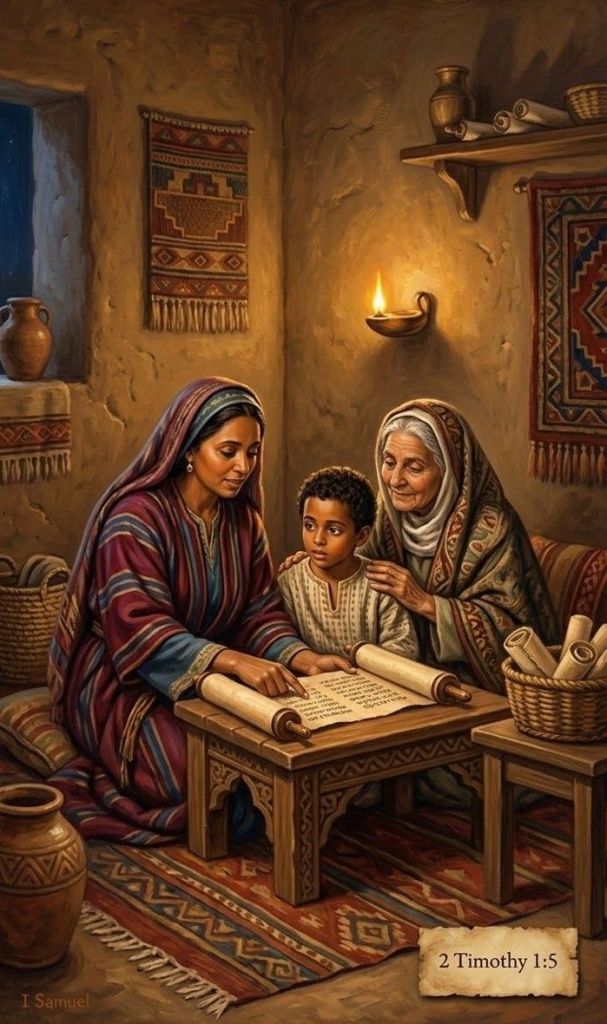
Young boy Timothy sitting with his grandmother Lois and mother Eunice

His Foundation:
· Lois & Eunice (2 Tim. 1:5) filled his early years with God’s Word
· Outcome: He grew into Paul’s trusted partner in ministry

2. SAMUEL: Taught to Listen for God
“Speak, Lord, for Your servant is listening.”
1 Samuel 3:10

Young boy Samuel lying in the temple at night, light shining down

His Foundation:
· Hannah gave him to God (1 Sam. 1:28)
· Eli showed him how to answer God’s call
· Outcome: He led Israel with integrity

3. DANIEL: Steady in a Hostile Culture
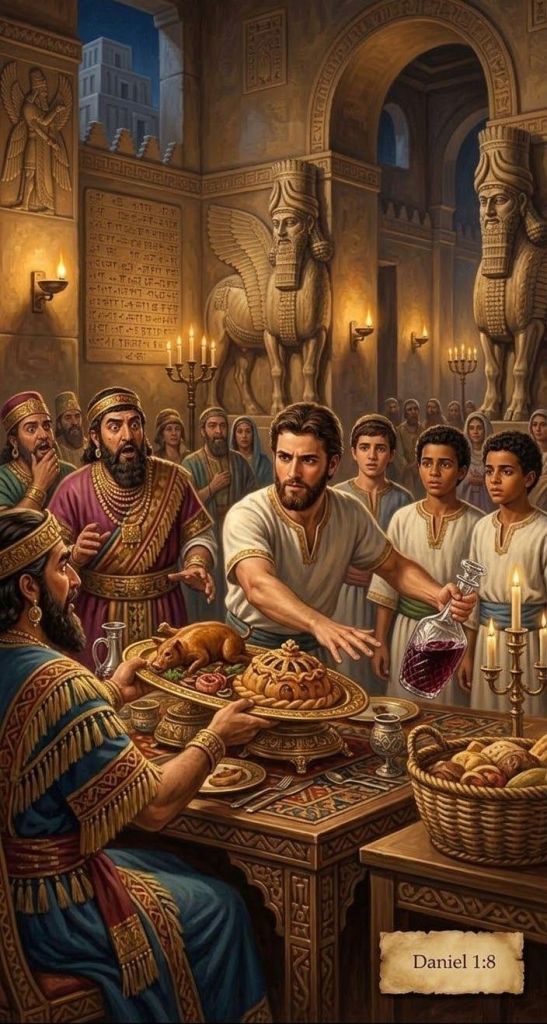
“Daniel resolved not to defile himself with the royal food and wine.”
Daniel 1:8

Daniel standing firm at the king’s table in Babylon, pushing away royal food and wine

His Foundation:
· His parents rooted him in God’s commands (Deut. 6:7)
· Outcome: He held his ground in Babylon’s palace

Timothy, Samuel, and Daniel all stood firm because someone built on the rock, not the sand. The storms will come, but the home built on Christ will stand.

This Week’s Challenge:
· Morning: Read a verse about who God is
· Mealtime: Tell a story about a hero of the Bible
· Bedtime: Pray a promise from Scripture over your child

A Prayer for Your Home:
Lord, be the foundation of our family. Help us hear Your Word and put it into practice, so that when the storms come, our house stands on You. Amen.

Of these three examples (Timothy, Samuel, or Daniel), which speaks to you most, and why?

(I’ll start: Timothy’s story pushes me to be more intentional.)

Jesus Is Lord

Godly Parenting in the 21st Century

Apps update, AI evolves, and technology never stops changing. But God’s Word stands forever. Godly parenting isn’t software to install. It’s a manual for living.

Series: Godly Parenting in the 21st Century
Introduction: A Changing World, an Unchanging Word
Part 1: Passing the Faith On: Guiding Your Child Toward God in a Screen-Filled World


Part 2: Psychological Abuse and Godly Parenting

Introduction: A Changing World, an Unchanging Word

Every few weeks, our phones ask us to update. New apps replace old ones. Software that felt cutting-edge last year is outdated today. Artificial intelligence is reshaping how we work, learn, and communicate, and our children are growing up in the middle of it all. Parents can feel as though they’re always a step behind.

In a world that never stops changing, it is tempting to think parenting must be reinvented with every new trend, device, and platform.

A phone showing an update notification beside an open Bible

But some things do not change.

“The grass withers, the flower fades, but the word of our God stands forever.”

“Jesus Christ is the same yesterday, today, and forever.”

The technology our children use will keep evolving. The God they need will not. His truth was sufficient for the parents of every past generation, and it is sufficient for us.

Godly parenting is not software to be installed. There is no download, no upgrade, no quick fix. It is a manual for living, drawn from a Word that is living and active, and it is worked out daily through prayer, example, patience, and love.

Hands holding an open Bible with blurred screens in the background

“All Scripture is given by inspiration of God, and is profitable for doctrine, for reproof, for correction, for instruction in righteousness, that the man of God may be complete, thoroughly equipped for every good work.”

His Word is enough for His work.

In this series, we will look at how to pass the faith on in a screen-filled world, and how to build homes where children and spouses feel safe, valued, and loved. The tools around us will change, but the foundation will not.


Continue the series:
Next in the series: Part 1, Passing the Faith On: Guiding Your Child Toward God in a Screen-Filled World

The Abraham Parenting Model: Daily Rhythms from Genesis 18

Genesis 18 holds one of Scripture’s most overlooked parenting models — not a list of rules, but a rhythm. Discover how Abraham’s morning watch, daytime service, and evening honesty with his family offer a simple, three-part pattern for directing your children toward God every single day.

We often look to the Proverbs for parenting advice, or to the epistles of Paul for household instructions. But tucked away in the narrative of Genesis 18 is one of the most profound models for parenting in all of Scripture. It is a model built not on rules, but on rhythm.

In this chapter, we find Abraham sitting at the door of his tent. He is not just hosting guests; he is modeling a lifestyle of faith that is meant to be replicated by his children. God Himself acknowledges this in verse 19: “For I have chosen him, so that he will direct his children and his household after him to keep the way of the Lord by doing what is right and just.”

Here is how we can apply the Abraham Parenting Model to our daily lives.

MORNING: “SEE God First”

“I saw the Lord at my tent door” (v.2)

A father sitting at the entrance of a tent at sunrise

Abraham’s day began with availability. He was sitting at the entrance of his tent, the threshold between his private sanctuary and the public world. He was watching. He was waiting. Before the heat of the day hit, before the tasks of the day piled up, he saw the Lord.

In our modern age, the “tent door” of our morning is usually a glowing screen. The first thing we see is usually an email, a headline, or a social media feed. This sets our internal compass for the day.

The Practice:
To parent like Abraham, we must establish a morning boundary. Before the world rushes in, we must look out for the Lord.

  • Scripture First: Aim for 5 minutes of Scripture before you check your phone. This doesn’t require a seminary degree, just a verse.
  • The Handoff: As parents, we set the spiritual temperature of the home. If our children see us prioritizing God in the morning, they learn that God is the source of our day, not just a Sunday accessory.

DAYTIME: “SERVE as Worship”

“Abraham hurried to prepare bread” (v.6)

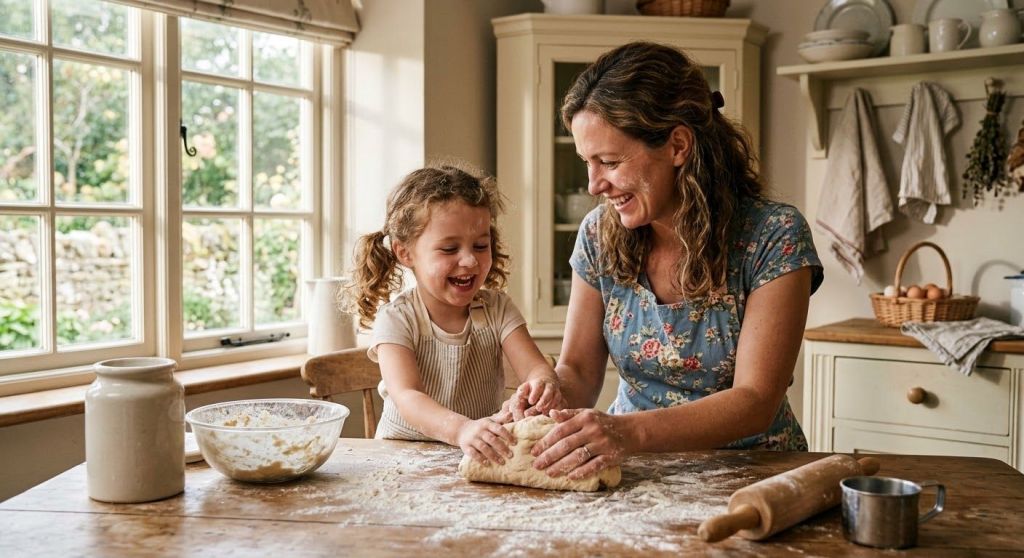
A mother and child baking bread together in a rustic kitchen

When the visitors arrived, Abraham didn’t just point them to the kitchen. He ran. He hurried. He involved his household in the preparation. He told Sarah to bake bread, and he ran to the herd to select a calf. This was messy, physical, and mundane work.

Yet, in this moment, making a meal was a sacred act. Abraham was entertaining angels (and the Lord Himself) without knowing it.

The Practice:
Parenting is largely made up of repetitive, mundane tasks. Laundry, dishes, homework, and taxi driving can feel like a distraction from “spiritual” things. But the Abrahamic model turns the mundane into the divine.

  • Turn Chores into Holy Work: When you cook, cook for the glory of God. When you fold laundry, pray for the person who wears the clothes.
  • Model Service: Let your children see you serving your spouse, your neighbors, and your church with the same “hurry” and enthusiasm Abraham showed. As Colossians 3:23 says, “Whatever you do, work at it with all your heart, as working for the Lord.”

EVENING: “SHARE Reflections”

“Shall I hide from Abraham what I do?” (v.17)

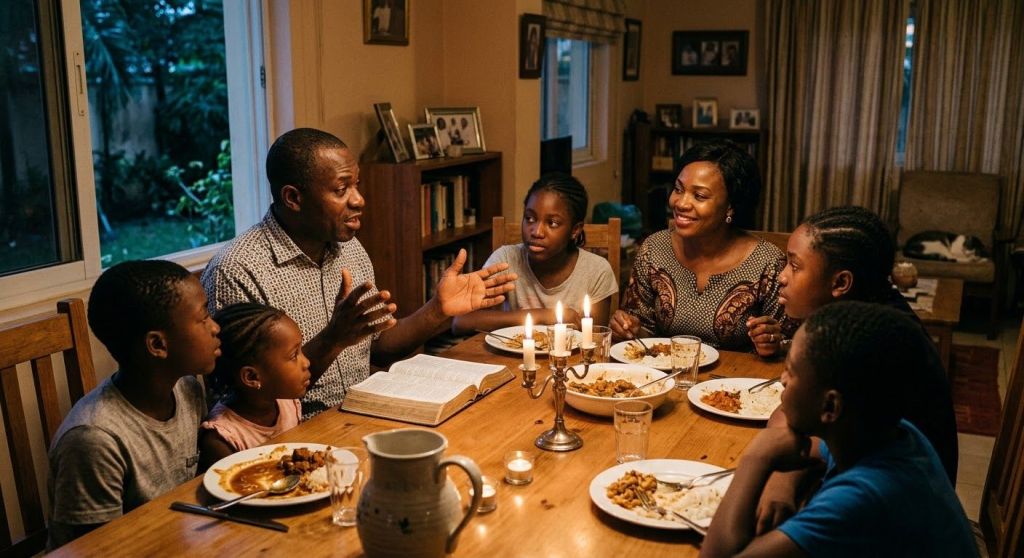
A family gathered around a dinner table at dusk

As the day turned to evening, the dynamic shifted. The meal was finished, and the Lord looked at Abraham and decided to reveal His plans for Sodom and Gomorrah. Why? Because God viewed Abraham as a partner, a friend, and He knew Abraham would teach his children.

The evening is a time for intimacy and transparency. It is when the “table talk” happens.

The Practice:
Don’t let the day end without connecting the dots between life and faith.

  • The Question: Instead of asking, “How was school?” (which yields “Fine”), ask a deeper question: “Where did we see God today?”
  • The Prophetic Role: Like God shared His heart with Abraham, share your heart with your children. Talk about how you saw God provide, how you struggled, and how you prayed. When we share our reflections, we model a living faith, not just a historical religion.

CENTRAL VERSE

“I have chosen him to direct his children…” (Gen 18:19)

This entire model hinges on the phrase “I have chosen him.” The Abraham Parenting Model is not about perfect behavior; it is about direction.

God said Abraham would “direct” his children. The Hebrew word implies a command, a guarding, and a pointing of the way. Abraham didn’t just save his children from the world; he directed them toward the Lord.

You cannot change your children’s hearts, that is the Holy Spirit’s job. But you can set the direction. You can point the car toward the Kingdom every morning, every afternoon, and every evening.

Challenge: Try the Abraham Model for one week.

  1. See God first before looking at a screen.
  2. Serve in your chores as if you were serving the Lord Himself.
  3. Share your reflections on His faithfulness at the dinner table.

He has chosen you to direct your children. Walk in that high calling today.


A Closing Call: Start Your Journey Today

Two hands reaching toward each other with a glowing cross of light

Friend, before you can walk in any of these truths, before you can parent with purpose or lead your home with intention, there is a first step. Every benefit, every promise, and every principle found in Scripture begins with one thing: being born again.

Jesus said in John 3:3, “Unless one is born again, he cannot see the kingdom of God.” Without this foundational experience, the Word of God remains a closed book and its promises remain out of reach. But the moment you surrender your life to Christ, everything changes. You are made new. You are adopted into God’s family. You receive the Holy Spirit as your Teacher, your Comforter, and your Guide.

If you have never taken this step, or if you want to rededicate your life to Him today, say this prayer with me to start your journey:

Heavenly Father, I come to You just as I am. I acknowledge that I am a sinner and that I cannot save myself. I believe that Jesus Christ is Your Son, that He died on the cross for my sins, and that He rose again on the third day. Today, I confess with my mouth that Jesus is Lord and I believe in my heart that God raised Him from the dead. I repent of my sins and I turn away from my old life. I ask You, Lord Jesus, to come into my heart. Be my Savior and my Lord. Fill me with Your Holy Spirit. I am Yours now and forever. Thank You for saving me. In Jesus’ mighty name, Amen.

If you prayed that prayer sincerely, heaven is rejoicing over you right now! You are now a child of God, born again by His Spirit. The same power that raised Christ from the dead now lives in you. Now, the journey begins, a journey of daily walking with Him, discovering His Word, and yes, even parenting according to His perfect model.

Find a Bible-believing church. Get baptized. Surround yourself with other believers. And let the Holy Spirit lead you every step of the way.

Remain Ever Blessed.
Jesus Is Lord.

Raising Children in the Fear of God: A Biblical Mandate for Every Parent Part 2

Godly parenting isn’t just about correction, it’s about the heart behind it. In part two, we look at daily instruction, the spiritual battle behind Revelation twelve, and the beautiful promise that we’re never parenting alone, the Holy Spirit is our Helper every step of the way.

Anchor Scripture: 2 Timothy 3:16-17

Yesterday, in Part 1, we looked at the foundational mandate to teach and model faith, the goal of raising godly offspring, and the role of loving discipline. Today, in Part 2, we turn to the posture of the parent’s heart, the daily rhythm of instruction, the urgent spiritual battle revealed in Revelation 12, and the promise of the Holy Spirit as our divine Helper in this sacred calling.


Part Four: Heart Posture and Daily Walk

Godly parenting is as much about the parent’s heart as it is about the child’s behavior. The tone, patience, and compassion of the parent shape the child’s view of God.

“Fathers, do not provoke your children, lest they become discouraged.”

Colossians 3:21

Harshness, neglect, or favoritism can crush a child’s spirit. Parents must guard against discouraging their children.

“A soft answer turns away wrath, but a harsh word stirs up anger.”

Proverbs 15:1

Gentleness is a powerful tool in parenting. The way we speak to our children matters.

“As a father shows compassion to his children, so the Lord shows compassion to those who fear him.”

Psalm 103:13

Earthly fathers are meant to mirror the compassion of our Heavenly Father. When parents show compassion, children learn to trust God’s mercy.


Part Five: Ongoing Instruction and Conversation

Godly parenting is not a one-time event but a daily rhythm. Children learn best when truth is woven into the ordinary moments of life.

“Teach them to your children, talking about them when you sit at home and when you walk along the road, when you lie down and when you get up.”

Deuteronomy 11:19

Every moment is a teaching opportunity. Parents are called to make God’s Word a constant topic of conversation.

“And when your children ask you, ‘What does this ceremony mean to you?’ then tell them, ‘It is the Passover sacrifice to the Lord…'”

Exodus 12:26-27

Children are naturally curious. Godly parents welcome their questions and use them as opportunities to declare God’s mighty acts.

“In days to come, when your son asks you, ‘What does this mean?’ say to him, ‘With a mighty hand the Lord brought us out of Egypt, out of the land of slavery.'”

Exodus 13:14

The story of redemption is to be told and retold. Parents are the primary storytellers of God’s faithfulness.


Part Six: The Urgent Battle — The Reason for Godly Parenting (Revelation 12)

Why is godly parenting so urgent? Revelation 12 pulls back the curtain on the cosmic battle raging for the souls of children. The enemy is not passive, he is actively seeking to devour.

“Then the dragon stood before the woman about to give birth, to devour her child when she gave birth.”

Revelation 12:4

The dragon, Satan, positions himself to destroy children from birth. This reveals that godly parenting is spiritual warfare. The enemy targets the youngest among us.

“Then the dragon became angry with the woman and went off to wage war against the rest of her offspring, those who keep God’s commandments and bear witness to Jesus.”

Revelation 12:17

When the dragon could not destroy the Christ child, he turned his fury on all who follow Jesus. Your children are born into a war zone. Raising them in the fear of God is raising soldiers for this battle.

“The huge dragon, the ancient serpent, who is called the Devil and Satan, who deceived the whole world.”

Revelation 12:9

The enemy arrayed against your family is the ancient deceiver, the accuser of the brethren. He has been waging war against God’s people since Eden. Neglecting godly parenting leaves children undefended in this ancient conflict.

“But woe to you, earth and sea, for the Devil has come down to you in great fury, for he knows he has but a short time.”

Revelation 12:12

The intensity of the enemy’s attacks is proportional to his desperation. He knows his time is short. This should awaken urgency in every parent, the window to establish children in the fear of the Lord is not indefinite.

“The woman fled into the wilderness to a place prepared for her by God, where she might be taken care of… The woman was given the two wings of a great eagle, so that she might fly to the place prepared for her in the wilderness, where she would be taken care of.”

Revelation 12:6, 14

While the dragon pursues, God provides. When you raise your children in the fear of the Lord, you place them under the covering of the One who prepares a place of protection. The dragon may rage, but he cannot snatch those who belong to the Lamb.

“They triumphed over him by the blood of the Lamb and by the word of their testimony.”

Revelation 12:11

Victory over the dragon comes through the blood of Jesus and the testimony of His people. Godly parenting raises children who know the power of the Cross and who bear witness to Jesus with their lives.


Part Seven: The Promise of the Holy Spirit — Our Divine Helper

The call to raise children in the fear of God is daunting. No parent has the wisdom, patience, or strength to fulfill it perfectly. But Jesus did not leave us to accomplish this task alone. Before His ascension, He promised the Holy Spirit, the Helper, the Teacher, the Comforter, who would guide us into all truth and empower us for every good work.

“But the Advocate, the Holy Spirit, whom the Father will send in my name, will teach you all things and will remind you of everything I have said to you.”

John 14:26

The Holy Spirit is our divine Teacher. When we lack wisdom in parenting, He reminds us of God’s Word and teaches us how to apply it. He brings to remembrance the Scriptures we have hidden in our hearts, equipping us to instruct our children in the moment of need.

“But when he, the Spirit of truth, comes, he will guide you into all the truth. He will not speak on his own; he will speak only what he hears, and he will tell you what is yet to come.”

John 16:13

The Spirit guides us into all truth. In the complexities of parenting, decisions about discipline, education, relationships, and faith, the Holy Spirit leads us into God’s will. He is not silent; He speaks through the Word and through His still, small voice.

“If you then, though you are evil, know how to give good gifts to your children, how much more will your Father in heaven give the Holy Spirit to those who ask him!”

Luke 11:13

Jesus assures us that the Father delights to give the Holy Spirit to those who ask. Parents should pray daily for the Spirit’s filling, for He is the source of love, joy, peace, patience, kindness, goodness, faithfulness, gentleness, and self-control (Galatians 5:22-23), the very fruits needed to parent well.

“In the same way, the Spirit helps us in our weakness. We do not know what we ought to pray for, but the Spirit himself intercedes for us through wordless groans.”

Romans 8:26

There are moments in parenting when we do not know how to pray. The Spirit intercedes for us. He knows the needs of our children better than we do and prays according to the will of God.

“But you will receive power when the Holy Spirit comes on you; and you will be my witnesses in Jerusalem, and in all Judea and Samaria, and to the ends of the earth.”

Acts 1:8

The Holy Spirit gives power to be witnesses. The first mission field is the home. Parents filled with the Spirit become powerful witnesses to their children, demonstrating the reality of the Gospel in word and deed.

“But the fruit of the Spirit is love, joy, peace, forbearance, kindness, goodness, faithfulness, gentleness and self-control. Against such things there is no law.”

Galatians 5:22-23

The fruit of the Spirit is the character of godly parenting. No amount of technique or discipline can produce these qualities, they are the supernatural work of the Spirit in a yielded heart. When parents walk in the Spirit, their children encounter the living God through them.

“‘Not by might nor by power, but by my Spirit,’ says the Lord Almighty.”

Zechariah 4:6

Godly parenting is not accomplished by human strength, perfect strategies, or sheer willpower. It is accomplished by the Spirit of God. When we feel inadequate, and we will, we must remember that the same Spirit who raised Christ from the dead lives in us (Romans 8:11) and is more than sufficient for the task.

“All your children will be taught by the Lord, and great will be their peace.”

Isaiah 54:13

This is a precious promise: God Himself teaches our children. When we faithfully instruct them in His Word, the Holy Spirit works in their hearts, drawing them to Himself. We plant and water, but God gives the increase (1 Corinthians 3:6).


Conclusion: Equipped, Empowered, and Never Alone

The task of raising children in the fear of God is overwhelming, but it is not ours to accomplish alone. The same Scripture that commands us to teach, correct, and train is the Scripture that equips us for every good work (2 Timothy 3:16-17). And the same God who calls us to this sacred task has given us His Holy Spirit, the Helper, the Teacher, the Comforter, to guide us every step of the way.

From Genesis to Revelation, God calls parents to raise a godly offspring, children who know Him, love Him, and stand firm in the faith. The enemy rages, the dragon pursues, but the Lamb has overcome. And we do not face this battle in our own strength. Jesus promised, “I will ask the Father, and he will give you another advocate to help you and be with you forever, the Spirit of truth” (John 14:16-17). The Holy Spirit is our ever-present Helper, teaching us all things, reminding us of God’s Word, guiding us into truth, interceding for us in our weakness, and producing His fruit in our lives.

When we hide God’s Word in our hearts, teach it diligently to our children, discipline them in love, and cover them in prayer, we participate in the victory of the Lamb. We are not perfect parents, but we serve a perfect Father who has given us a perfect Helper. The Spirit empowers us to love when we are weary, to be patient when we are frustrated, to correct with gentleness, and to point our children to Jesus in every season.

May every parent take up this sacred calling with urgency and joy, relying not on their own strength but on the Spirit of the living God. May we be found faithful, raising arrows aimed at the heart of the enemy and destined for the glory of God, arrows that will fly straight and true, carried by the wind of the Holy Spirit.

“Train up a child in the way he should go; even when he is old he will not depart from it.”

Proverbs 22:6

“But the Advocate, the Holy Spirit, whom the Father will send in my name, will teach you all things and will remind you of everything I have said to you.”

John 14:26

If this article encouraged you, explore more practical biblical insights for raising children in God’s Word, character and purpose at Godly Parenting Insights.

Godlyparentingtips.family.blog


REMAIN BLESSED

JESUS IS LORD

Raising Children in the Fear of God: A Biblical Mandate for Every Parent Part 1

Every parent stands between a sacred calling and a cosmic battle. In part one of this two part series, we explore the biblical mandate to teach and model faith, God’s desire for godly offspring, and why loving discipline is an act of hope, not harm.

“All Scripture is God-breathed and is useful for teaching, rebuking, correcting and training in righteousness, so that the servant of God may be thoroughly equipped for every good work.”

2 Timothy 3:16-17

Introduction

Every parent stands at the intersection of a sacred calling and a cosmic battle. The task of raising children in the fear of God is not merely a cultural tradition or a moral duty, it is a divine mandate woven throughout the entirety of Scripture. From the opening chapters of Genesis to the closing visions of Revelation, God consistently reveals His heart for the next generation and the serious responsibility He places upon parents.

The apostle Paul, writing to young Timothy, reminds us that all Scripture, every command, every warning, every promise, is God-breathed and profitable for equipping God’s people. This includes the call to godly parenting. The Word of God is sufficient to teach us how to raise children who know, love, and fear the Lord. It rebukes our negligence, corrects our errors, and trains us in the righteousness needed to shepherd the souls entrusted to our care.

This is Part 1 of a two-part series compiling some biblical foundations for godly parenting. Today we’ll look at the foundational mandate to teach and model faith, the goal of raising godly offspring, and the role of discipline. Part 2, coming tomorrow, will cover the posture of the heart, the rhythm of daily instruction, the spiritual battle revealed in Revelation 12, and the promise of the Holy Spirit as our Helper.


Part One: The Foundational Mandate — Teaching and Modeling Faith

The primary responsibility of godly parenting is not merely to tell children about God but to embody a life of faith before them. Scripture calls parents to weave the knowledge of God into the fabric of everyday life.

“Love the Lord your God with all your heart and with all your soul and with all your strength. These commandments that I give you today are to be on your hearts. Impress them on your children. Talk about them when you sit at home and when you walk along the road, when you lie down and when you get up.”

Deuteronomy 6:5-7

This is the foundational text for godly parenting. Before parents can impress God’s truth on their children, it must first be on their own hearts. Faith is not a Sunday event, it is a daily conversation, a constant walk.

“Only be careful, and watch yourselves closely so that you do not forget the things your eyes have seen or let them fade from your heart as long as you live. Teach them to your children and to their children after them… so that they may learn to fear me as long as they live, and so that they may teach their children to do the same.”

Deuteronomy 4:9-10

The call to teach is generational. What we receive from God, we must pass to our children, and they to theirs. The fear of the Lord is not inherited automatically, it is taught and modeled.

“We will not hide these truths from our children; we will tell the next generation about the glorious deeds of the Lord, about his power and his mighty wonders… so the next generation might know them, even the children not yet born, and they in turn will teach their own children.”

Psalm 78:4-6

The psalmist resolves to declare God’s works to the next generation. Godly parenting is intentional, forward-looking, and committed to preserving the testimony of God’s faithfulness.

“For I have chosen him, so that he will direct his children and his household after him to keep the way of the Lord by doing what is right and just.”

Genesis 18:19

God’s commendation of Abraham reveals His expectation: fathers are to direct their households in the way of the Lord. This is not passive, it requires deliberate instruction, leadership, and example.

“Fathers, do not provoke your children to anger, but bring them up in the discipline and instruction of the Lord.”

Ephesians 6:4

Paul balances correction with nurture. Godly parenting avoids exasperating children while providing both discipline and instruction rooted in the Lord.


Part Two: The Goal — Godly Offspring and a Legacy of Faith

God’s desire is not merely that children behave well but that they become a godly offspring, a generation that belongs to Him and carries His covenant forward.

“Has not the one God made you? You belong to him in body and spirit. And what does the one God seek? Godly offspring.”

Malachi 2:15

This verse reveals God’s heart: He seeks godly offspring. The marriage covenant and parenting are designed to produce children who fear and serve the Lord.

“Train up a child in the way he should go; even when he is old he will not depart from it.”

Proverbs 22:6

This is a promise and a principle. Early, consistent training in the fear of God shapes the trajectory of a child’s entire life.

“From infancy you have known the Holy Scriptures, which are able to make you wise for salvation through faith in Christ Jesus.”

2 Timothy 3:15

Timothy’s mother and grandmother began teaching him Scripture from infancy. The Word of God is the primary means by which children are made wise unto salvation.

“Behold, children are a heritage from the Lord, the fruit of the womb a reward. Like arrows in the hand of a warrior are the children of one’s youth.”

Psalm 127:3-5

Children are not a burden but a heritage. They are arrows, meant to be aimed, shaped, and sent into the world for God’s purposes.


Part Three: Discipline, Correction, and the Rod

Godly parenting includes loving discipline. Scripture is clear that correction is an expression of love, not cruelty.

“Whoever spares the rod hates his son, but he who loves him is diligent to discipline him.”

Proverbs 13:24

Love and discipline are not opposites, they are partners. To neglect correction is to neglect the child’s wellbeing.

“Folly is bound up in the heart of a child, but the rod of discipline drives it far from him.”

Proverbs 22:15

Children are not born morally neutral, they are born with folly bound in their hearts. Discipline is the God-ordained means of driving it out.

“Discipline your son, for there is hope; do not set your heart on putting him to death.”

Proverbs 19:18

Discipline is an act of hope. It declares that change is possible and that the child’s future matters.

“Do not withhold correction from a child, for if you beat him with a rod, he will not die.”

Proverbs 23:13

This proverb corrects the fear that discipline will harm a child. Rightly applied, discipline brings life, not death.

“For the moment all discipline seems painful rather than pleasant, but later it yields the peaceful fruit of righteousness to those who have been trained by it.”

Hebrews 12:11

The fruit of discipline is righteousness and peace. Parents must endure the temporary discomfort of correction for the eternal benefit of their children.


Discipline shapes behavior, but it is only half the picture. The heart behind the correction matters just as much as the correction itself, and that is where we turn next.

This is Part 1 of a two-part series on the biblical foundation for godly parenting. Part 2, covering heart posture, daily instruction, the spiritual battle of Revelation 12, and the promise of the Holy Spirit, will be posted tomorrow.


Growing children in God’s Word, character and purpose.

If this article encouraged you, explore more practical biblical insights for raising children in God’s Word, character and purpose at Godly Parenting Insights.

Godlyparentingtips.family.blog

Remian Ever Blessed

Jesus is Lord

Create your own website, free on WordPress.com.Create your own website.
Start free