
The Abraham Parenting Model: Daily Rhythms from Genesis 18

Genesis 18 holds one of Scripture’s most overlooked parenting models — not a list of rules, but a rhythm. Discover how Abraham’s morning watch, daytime service, and evening honesty with his family offer a simple, three-part pattern for directing your children toward God every single day.

We often look to the Proverbs for parenting advice, or to the epistles of Paul for household instructions. But tucked away in the narrative of Genesis 18 is one of the most profound models for parenting in all of Scripture. It is a model built not on rules, but on rhythm.

In this chapter, we find Abraham sitting at the door of his tent. He is not just hosting guests; he is modeling a lifestyle of faith that is meant to be replicated by his children. God Himself acknowledges this in verse 19: “For I have chosen him, so that he will direct his children and his household after him to keep the way of the Lord by doing what is right and just.”

Here is how we can apply the Abraham Parenting Model to our daily lives.

MORNING: “SEE God First”

“I saw the Lord at my tent door” (v.2)

A father sitting at the entrance of a tent at sunrise

Abraham’s day began with availability. He was sitting at the entrance of his tent, the threshold between his private sanctuary and the public world. He was watching. He was waiting. Before the heat of the day hit, before the tasks of the day piled up, he saw the Lord.

In our modern age, the “tent door” of our morning is usually a glowing screen. The first thing we see is usually an email, a headline, or a social media feed. This sets our internal compass for the day.

The Practice:
To parent like Abraham, we must establish a morning boundary. Before the world rushes in, we must look out for the Lord.

  • Scripture First: Aim for 5 minutes of Scripture before you check your phone. This doesn’t require a seminary degree, just a verse.
  • The Handoff: As parents, we set the spiritual temperature of the home. If our children see us prioritizing God in the morning, they learn that God is the source of our day, not just a Sunday accessory.

DAYTIME: “SERVE as Worship”

“Abraham hurried to prepare bread” (v.6)

A mother and child baking bread together in a rustic kitchen

When the visitors arrived, Abraham didn’t just point them to the kitchen. He ran. He hurried. He involved his household in the preparation. He told Sarah to bake bread, and he ran to the herd to select a calf. This was messy, physical, and mundane work.

Yet, in this moment, making a meal was a sacred act. Abraham was entertaining angels (and the Lord Himself) without knowing it.

The Practice:
Parenting is largely made up of repetitive, mundane tasks. Laundry, dishes, homework, and taxi driving can feel like a distraction from “spiritual” things. But the Abrahamic model turns the mundane into the divine.

  • Turn Chores into Holy Work: When you cook, cook for the glory of God. When you fold laundry, pray for the person who wears the clothes.
  • Model Service: Let your children see you serving your spouse, your neighbors, and your church with the same “hurry” and enthusiasm Abraham showed. As Colossians 3:23 says, “Whatever you do, work at it with all your heart, as working for the Lord.”

EVENING: “SHARE Reflections”

“Shall I hide from Abraham what I do?” (v.17)
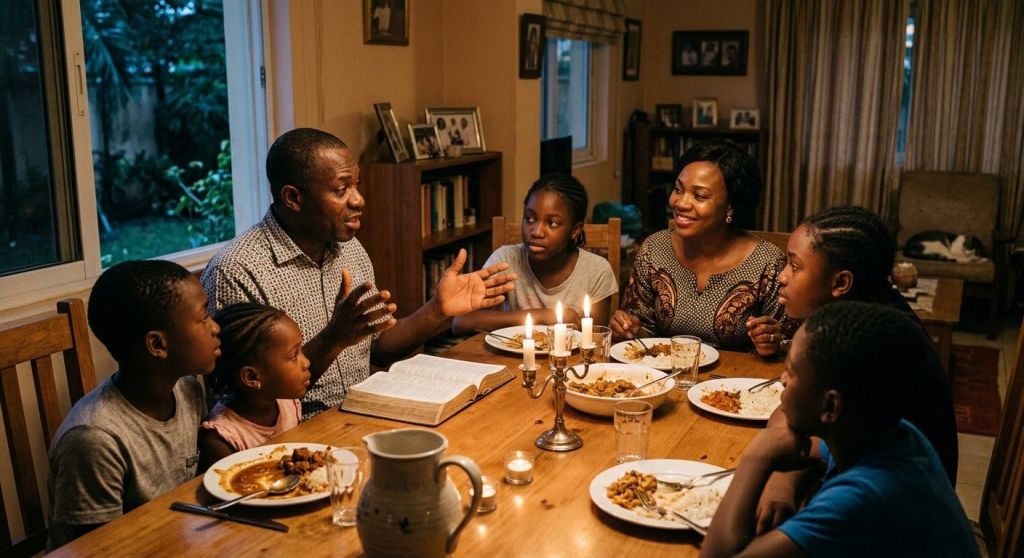
A family gathered around a dinner table at dusk

As the day turned to evening, the dynamic shifted. The meal was finished, and the Lord looked at Abraham and decided to reveal His plans for Sodom and Gomorrah. Why? Because God viewed Abraham as a partner, a friend, and He knew Abraham would teach his children.

The evening is a time for intimacy and transparency. It is when the “table talk” happens.

The Practice:
Don’t let the day end without connecting the dots between life and faith.

  • The Question: Instead of asking, “How was school?” (which yields “Fine”), ask a deeper question: “Where did we see God today?”
  • The Prophetic Role: Like God shared His heart with Abraham, share your heart with your children. Talk about how you saw God provide, how you struggled, and how you prayed. When we share our reflections, we model a living faith, not just a historical religion.

CENTRAL VERSE

“I have chosen him to direct his children…” (Gen 18:19)

This entire model hinges on the phrase “I have chosen him.” The Abraham Parenting Model is not about perfect behavior; it is about direction.

God said Abraham would “direct” his children. The Hebrew word implies a command, a guarding, and a pointing of the way. Abraham didn’t just save his children from the world; he directed them toward the Lord.

You cannot change your children’s hearts, that is the Holy Spirit’s job. But you can set the direction. You can point the car toward the Kingdom every morning, every afternoon, and every evening.

Challenge: Try the Abraham Model for one week.

  1. See God first before looking at a screen.
  2. Serve in your chores as if you were serving the Lord Himself.
  3. Share your reflections on His faithfulness at the dinner table.

He has chosen you to direct your children. Walk in that high calling today.


A Closing Call: Start Your Journey Today

Two hands reaching toward each other with a glowing cross of light

Friend, before you can walk in any of these truths, before you can parent with purpose or lead your home with intention, there is a first step. Every benefit, every promise, and every principle found in Scripture begins with one thing: being born again.

Jesus said in John 3:3, “Unless one is born again, he cannot see the kingdom of God.” Without this foundational experience, the Word of God remains a closed book and its promises remain out of reach. But the moment you surrender your life to Christ, everything changes. You are made new. You are adopted into God’s family. You receive the Holy Spirit as your Teacher, your Comforter, and your Guide.

If you have never taken this step, or if you want to rededicate your life to Him today, say this prayer with me to start your journey:

Heavenly Father, I come to You just as I am. I acknowledge that I am a sinner and that I cannot save myself. I believe that Jesus Christ is Your Son, that He died on the cross for my sins, and that He rose again on the third day. Today, I confess with my mouth that Jesus is Lord and I believe in my heart that God raised Him from the dead. I repent of my sins and I turn away from my old life. I ask You, Lord Jesus, to come into my heart. Be my Savior and my Lord. Fill me with Your Holy Spirit. I am Yours now and forever. Thank You for saving me. In Jesus’ mighty name, Amen.

If you prayed that prayer sincerely, heaven is rejoicing over you right now! You are now a child of God, born again by His Spirit. The same power that raised Christ from the dead now lives in you. Now, the journey begins, a journey of daily walking with Him, discovering His Word, and yes, even parenting according to His perfect model.

Find a Bible-believing church. Get baptized. Surround yourself with other believers. And let the Holy Spirit lead you every step of the way.

Remain Ever Blessed.
Jesus Is Lord.

9 Powerful Prayers for Children, Parents, and Everyone Raising the Next Generation

Nine powerful, Scripture-based prayers for children, parents, teachers, guardians, mentors, and everyone entrusted with raising the next generation in the ways of God.

Raising children in the ways of God is a sacred responsibility. It requires wisdom, patience, discernment, consistency, correction, instruction, and above all, dependence on God.

From training children in God’s Word, to correcting them in love, to ensuring that they are not merely spectators in the faith, and to learning from the wisdom of those who have gone before us, one truth remains: we need God’s help.

“Except the LORD build the house, they labour in vain that build it.”
Psalm 127:1 (KJV)

So, as parents, guardians, teachers, mentors, and everyone entrusted with the responsibility of raising children, let us pray.

1. Prayer for Parents to Receive Wisdom

Scripture: James 1:5

“If any of you lack wisdom, let him ask of God…”

Heavenly Father, give every parent wisdom to raise their children according to Your will. Help us to know when to correct, when to encourage, when to discipline, when to listen, and when to simply embrace our children.

Give us wisdom beyond our years and understanding beyond our natural abilities. Help us not to parent merely according to culture, emotions, or personal experience, but according to Your Word.

May our homes be guided by Your wisdom, and may everything we do produce godly fruit in the lives of our children.

In Jesus’ name, Amen.

2. Prayer for Children to Know God From an Early Age

Scripture: 2 Timothy 3:15

“And that from a child thou hast known the holy scriptures…”

Father, may our children know You from their earliest years.

Let Your Word become familiar to them from childhood. May they grow up hearing Scripture, seeing it demonstrated, praying, worshipping, and learning to love the things that please You.

Let them not merely inherit their parents’ faith as a tradition. May they personally encounter You and develop a genuine relationship with You.

Give them hearts that are sensitive to Your voice and willing to follow Your ways.

In Jesus’ name, Amen.

3. Prayer for Parents to Correct Their Children in Love

Scripture: Proverbs 22:6

“Train up a child in the way he should go…”

Lord, help us never to neglect the responsibility of correction.

Give parents the grace to correct their children when they are wrong, but let our correction be guided by love, wisdom, patience, and Your Word.

Help us to correct without destroying their confidence, discipline without provoking them to anger, and instruct without condemning.

May our children understand that biblical correction is not rejection. Let them see correction as an expression of love and preparation for their future.

Give parents courage to address wrong behaviour today rather than allowing small problems to become greater problems tomorrow.

In Jesus’ name, Amen.

4. Prayer for Children to Choose Godly Friends

Scripture: 1 Corinthians 15:33

“Be not deceived: evil communications corrupt good manners.”

Father, surround our children with godly friendships.

Give them discernment to recognize friendships that will strengthen their faith and wisdom to walk away from relationships that could lead them into disobedience, dishonesty, rebellion, immorality, or destructive habits.

Give them friends who will encourage them to study, pray, obey, grow, and pursue righteousness.

And where our children are already connected to unhealthy influences, give parents the wisdom and courage to intervene appropriately.

Let our children become good influences themselves, shining as lights among their generation.

In Jesus’ name, Amen.

5. Prayer for Parents to Lead by Example

Scripture: Deuteronomy 6:6-7

“And thou shalt teach them diligently unto thy children…”

Father, help us remember that our children are watching more than they are listening.

Help parents to live what they teach.

When we teach honesty, help us to be honest. When we teach forgiveness, help us to forgive. When we teach prayer, let our children see us pray. When we teach the Word, let them see us obey it.

Let our lives become living lessons before our children.

May our children see Christ reflected in our words, our decisions, our relationships, our homes, and even in the way we respond when we make mistakes.

In Jesus’ name, Amen.

6. Prayer for Teachers, Guardians, Mentors, and Caregivers

Scripture: Isaiah 30:20-21

“…yet shall not thy teachers be removed into a corner any more…”

Lord, strengthen every teacher, guardian, mentor, pastor, Sunday school teacher, caregiver, and every person entrusted with influencing the lives of children.

Give them wisdom, patience, discernment, compassion, and understanding.

Help them to recognize that their influence may reach much further than they realize.

Place godly people around our children who will point them toward Christ and reinforce the truths being taught at home.

Raise teachers who will not merely educate children’s minds but will also help shape their character.

May everyone entrusted with raising or teaching children understand the weight and privilege of that responsibility.

In Jesus’ name, Amen.

7. Prayer for Parents to Have a Teachable Spirit

Scripture: Proverbs 1:5

“A wise man will hear, and will increase learning…”

Father, give every parent a humble and teachable heart.

Help us understand that we do not have to learn everything through painful experiences.

Teach us to study Your Word and to learn from faithful men and women whose lives demonstrate the truth they teach.

Give us discernment to recognize sound, biblical counsel and wisdom to reject anything that contradicts Your Word.

As Daniel understood by books, help us also to gain understanding through Scripture and through the proven wisdom You have preserved through others.

May we never become too proud to learn, too busy to read, or too familiar with our own ways to receive instruction.

In Jesus’ name, Amen.

8. Prayer for the Next Generation

Scripture: Psalm 78:4

“We will not hide them from their children, shewing to the generation to come the praises of the LORD…”

Heavenly Father, let the knowledge of You continue from one generation to another.

May the faith we receive not end with us.

Help parents and guardians intentionally pass biblical truth to their children. Let our children know the stories of Your faithfulness, the power of prayer, the importance of obedience, and the beauty of walking with You.

Raise a generation that knows Your Word, loves Your presence, honours godly authority, and boldly lives for Christ.

May our children become carriers of a godly legacy and may their children after them know You even more deeply.

In Jesus’ name, Amen.

9. Prayer for Grace to Finish the Parenting Journey Well

Scripture: Galatians 6:9

“And let us not be weary in well doing: for in due season we shall reap, if we faint not.”

Father, give every parent grace not to become weary.

There will be days when parenting feels difficult. There will be moments when correction seems ineffective, prayers appear unanswered, and the desired harvest seems far away.

Help us not to give up.

Remind us that every prayer, every Scripture taught, every correction given in love, every godly example, and every sacrifice made in obedience to You is a seed.

Help us to remain faithful even when we cannot yet see the harvest.

Let parents trust You with the process and continue faithfully sowing into the lives of their children.

And in Your appointed time, let us see the fruit of the seeds we have planted.

In Jesus’ name, Amen.

A Final Prayer for Every Parent and Child

Father, we commit every child, every parent, every guardian, every teacher, every mentor, and everyone involved in raising the next generation into Your hands.

Give us wisdom where we lack wisdom, strength where we are weak, patience where we are frustrated, courage where we are afraid, and discernment where we are uncertain.

Help us to build homes where Your Word is honoured, prayer is normal, correction is given in love, learning is encouraged, and Christ remains at the centre.

Help us remember that we do not have to start from scratch. Your Word is our foundation, godly teachers are available to guide us, and the testimonies of faithful people can teach us valuable lessons.

Above all, help us to depend completely on You.

May every child grow in wisdom, stature, and favour with God and with people.

May every parent receive grace to fulfil their assignment.

May every teacher and guardian recognize the eternal significance of their influence.

And may the next generation rise to know, love, serve, and honour You.

In the mighty name of Jesus Christ, Amen.


Key Note

Parenting is a responsibility we cannot fulfil effectively without God’s help. Pray for your children. Pray for yourself. Pray for their teachers, guardians, mentors, and everyone influencing their lives. Then continue to teach, correct, guide, learn, and sow God’s Word faithfully.

The seeds we plant today may become tomorrow’s testimony.

I pray that God empowers every parent, every guardian, every teacher, and everyone entrusted with the responsibility of raising children to faithfully train them in the way of the Lord. May He grant us wisdom, discernment, humility, and a teachable spirit as we continue to grow in His truth.

May God help every parent in the mighty name of Jesus.

Grace and peace.

Keep building godly homes, one Scripture at a time.

Remain ever blessed. Jesus is Lord.

Wisdom and Understanding in Godly Parenting: Raising Children God’s Way.

Learn practical, biblical ways to apply wisdom and understanding in godly parenting and raise children according to God’s design.

In a world full of parenting advice, opinions, and endless noise, one truth remains steady and unshaken: God’s way is still the best way.

But here’s the question many parents wrestle with quietly… How do I actually raise my child in a godly way?

The answer is found in two powerful companions that must never be separated: wisdom and understanding. If you’re navigating modern challenges, you may also find this helpful: Raising Godly Children in a Digital Age.

“Wisdom is the principal thing; therefore get wisdom: and with all thy getting get understanding.” — Proverbs 4:7

Wisdom: More Than Knowing—It’s Doing

Wisdom is knowing what to do and actually doing it. It is bringing God’s Word into everyday parenting moments—the noise, the mess, the discipline, and the love.

Knowledge is having a map. Wisdom is walking the road. And sometimes, that journey is shaped by what we say—see The Power of Words in Parenting.

“Wisdom in parenting is intentional obedience to God’s Word.”

Wisdom Makes a Demand

Wisdom calls for action. God does not give wisdom for decoration, but for application.

In parenting, this means choosing consistency, doing what is right even when it is hard, and seeking God daily. This connects closely with raising children through intentional discipleship, not just discipline.

“Do what God says, the way God says it, no matter how you feel.”

“Wisdom is proven by action, not knowledge alone.”

Understanding: The Missing Link

If wisdom tells you what to do, understanding teaches you how to do it.

Understanding helps you apply wisdom correctly, especially when dealing with different children and situations. It also plays a vital role in shaping how children receive correction and guidance.

“Understanding helps you apply wisdom correctly and effectively.”

Putting It Into Practice

  • Teach God’s Word daily
  • Live what you teach
  • Discipline with love
  • Know your child
  • Pray always
  • Be patient
  • Build a godly environment

“Wisdom shows you what to do. Understanding shows you how to do it. Consistency makes it fruitful.”

Related Reading

Continue your journey in godly parenting:

Final Thought

Godly parenting is not about perfection. It is about intentional, daily alignment with God’s Word.

Every small act of wisdom and understanding is a seed planted for a child’s future.

The Prayer Seed Is Never Wasted

A mother prayed over her aggressive son when nothing seemed to change. Months later, transformation came. Discover why the prayer seed sown in the lives of children is never wasted and how Scripture assures parents that God’s Word always bears fruit.

Why Praying Parents Always Win in the End

A friend once shared her heart with me.

Her son had suddenly changed. He became aggressive. Disobedient. Restless. It felt like something had shifted overnight.

She was tired. Concerned. Confused.

I told her something simple:

“Pray. Keep praying. The seed of prayer is never wasted.”

So she did.

She prayed when she saw no change.
She prayed when his behavior seemed worse.
She prayed when discouragement whispered, “It’s not working.”

But something was happening beneath the surface.

Over time, that same boy transformed. His aggression softened. His heart changed. Peace returned.

The Word Is a Seed

Isaiah 55:11 says:

“So shall My word be that goeth forth out of My mouth: it shall not return unto Me void…”

God’s Word is never empty. When spoken in prayer, it becomes a seed planted in the soil of a child’s heart.

Even when we don’t see it sprouting immediately.

Jesus explained this mystery in Mark 4:26–27:

“The kingdom of God is as if a man should cast seed into the ground… and the seed should spring and grow up, he knoweth not how.”

Prayer works underground before it works outward.

Rooted Downward, Bearing Fruit Upward

When you pray Scripture over your child, you are planting:

  • Identity
  • Destiny
  • Spiritual protection
  • Godly character

It may look like nothing is happening.

But seeds do their best work in darkness.

Psalm 126:5 reminds us:

“They that sow in tears shall reap in joy.”

A Word to Every Parent

If your child is aggressive, disobedient, withdrawn, or confused — do not give up.

The seed you sow in prayer is not wasted. It is taking root.

A Short Prayer for Parents

Father, strengthen every weary parent. Let every prayer sown over our children take root. Cause righteousness to spring up. In Jesus’ name, Amen.

A Salvation Call

The first seed every parent must sow is their own surrender to Christ.

If you desire transformation in your home, begin with your heart.

Pray:
“Lord Jesus, I surrender my life to You. Forgive my sins. Teach me to walk in Your Word. Help me raise my children according to Your will. Be Lord over my home. In Jesus’ name, Amen.”

Keep praying. Keep sowing. The prayer seed is never wasted.

Remain Ever Blessed.

Withdrawal Privilege and Godly Parenting: Raising Children with Grace and Boundaries

A father once excused his daughter’s bad habits until they embarrassed him in public. That moment revealed a powerful truth: correction delayed is correction denied. This article explores the Christian principle of withdrawal privilege, a loving, biblical approach to discipline that teaches responsibility, restores respect, and mirrors the way God trains His own children with grace and boundaries.

A Lesson from My Uncle’s Story

I remember once when one of my uncles would always refuse to correct his daughter about slapping adults as a way of playing. Whenever anyone cautioned him, he would shrug it off and say, “She’s just a child.” For a while, it seemed harmless, just innocent fun.

But one day, during a family gathering, that same little girl playfully slapped her father in public. This time, it was no longer funny. He felt deeply embarrassed. Sadly, it was too late to correct her in that moment, because what he had once excused had now become her habit.

That experience taught me something vital: correction delayed is correction denied. In our effort to be loving and gentle, we sometimes forget that godly love includes discipline. Parenting is not only about showing affection, it’s also about guiding behavior with firmness and grace.

“Love without correction breeds destruction; correction without love breeds rebellion.”

Understanding Withdrawal Privilege

In Christian parenting, withdrawal privilege means temporarily removing certain benefits or freedoms when a child disobeys or fails to take responsibility. It’s not done in anger, but as a gentle lesson in accountability and growth.

For example, if a teenager neglects their homework, they may lose screen time until they complete it. If a younger child disrespects instructions, they might lose playtime or a favorite treat. The goal isn’t to hurt them, but to help them understand that privileges are earned through responsibility, just as blessings often follow obedience in our relationship with God.

A beautiful example is seen in Jesus’ early life. When He stayed behind in the temple at age twelve (Luke 2:41–52), His parents, Joseph and Mary, were worried and searched for Him for three days. When they finally found Him, Mary lovingly corrected Him, saying,

“Son, why have You done this to us? Look, Your father and I have sought You anxiously.” — Luke 2:48 (NKJV)

Jesus’ response was respectful, yet Scripture notes something significant afterward:

“Then He went down with them and came to Nazareth, and was subject to them.” — Luke 2:51

That gentle correction restored understanding and order. The Bible never recorded Him repeating such an act. It shows us that even in love, parents must teach boundaries, and that loving correction can prevent future errors.

The Biblical Foundation for Discipline

In the Bible, discipline means doing what is right, not what we like. It’s not about punishment but about training, helping children build habits that please God and strengthen character.

“For whom the Lord loves He disciplines, and He scourges every son whom He receives.” — Hebrews 12:6 (NKJV)

God’s discipline is an expression of love, not rejection. Sometimes, He allows us to experience the consequences of our actions so we can grow in wisdom. When we drift from His will, He may withhold certain blessings, not out of anger, but to draw us back to the right path.

Think of the Prodigal Son (Luke 15:11–24). The father allowed his son to leave and experience the loss of privileges that came with rebellion. Yet, when the son repented, the father restored him completely. That’s divine discipline, correction with the goal of restoration.

The Purpose Behind Withdrawing Privileges

Every act of godly discipline should aim to heal, not to hurt. When parents withdraw privileges, it should be done prayerfully, with a heart focused on growth, not frustration.

Withdrawal of privileges teaches:

  • Responsibility: Children learn that actions have consequences.
  • Respect: They begin to honor rules and authority.
  • Restoration: They realize that obedience restores lost privileges, just as repentance restores relationship with God.

“Withdrawal privilege should never say ‘You’re unloved,’ but ‘I love you too much to let you continue in this behavior.’”

Practical Ways to Apply Withdrawal Privilege (with Scripture)

1. Be Clear and Consistent — Proverbs 29:15

“The rod and rebuke give wisdom, but a child left to himself brings shame to his mother.”

Children thrive when expectations are clear. Define rules and link them to privileges. For instance: “If you complete your homework, you can watch your favorite show. If not, that privilege will be paused.” Consistency helps children understand that obedience brings reward, and disobedience brings consequence.

2. Stay Calm and Prayerful — James 1:19–20

“Everyone should be quick to listen, slow to speak and slow to become angry, because human anger does not produce the righteousness that God desires.”

Parenting under pressure can test your patience. But correction done in anger can damage trust. Before reacting, take a moment to pray. Ask the Holy Spirit for peace and self-control. Let your discipline reflect God’s calm firmness, not human frustration.

3. Communicate with Love — Proverbs 15:1

“A gentle answer turns away wrath, but a harsh word stirs up anger.”

After withdrawing a privilege, explain why it happened. Let your child understand the connection between their action and the consequence. Always reassure them of your love: “I’m correcting you because I love you, and I want you to learn what’s right.” This builds security, not resentment.

4. Restore Gracefully — Galatians 6:1

“Brothers and sisters, if someone is caught in a sin, you who live by the Spirit should restore that person gently.”

When your child takes responsibility or shows repentance, restore their privilege with warmth. Celebrate their growth. Just as God restores us when we turn back to Him, let restoration be a moment of joy and encouragement, not pride or guilt.

Balancing Grace and Discipline

Godly parenting means balancing grace and truth. Too much leniency can lead to entitlement; too much harshness can lead to rebellion.

“Fathers, do not provoke your children to wrath, but bring them up in the training and admonition of the Lord.” — Ephesians 6:4

Parenting isn’t about control, it’s about cultivating character. The goal is not perfection but partnership with God in shaping hearts. Each child is unique, so rely on the Holy Spirit for wisdom on when and how to apply discipline.

“God never withdraws His love, even when He withdraws a privilege.”

A Call to Godly Parents

Parenting will always stretch our patience, wisdom, and humility. But as we mirror God’s nature, firm in truth, rich in mercy, steadfast in love, we reflect His heart to our children.

When correction is guided by love, it strengthens relationship, not weakens it. Withdrawal privilege, when done rightly, becomes a bridge to maturity, not a barrier to connection.

A Short Prayer for Parents

Heavenly Father, thank You for the gift of parenting. Teach us to correct our children with wisdom and love. Help us to reflect Your nature in discipline, firm yet full of grace. May our homes be places of learning, joy, and righteousness. In Jesus’ name, Amen.

Final Thoughts

Parenting is one of the most sacred ministries on earth. As we guide our children, let us remember: discipline is not rejection, it’s redirection. And just as God lovingly shapes us, so we are called to shape our children with patience, purpose, and prayer.

Is Your Parenting Manual Alive or Collecting Dust?

We fill our shelves with books. We save countless Instagram posts. We search for the perfect method, the one key that will unlock peaceful, effective, and godly parenting.

But what if the most powerful parenting guide wasn’t a static set of rules, but a living, breathing source of wisdom that adapts to every unique challenge?

The writer of Hebrews gives us a breathtaking description of the tool we often overlook:

“For the word of God is alive and active. Sharper than any double-edged sword, it penetrates even to dividing soul and spirit, joints and marrow; it judges the thoughts and attitudes of the heart.” – Hebrews 4:12 (NIV)

A sharp double-edged sword made of light, point down, cleanly dividing a dark, chaotic scribble from a bright, ordered pattern.

This isn’t a description of a dusty reference book. This is the profile of the ultimate parenting resource.

Why a “Living” Word Makes All the Difference

Unlike any best-selling parenting book, God’s Word possesses three dynamic qualities that make it uniquely suited for the complex task of raising children.

  1. It’s ALIVE: The Personalized Parenting Guide

A printed book gives the same advice to every reader. But God’s Word is alive. It breathes fresh, specific wisdom for your child, in your situation, at this exact moment.

· When you’re facing a tantrum, it can bring to mind the perfect verse about patience (Ephesians 4:2).
· When your child lies, it can guide you to a story about honesty (Acts 5:1-11) and the restoration that follows confession.
· When you feel inadequate, it whispers the promise that His grace is sufficient (2 Corinthians 12:9).

It doesn’t offer a one-size-fits-all solution because it knows the unique heart of your child, and you.

  1. It’s ACTIVE: The Heart-Transforming Agent

Human parenting strategies often focus on modifying outward behavior. God’s Word goes deeper. It is active, meaning it doesn’t just inform; it transforms from the inside out.

It works in your child’s spirit long after you’ve closed the Bible. A simple verse about kindness, planted in their heart during a calm moment, can become the Holy Spirit’s tool to convict them after they’ve been cruel to a sibling. It does the work we cannot.

  1. It’s SURGICALLY PRECISE: The Ultimate Diagnostic Tool

Parenting often involves guessing: “Is this a willful spirit or a wounded soul? Is this a phase or a character issue?”

The Word of God is “sharper than any double-edged sword.” It performs spiritual surgery, precisely dividing soul (the mind, will, and emotions) from spirit (the part that connects with God). It can judge the “thoughts and attitudes of the heart,” revealing the true root of the behavior, whether it’s fear, pride, or a simple need for connection.

Your Move: From Static Strategies to Dynamic Truth

So, how do we trade our dependence on static methods for this dynamic resource?

Your challenge is simple but powerful: The Next-Time Principle.

"A parent's hand resting on a child's shoulder, with a subtle, soft glow connecting them.

The next time you face a parenting struggle, defiance, back-talk, fear, sibling rivalry, make a conscious choice.

  1. Pause before you react.
  2. Trade 10 minutes of frantic scrolling for 5 minutes in Scripture.
  3. Ask: “Holy Spirit, what truth from Your Word applies to this situation?”

Open the Bible, use a concordance, or search a keyword in a Bible app. Look for a story, a proverb, or a teaching of Jesus that speaks to the heart of the matter.

The Promise of the Living Word

Your role as a godly parent is not to have all the answers. It is to be the faithful assistant to the Great Physician, handing Him the one tool, His Word, that can perform the heart-level surgery your child needs.

Stop relying on manuals that collect dust. Start leaning on the Word that is alive, active, and sharper than any tool you will ever own. It is fully equipped to handle any situation, for it is the very voice of the One who created your child’s heart.


Let’s Connect:
What’s ONE situation where you need the’alive and active’ power of God’s Word this week?

Share in the comments on my latest LinkedIn post, let’s cover each other’s children in prayer.

#LivingWord #GodlyParenting #Hebrews412 #FaithBasedFamily

Design a site like this with WordPress.com
Get started