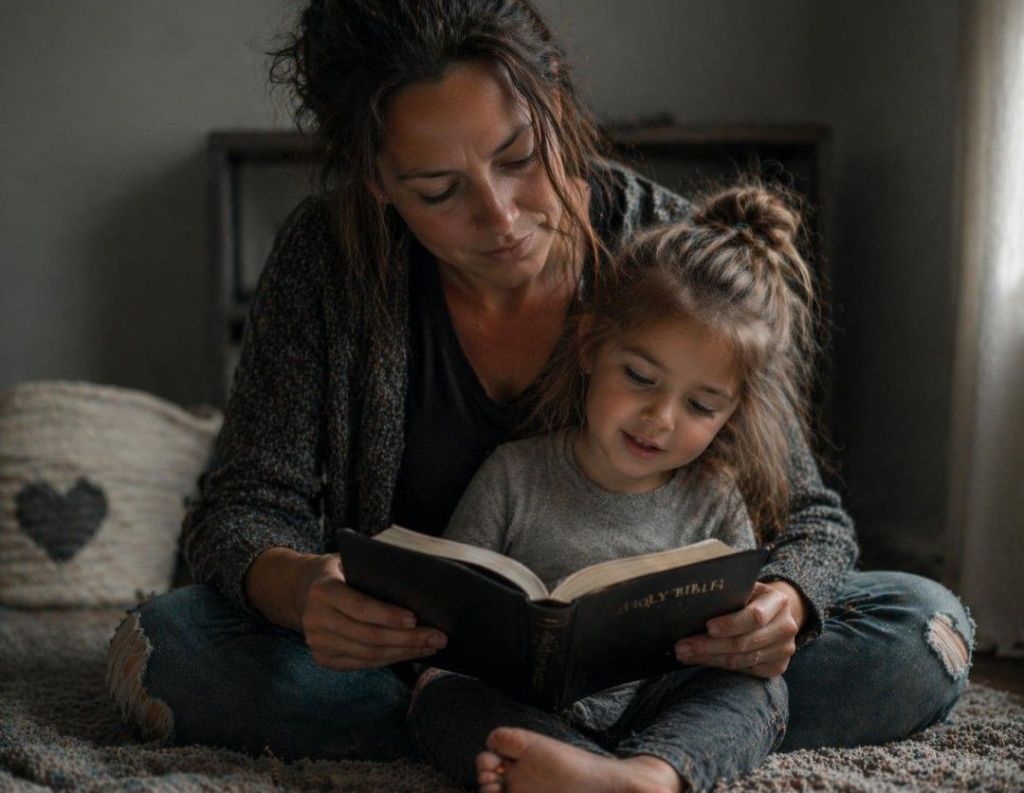
Is well-behaved the goal? Insights from Dr. Brian Cosby on raising covenant children and making your home a witness for Christ.
Most of us want well-behaved kids. But is that the goal?
In Colossians 3:18–4:1, Paul moves from who we are in Christ to how we live for Christ, and he starts with the household. It’s easy to miss how significant that is. Christians sometimes borrow family advice from the culture around us, then add “in Jesus’ name” on top. Paul isn’t doing that. Faith isn’t a coat of paint on ordinary parenting. It changes the foundation.
Dr. Brian Cosby, senior minister at Wayside Presbyterian Church in Signal Mountain, Tennessee, explores this in his essay Godly Parenting as a Witness to the World. A few of his thoughts stayed with me.
We’re raising covenant children
Our kids aren’t just future adults who need to succeed. They belong to God’s story, and our parenting has a purpose beyond getting through the day.
It’s daily, not occasional
Deuteronomy 6 describes teaching God’s Word when we sit at home, when we walk, when we lie down and when we rise. Faith gets passed on in ordinary moments, not only on Sundays.
Discipline and instruction go together
Ephesians 6:4 warns fathers not to provoke their children, but to raise them in the Lord’s discipline and instruction. Correction without teaching crushes. Teaching without correction leaves gaps. Children need both, wrapped in grace.
Our homes are a witness
According to Cosby, when parents raise children God’s way, the watching world sees something about God’s truth, love and wisdom. Christ is Lord of heaven and earth, so He is Lord of our homes too.
If you’re feeling the weight of it all, take heart. Cosby points to Philippians 1:6: the God who began a good work in our children will carry it on to completion. We rely on His grace, not our perfection.
A question for you this week: Where could you weave God’s Word into an ordinary moment with your child?
Remember, every grace for parenting begins with the experience of the new birth. You cannot pour out what you have not received. Pray with me:
Father, I take personal responsibility for the home You have entrusted to me. I cannot raise my children in my own strength. Forgive me where I have been careless, impatient or prayerless. Give me grace to teach Your Word daily, to correct with love, and to model Christ before my children. Let my home bear witness to Your truth. In Jesus’ name, Amen.
Prayer of Salvation
If you have never given your life to Christ, or you are not sure where you stand with God, you can begin right now. Pray this from your heart:
Lord Jesus, I come to You as a sinner. I believe You died for my sins and rose again on the third day. I repent and turn from my sins. Come into my heart, be my Lord and Savior, and make me a new creation. Thank You for saving me. In Jesus’ name, Amen.
If you prayed that prayer sincerely, welcome to the family of God! Find a Bible-believing church and begin to grow in His Word.
Tired of the nagging child and the weight of parenting? Don’t give in yet. Discover why steadfast stewardship, backed by Proverbs 22:6, brings a reward now and after.
Are you tired of that nagging child?
Does the weight of parenting feel so heavy that it seems to crush you to your knees? Does it seem as if your struggles are peculiar to you alone? Are you worn down by the endless cycles of your child’s rebellion, and by the midnight hours spent on the altar of prayer and searching the Scriptures?
Tired looking mother kneeling in prayer beside a bed at night
If that’s you, I have good news today: don’t give in yet. Tarry a little longer. (1 Corinthians 9:24-25; Habakkuk 2:3)
Pull up a chair, because today we’re talking about stewardship and steadfastness in godly parenting.
First, what do these words mean?
Understanding the terms will give us clarity.
Steadfastness means being firm, resolute, and unyielding, staying loyal to a course, a belief, or a person without compromise.
Stewardship means being a servant, someone who serves the interest of another.
Put them together and you get a parent who trusts, receives, and believes what Scripture teaches about parenting, then puts it to work without compromise. (James 1:22-25; Genesis 18:19)
Proverbs 22:6 is a commandment, not a suggestion
Let me say this plainly. Proverbs 22:6 is a commandment to every believer, whether you’re a practising parent or still finding your feet. It isn’t an option, a tip, or a piece of advice. It’s a priority, and it must be obeyed if we want to raise godly children who will carry the banner of Christ tomorrow.
And because it’s a priority, we are called to be steadfast in our stewardship. In fact, where our steadfastness stops is where our stewardship stops. (Matthew 24:45-47)
The mark of a steadfast steward: endurance
A thousand small checkmarks. One quiet yes after another.
Scripture calls us to endure hardness (2 Timothy 2:3). Endurance is:
the ability to keep doing something difficult for a long time to reach a goal;
the ability to bear discomfort and suffering over the long haul for that goal;
the discipline of keeping your body under subjection again and again, which is self-denial (1 Corinthians 9:24-25);
refusing to faint while doing the work of God.
Your labour is not in vain
Here is the encouraging part. Every steadfast parental steward has a two-way reward, now and hereafter. (Habakkuk 2:3; Luke 18:28-30)
What you’re going through is training with purpose, not suffering without meaning, and the reward far outweighs the labour. So let’s stay unmovable in our duties, serving with joy and delight as unto the Lord. God didn’t give us children to stress us or burden us. He gave them to bless us.
Pray for grace to be a steadfast steward of the children God has placed in your hands. (Hebrews 4:16)
Where it all begins
Salvation is the first step to becoming a steadfast steward. If you’ve never given your life to Christ, or you want to renew your commitment, pray this with me:
Dear Heavenly Father, I come to You today. I know I am a sinner, and I acknowledge my sins. I believe You died for me and rose again on the third day to cleanse me from sin and from the power of Satan. Please come into my heart and life. I want You to be my Lord and Savior, and I want to serve You as my Lord and Savior. Amen.
Let’s talk
What has been the hardest part of staying steadfast in your parenting? Share it in the comments, and let’s encourage one another.
Godly parenting requires more than good intentions. Are we willing to sacrifice our comfort, obey God’s Word, and become the parents He wants us to be? Discover the responsibility, cost, and grace of raising children in God’s ways.
Scripture Text: Matthew 20:20–22 (KJV)
There was a time when the mother of James and John came to Jesus with a request concerning her sons. She desired places of honor for them in His kingdom. But Jesus turned the conversation toward a question of readiness and sacrifice: “Are ye able to drink of the cup that I shall drink of?” (Matthew 20:22, KJV).
She desired a glorious future for her children, but Jesus drew attention to the price associated with that future. This raises an important question for every parent who desires to see their children fulfil God’s purpose: Are ye able?
Are we willing to pay the price required to raise our children according to God’s Word? Are we prepared to make the sacrifices necessary to nurture their faith, shape their character, and guide them in the way of the Lord?
Godly Parenting Is a Divine Assignment
Parenting is more than giving birth, providing food, paying school fees, or securing a comfortable future for our children. It is a divine responsibility entrusted to us by God.
Consider what God said about Abraham:
“For I know him, that he will command his children and his household after him, and they shall keep the way of the LORD, to do justice and judgment…”
Genesis 18:19 (KJV)
God had confidence that Abraham would take responsibility for directing his household in His ways. Abraham was not merely expected to desire that his children follow God; he was expected to lead them.
Likewise, godly parenting requires more than wishing our children would grow up to love God. It requires intentional teaching, godly example, prayer, correction, and consistent guidance.
In Judges 13:8, Manoah prayed to God for instruction on how to raise the son who would be born to him. His prayer reminds us that parents do not have to depend on their own understanding. We can ask God to teach us how to fulfil the responsibility He has entrusted to us.
The Greatest Challenge May Not Be the Child, but the Parent
In reaching out to children and teaching them the Word of God, one of the challenges that can emerge is the influence of the home environment. A child may hear the truth in a lesson, learn a Bible verse, and understand the importance of godly character, only to return home to an environment that contradicts what was taught.
When children hear us teach patience but regularly see us act in anger, or learn about prayer while never seeing us make room for God, our example may weaken the message our words are meant to communicate.
This is why parents must examine themselves. We cannot consistently give what we have refused to receive, learn, or practise. If we want our children to love the Word of God, we must be willing to grow in it ourselves.
This does not mean parents must be perfect before they can teach their children. It means we must be honest enough to keep learning, humble enough to correct our own mistakes, and willing to practise the truth we teach.
We may desire children who become leaders, pathfinders, solution-builders, and shining lights in their generation. But what are we doing today to prepare them for that future? Their upbringing cannot be left to chance while we assume that good intentions alone will produce godly results.
The Price of Godly Parenting Is Dying to Self
Jesus said:
“If any man serve me, let him follow me…”
John 12:26 (KJV)
And in John 12:24, Jesus uses the picture of a grain of wheat that must fall into the ground and die before it brings forth much fruit. This principle helps us understand an important part of parenting: fruitful parenting often requires us to surrender some of our personal comfort and convenience.
Dying to self does not mean neglecting our well-being or losing our identity. It means refusing to let selfishness rule our decisions when God has entrusted us with the care and spiritual development of our children.
Sometimes, the price may mean waking up earlier to pray with our children instead of sleeping a little longer. It may mean putting down our phones to listen to their questions, studying Scripture so we can teach them, or patiently correcting them when we would rather avoid the inconvenience.
It may also mean changing habits, apologizing when we are wrong, and choosing a godly response when our emotions urge us in another direction.
Jesus said, “If ye love me, keep my commandments” (John 14:15, KJV). Love for God must find expression in obedience. If we love God and desire to raise our children in His ways, we must be willing to follow His instructions, even when obedience costs us something.
Children are a heritage from the Lord (Psalm 127:3). They are not interruptions to the life we want to live; they are a sacred responsibility within the life God has entrusted to us. We must therefore be careful not to protect our leisure at the expense of the attention, guidance, and spiritual care they need.
God Has Given the Assignment, and He Will Help Us Fulfil It
The question “Are ye able?” is not meant to leave parents discouraged or afraid. It is an invitation to examine our willingness and turn to God for the grace to fulfil our responsibility.
God does not expect us to rely entirely on our own strength. He invites us to seek His wisdom, follow His Word, and depend on His help. As Manoah prayed for guidance concerning his son, we too can ask God to show us what our children need at each stage of their lives.
Proverbs 22:6 instructs us to train up a child in the way he should go. Training requires intention and consistency. It means teaching, modelling, correcting, encouraging, and creating opportunities for our children to know and follow God.
If you did not grow up with a strong foundation in the Word of God, do not conclude that it is too late to begin. You can start learning now. You can grow alongside your children, establish new family habits, and allow God’s Word to reshape your home. God is able to equip those who sincerely answer His call.
We may not always know what to do next, but we can seek God daily and obey the light He gives us. We do not need to have every answer before we begin; we need a willing heart that is ready to learn and act.
Conclusion: Are Ye Able?
Every parent may desire to see their children excel, fulfil their purpose, and become a blessing to their generation. But godly parenting calls us beyond desire into responsibility.
Are we willing to make time for prayer, the Word, meaningful conversations, loving correction, and godly example? Are we willing to examine our own lives and allow God to change us as we guide our children?
We do not have to be flawless parents, but we must be willing parents: willing to learn, willing to obey, willing to sacrifice, and willing to depend on God.
So, as we dream of what our children may become, let us also consider what God is asking us to become for their sake.
Are ye able?
A Prayer of Salvation
If you have not yet surrendered your life to Jesus Christ, you can begin today by turning to Him in faith. The greatest gift we can share with our children is a life that belongs to the Lord.
Pray sincerely:
Heavenly Father, I come to You in the name of Jesus Christ. I confess that I am a sinner and need Your forgiveness. I believe that Jesus died for my sins and rose again. I repent of my sins and receive Jesus Christ as my Lord and Savior. Please forgive me, give me a new heart, and help me to live according to Your Word. Thank You for saving me. In Jesus Christ’s name, Amen.
A Prayer for Parents
Heavenly Father, thank You for the precious gift of our children. Grant us the grace and strength to fulfil our responsibility of raising them in Your ways. Help us to become the parents You want us to be and to lead our children by both our words and our examples.
In the name of Jesus the Christ, Amen.
Keep building godly homes, one Scripture at a time. Jesus Is Lord.
A house falls without a foundation, and so does parenting without God’s Word. See how Timothy, Samuel, and Daniel were raised on the rock, and how you can build the same foundation at home this week.
“For no one can lay any foundation other than the one already laid, which is Jesus Christ.” 1 Corinthians 3:11
Jesus Himself told us what happens when storms hit a home:
“Therefore everyone who hears these words of mine and puts them into practice is like a wise man who built his house on the rock. The rain came down, the streams rose, and the winds blew and beat against that house; yet it did not fall, because it had its foundation on the rock.” Matthew 7:24-25
The storms will come to every family. What decides whether the house stands is what it was built on. When we build on Scripture and put it into practice, we raise Timothys, Samuels, and Daniels. Here’s what that looks like:
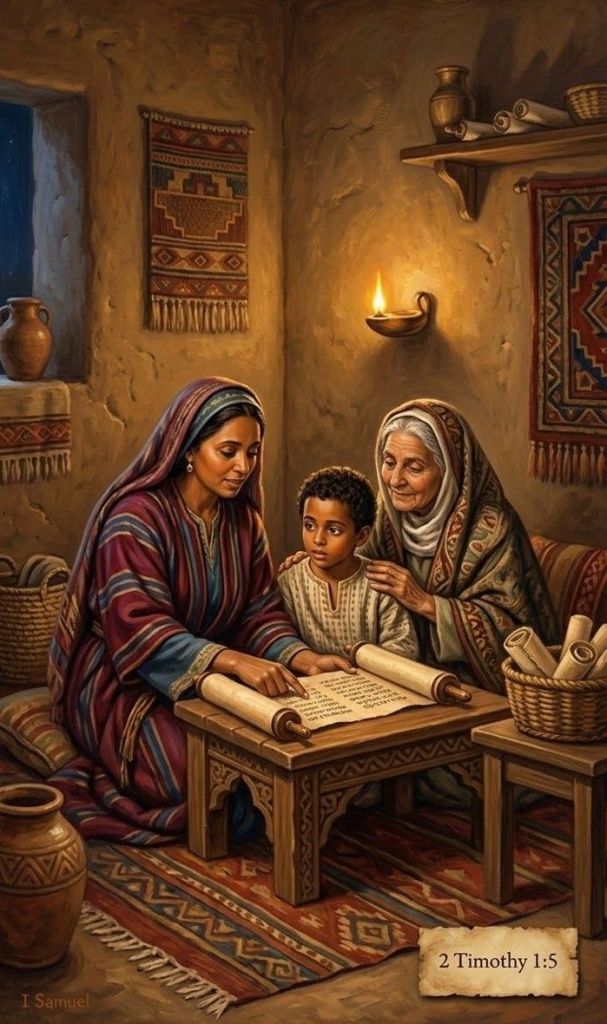
1. TIMOTHY: Raised on Scripture From Childhood “From infancy you have known the Holy Scriptures, which are able to make you wise for salvation.” 2 Timothy 3:15
Young boy Timothy sitting with his grandmother Lois and mother Eunice
His Foundation: · Lois & Eunice (2 Tim. 1:5) filled his early years with God’s Word · Outcome: He grew into Paul’s trusted partner in ministry
2. SAMUEL: Taught to Listen for God “Speak, Lord, for Your servant is listening.” 1 Samuel 3:10
Young boy Samuel lying in the temple at night, light shining down
His Foundation: · Hannah gave him to God (1 Sam. 1:28) · Eli showed him how to answer God’s call · Outcome: He led Israel with integrity
3. DANIEL: Steady in a Hostile Culture “Daniel resolved not to defile himself with the royal food and wine.” Daniel 1:8
Daniel standing firm at the king’s table in Babylon, pushing away royal food and wine
His Foundation: · His parents rooted him in God’s commands (Deut. 6:7) · Outcome: He held his ground in Babylon’s palace
Timothy, Samuel, and Daniel all stood firm because someone built on the rock, not the sand. The storms will come, but the home built on Christ will stand.
This Week’s Challenge: · Morning: Read a verse about who God is · Mealtime: Tell a story about a hero of the Bible · Bedtime: Pray a promise from Scripture over your child
A Prayer for Your Home: Lord, be the foundation of our family. Help us hear Your Word and put it into practice, so that when the storms come, our house stands on You. Amen.
Of these three examples (Timothy, Samuel, or Daniel), which speaks to you most, and why?
(I’ll start: Timothy’s story pushes me to be more intentional.)
Passing the Faith On: Guiding Your Child Toward God in a Screen-Filled World
“But Jesus said, ‘Let the little children come to Me, and do not forbid them; for of such is the kingdom of heaven.'” (Matthew 19:14)
Jesus had a special place in His heart for children. When His disciples tried to keep them away, He corrected the disciples and welcomed the children. He then taught that the kingdom of God belongs to those who receive it with a child’s simple faith (Mark 10:14-15).
Children are a precious gift from God, and also a responsibility. Speaking of Abraham, God said:
“For I have known him, in order that he may command his children and his household after him, that they keep the way of the Lord.” (Genesis 18:19)
Godly parenting is more than providing food, clothing, education, and opportunity. These matter, but a child’s spiritual development must never be an afterthought.
The 21st-Century Child Needs Spiritual Guidance
Parents rightly want their children to excel academically, thrive socially, stay healthy, and be equipped for a fast-changing world. Yet in pursuing these goals, we can easily neglect the most important one: a living relationship with God.
Today’s children have unprecedented access to information, entertainment, games, and social media. Technology is not the enemy. It can be a powerful tool for spreading the gospel. The challenge is to keep it from replacing God or consuming the attention that belongs to Him.
Scripture gives us real hope:
“A posterity shall serve Him. It will be recounted of the Lord to the next generation.” (Psalm 22:30)
“All your children shall be taught by the Lord, and great shall be the peace of your children.” (Isaiah 54:13)
But hope calls for partnership. “Train up a child in the way he should go, and when he is old he will not depart from it” (Proverbs 22:6). Training takes intentionality. Faith is not automatic just because a child is born into a Christian home. Children must see, hear, experience, and learn the ways of God.
Five Ways to Guide Your Child Toward God
1. Use technology to make God’s Word accessible.
Bible apps, worship music, age-appropriate Christian videos, podcasts, and educational resources can meet children where they live. Instead of only telling them to avoid technology, teach them to use it wisely and with purpose.
2. Teach them God’s Word at home.
God’s instruction to Israel is a model for every household:
“You shall teach them diligently to your children, and shall talk of them when you sit in your house, when you walk by the way, when you lie down, and when you rise up… You shall write them on the doorposts of your house and on your gates.” (Deuteronomy 6:7-9)
Scripture was to fill the home, visibly and audibly, from morning to night. Faith cannot be confined to Sunday services or children’s church. Talk to your children about God. Answer their questions, including the hard ones. Read the Bible together. Let them see you pray, forgive, serve, and worship.
The home is the foundation and the filter for a child’s choices. What is built there stays for many years.
3. Pray for them.
Parents cannot control every influence their children will meet, but they can bring them before God continually. Pray for their character, friendships, decisions, education, emotional wellbeing, spiritual growth, and future. The Bible says, “Pray without ceasing” (1 Thessalonians 5:17). And when you lack wisdom for the task, remember the promise: “If any of you lacks wisdom, let him ask of God, who gives to all liberally and without reproach, and it will be given to him” (James 1:5).
Prayer does not replace responsible parenting. It expresses our dependence on God.
4. Involve children in God’s work.
Give children opportunities to serve, give, worship, help those in need, and take part in age-appropriate outreach. When they see themselves as part of God’s work, faith becomes something they live, not merely something they learn.
5. Depend on the Holy Spirit.
No parent can produce faith in a child’s heart by technique or effort. Jesus promised that the Holy Spirit “will teach you all things” (John 14:26) and “guide you into all truth” (John 16:13). Invite Him into your home, your teaching, and your parenting decisions. He can reach your child in places you cannot.
Let Us Raise a Godly Generation
The 21st-century child faces pressures earlier generations did not face in the same way. But the answer is not fear. It is intentional, Christ-centered parenting.
We must not surrender our children to the culture, the internet, or peer pressure. Neither should we raise them in isolation from the world. We equip them with biblical truth, wisdom, discernment, and a genuine relationship with Christ.
Our children are not only the next generation. They are a generation that needs our investment today. Let us teach them, listen to them, model Christ before them, and pray for them. Let us build homes where they can encounter the love and truth of God.
The responsibility of raising godly children belongs to all of us. Let us arise, take our place, stand in the gap, and faithfully nurture the children God has entrusted to us.
If you are not sure you have a relationship with Christ, the final section of Part 2 is for you.
Passing on the faith is more than teaching verses. It is also about the atmosphere of the home. In Part 2, we look at how our words and attitudes shape the hearts of our children and spouses.
Apps update, AI evolves, and technology never stops changing. But God’s Word stands forever. Godly parenting isn’t software to install. It’s a manual for living.
Introduction: A Changing World, an Unchanging Word
Every few weeks, our phones ask us to update. New apps replace old ones. Software that felt cutting-edge last year is outdated today. Artificial intelligence is reshaping how we work, learn, and communicate, and our children are growing up in the middle of it all. Parents can feel as though they’re always a step behind.
In a world that never stops changing, it is tempting to think parenting must be reinvented with every new trend, device, and platform.
But some things do not change.
“The grass withers, the flower fades, but the word of our God stands forever.”
“Jesus Christ is the same yesterday, today, and forever.”
The technology our children use will keep evolving. The God they need will not. His truth was sufficient for the parents of every past generation, and it is sufficient for us.
Godly parenting is not software to be installed. There is no download, no upgrade, no quick fix. It is a manual for living, drawn from a Word that is living and active, and it is worked out daily through prayer, example, patience, and love.
“All Scripture is given by inspiration of God, and is profitable for doctrine, for reproof, for correction, for instruction in righteousness, that the man of God may be complete, thoroughly equipped for every good work.”
His Word is enough for His work.
In this series, we will look at how to pass the faith on in a screen-filled world, and how to build homes where children and spouses feel safe, valued, and loved. The tools around us will change, but the foundation will not.
Genesis 18 holds one of Scripture’s most overlooked parenting models — not a list of rules, but a rhythm. Discover how Abraham’s morning watch, daytime service, and evening honesty with his family offer a simple, three-part pattern for directing your children toward God every single day.
We often look to the Proverbs for parenting advice, or to the epistles of Paul for household instructions. But tucked away in the narrative of Genesis 18 is one of the most profound models for parenting in all of Scripture. It is a model built not on rules, but on rhythm.
In this chapter, we find Abraham sitting at the door of his tent. He is not just hosting guests; he is modeling a lifestyle of faith that is meant to be replicated by his children. God Himself acknowledges this in verse 19: “For I have chosen him, so that he will direct his children and his household after him to keep the way of the Lord by doing what is right and just.”
Here is how we can apply the Abraham Parenting Model to our daily lives.
MORNING: “SEE God First”
“I saw the Lord at my tent door” (v.2)
A father sitting at the entrance of a tent at sunrise
Abraham’s day began with availability. He was sitting at the entrance of his tent, the threshold between his private sanctuary and the public world. He was watching. He was waiting. Before the heat of the day hit, before the tasks of the day piled up, he saw the Lord.
In our modern age, the “tent door” of our morning is usually a glowing screen. The first thing we see is usually an email, a headline, or a social media feed. This sets our internal compass for the day.
The Practice: To parent like Abraham, we must establish a morning boundary. Before the world rushes in, we must look out for the Lord.
Scripture First: Aim for 5 minutes of Scripture before you check your phone. This doesn’t require a seminary degree, just a verse.
The Handoff: As parents, we set the spiritual temperature of the home. If our children see us prioritizing God in the morning, they learn that God is the source of our day, not just a Sunday accessory.
DAYTIME: “SERVE as Worship”
“Abraham hurried to prepare bread” (v.6)
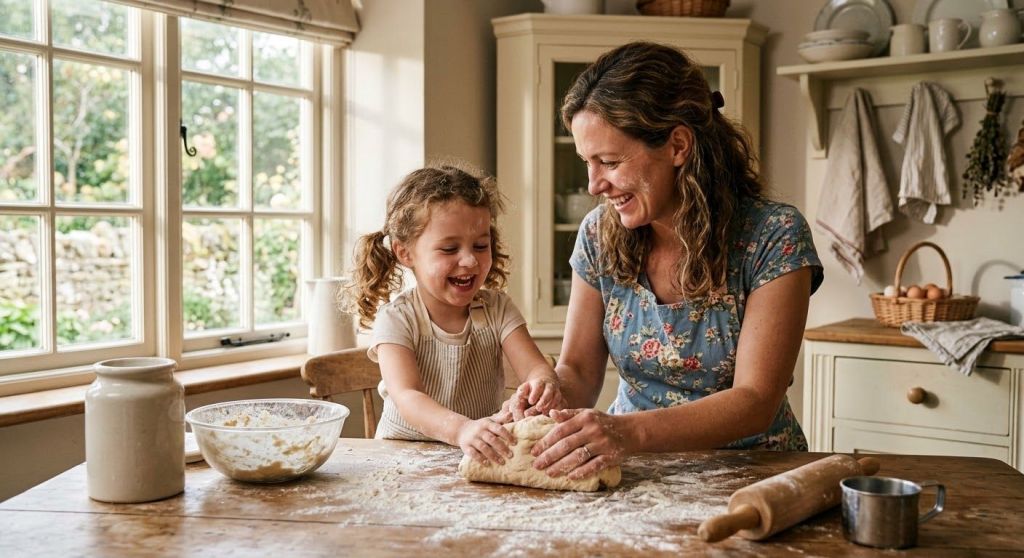
A mother and child baking bread together in a rustic kitchen
When the visitors arrived, Abraham didn’t just point them to the kitchen. He ran. He hurried. He involved his household in the preparation. He told Sarah to bake bread, and he ran to the herd to select a calf. This was messy, physical, and mundane work.
Yet, in this moment, making a meal was a sacred act. Abraham was entertaining angels (and the Lord Himself) without knowing it.
The Practice: Parenting is largely made up of repetitive, mundane tasks. Laundry, dishes, homework, and taxi driving can feel like a distraction from “spiritual” things. But the Abrahamic model turns the mundane into the divine.
Turn Chores into Holy Work: When you cook, cook for the glory of God. When you fold laundry, pray for the person who wears the clothes.
Model Service: Let your children see you serving your spouse, your neighbors, and your church with the same “hurry” and enthusiasm Abraham showed. As Colossians 3:23 says, “Whatever you do, work at it with all your heart, as working for the Lord.”
EVENING: “SHARE Reflections”
“Shall I hide from Abraham what I do?” (v.17)
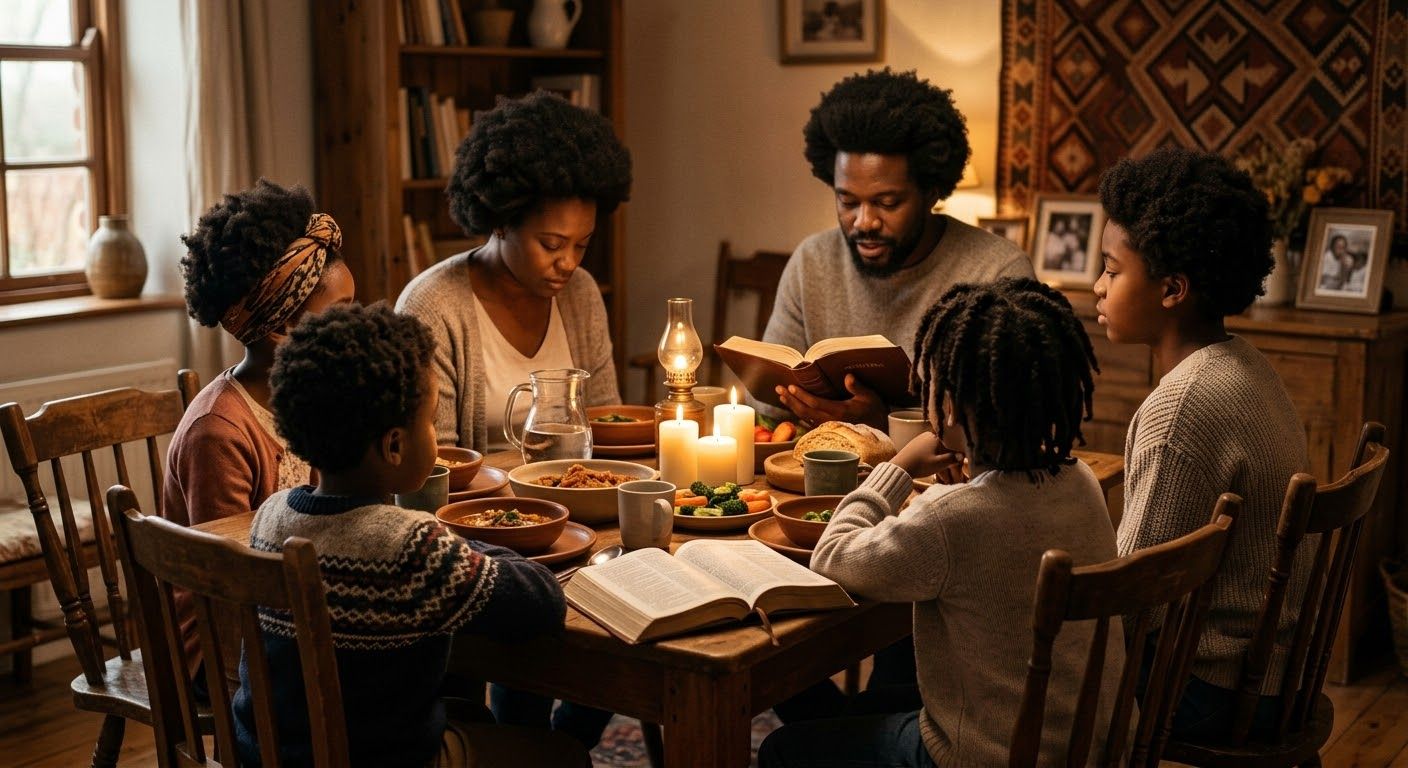
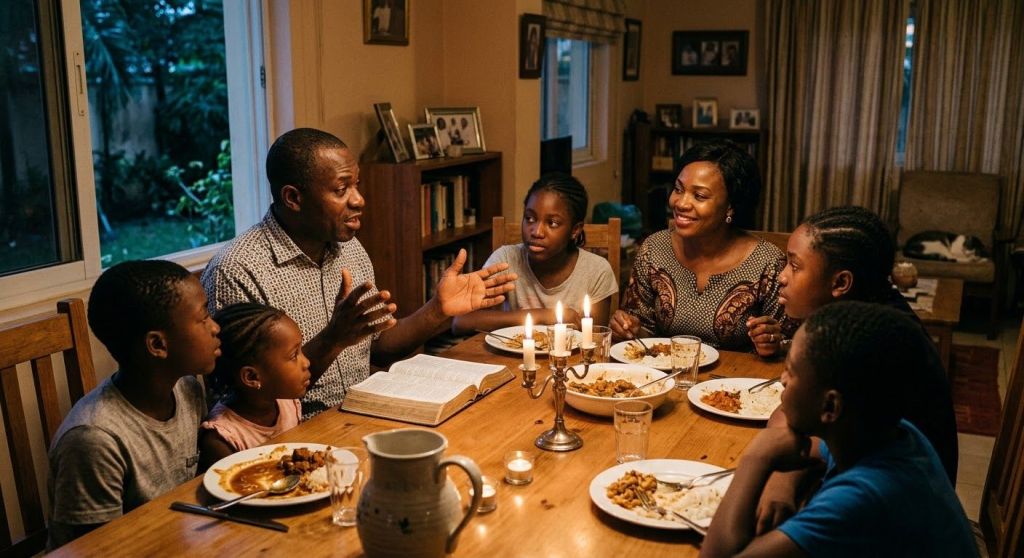
A family gathered around a dinner table at dusk
As the day turned to evening, the dynamic shifted. The meal was finished, and the Lord looked at Abraham and decided to reveal His plans for Sodom and Gomorrah. Why? Because God viewed Abraham as a partner, a friend, and He knew Abraham would teach his children.
The evening is a time for intimacy and transparency. It is when the “table talk” happens.
The Practice: Don’t let the day end without connecting the dots between life and faith.
The Question: Instead of asking, “How was school?” (which yields “Fine”), ask a deeper question: “Where did we see God today?”
The Prophetic Role: Like God shared His heart with Abraham, share your heart with your children. Talk about how you saw God provide, how you struggled, and how you prayed. When we share our reflections, we model a living faith, not just a historical religion.
CENTRAL VERSE
“I have chosen him to direct his children…” (Gen 18:19)
This entire model hinges on the phrase “I have chosen him.” The Abraham Parenting Model is not about perfect behavior; it is about direction.
God said Abraham would “direct” his children. The Hebrew word implies a command, a guarding, and a pointing of the way. Abraham didn’t just save his children from the world; he directed them toward the Lord.
You cannot change your children’s hearts, that is the Holy Spirit’s job. But you can set the direction. You can point the car toward the Kingdom every morning, every afternoon, and every evening.
Challenge: Try the Abraham Model for one week.
See God first before looking at a screen.
Serve in your chores as if you were serving the Lord Himself.
Share your reflections on His faithfulness at the dinner table.
He has chosen you to direct your children. Walk in that high calling today.
A Closing Call: Start Your Journey Today
Two hands reaching toward each other with a glowing cross of light
Friend, before you can walk in any of these truths, before you can parent with purpose or lead your home with intention, there is a first step. Every benefit, every promise, and every principle found in Scripture begins with one thing: being born again.
Jesus said in John 3:3, “Unless one is born again, he cannot see the kingdom of God.” Without this foundational experience, the Word of God remains a closed book and its promises remain out of reach. But the moment you surrender your life to Christ, everything changes. You are made new. You are adopted into God’s family. You receive the Holy Spirit as your Teacher, your Comforter, and your Guide.
If you have never taken this step, or if you want to rededicate your life to Him today, say this prayer with me to start your journey:
Heavenly Father, I come to You just as I am. I acknowledge that I am a sinner and that I cannot save myself. I believe that Jesus Christ is Your Son, that He died on the cross for my sins, and that He rose again on the third day. Today, I confess with my mouth that Jesus is Lord and I believe in my heart that God raised Him from the dead. I repent of my sins and I turn away from my old life. I ask You, Lord Jesus, to come into my heart. Be my Savior and my Lord. Fill me with Your Holy Spirit. I am Yours now and forever. Thank You for saving me. In Jesus’ mighty name, Amen.
If you prayed that prayer sincerely, heaven is rejoicing over you right now! You are now a child of God, born again by His Spirit. The same power that raised Christ from the dead now lives in you. Now, the journey begins, a journey of daily walking with Him, discovering His Word, and yes, even parenting according to His perfect model.
Find a Bible-believing church. Get baptized. Surround yourself with other believers. And let the Holy Spirit lead you every step of the way.
Godly parenting isn’t just about correction, it’s about the heart behind it. In part two, we look at daily instruction, the spiritual battle behind Revelation twelve, and the beautiful promise that we’re never parenting alone, the Holy Spirit is our Helper every step of the way.
Anchor Scripture: 2 Timothy 3:16-17
Yesterday, in Part 1, we looked at the foundational mandate to teach and model faith, the goal of raising godly offspring, and the role of loving discipline. Today, in Part 2, we turn to the posture of the parent’s heart, the daily rhythm of instruction, the urgent spiritual battle revealed in Revelation 12, and the promise of the Holy Spirit as our divine Helper in this sacred calling.
Part Four: Heart Posture and Daily Walk
Godly parenting is as much about the parent’s heart as it is about the child’s behavior. The tone, patience, and compassion of the parent shape the child’s view of God.
“Fathers, do not provoke your children, lest they become discouraged.”
Colossians 3:21
Harshness, neglect, or favoritism can crush a child’s spirit. Parents must guard against discouraging their children.
“A soft answer turns away wrath, but a harsh word stirs up anger.”
Proverbs 15:1
Gentleness is a powerful tool in parenting. The way we speak to our children matters.
“As a father shows compassion to his children, so the Lord shows compassion to those who fear him.”
Psalm 103:13
Earthly fathers are meant to mirror the compassion of our Heavenly Father. When parents show compassion, children learn to trust God’s mercy.
Part Five: Ongoing Instruction and Conversation
Godly parenting is not a one-time event but a daily rhythm. Children learn best when truth is woven into the ordinary moments of life.
“Teach them to your children, talking about them when you sit at home and when you walk along the road, when you lie down and when you get up.”
Deuteronomy 11:19
Every moment is a teaching opportunity. Parents are called to make God’s Word a constant topic of conversation.
“And when your children ask you, ‘What does this ceremony mean to you?’ then tell them, ‘It is the Passover sacrifice to the Lord…'”
Exodus 12:26-27
Children are naturally curious. Godly parents welcome their questions and use them as opportunities to declare God’s mighty acts.
“In days to come, when your son asks you, ‘What does this mean?’ say to him, ‘With a mighty hand the Lord brought us out of Egypt, out of the land of slavery.'”
Exodus 13:14
The story of redemption is to be told and retold. Parents are the primary storytellers of God’s faithfulness.
Part Six: The Urgent Battle — The Reason for Godly Parenting (Revelation 12)
Why is godly parenting so urgent? Revelation 12 pulls back the curtain on the cosmic battle raging for the souls of children. The enemy is not passive, he is actively seeking to devour.
“Then the dragon stood before the woman about to give birth, to devour her child when she gave birth.”
Revelation 12:4
The dragon, Satan, positions himself to destroy children from birth. This reveals that godly parenting is spiritual warfare. The enemy targets the youngest among us.
“Then the dragon became angry with the woman and went off to wage war against the rest of her offspring, those who keep God’s commandments and bear witness to Jesus.”
Revelation 12:17
When the dragon could not destroy the Christ child, he turned his fury on all who follow Jesus. Your children are born into a war zone. Raising them in the fear of God is raising soldiers for this battle.
“The huge dragon, the ancient serpent, who is called the Devil and Satan, who deceived the whole world.”
Revelation 12:9
The enemy arrayed against your family is the ancient deceiver, the accuser of the brethren. He has been waging war against God’s people since Eden. Neglecting godly parenting leaves children undefended in this ancient conflict.
“But woe to you, earth and sea, for the Devil has come down to you in great fury, for he knows he has but a short time.”
Revelation 12:12
The intensity of the enemy’s attacks is proportional to his desperation. He knows his time is short. This should awaken urgency in every parent, the window to establish children in the fear of the Lord is not indefinite.
“The woman fled into the wilderness to a place prepared for her by God, where she might be taken care of… The woman was given the two wings of a great eagle, so that she might fly to the place prepared for her in the wilderness, where she would be taken care of.”
Revelation 12:6, 14
While the dragon pursues, God provides. When you raise your children in the fear of the Lord, you place them under the covering of the One who prepares a place of protection. The dragon may rage, but he cannot snatch those who belong to the Lamb.
“They triumphed over him by the blood of the Lamb and by the word of their testimony.”
Revelation 12:11
Victory over the dragon comes through the blood of Jesus and the testimony of His people. Godly parenting raises children who know the power of the Cross and who bear witness to Jesus with their lives.
Part Seven: The Promise of the Holy Spirit — Our Divine Helper
The call to raise children in the fear of God is daunting. No parent has the wisdom, patience, or strength to fulfill it perfectly. But Jesus did not leave us to accomplish this task alone. Before His ascension, He promised the Holy Spirit, the Helper, the Teacher, the Comforter, who would guide us into all truth and empower us for every good work.
“But the Advocate, the Holy Spirit, whom the Father will send in my name, will teach you all things and will remind you of everything I have said to you.”
John 14:26
The Holy Spirit is our divine Teacher. When we lack wisdom in parenting, He reminds us of God’s Word and teaches us how to apply it. He brings to remembrance the Scriptures we have hidden in our hearts, equipping us to instruct our children in the moment of need.
“But when he, the Spirit of truth, comes, he will guide you into all the truth. He will not speak on his own; he will speak only what he hears, and he will tell you what is yet to come.”
John 16:13
The Spirit guides us into all truth. In the complexities of parenting, decisions about discipline, education, relationships, and faith, the Holy Spirit leads us into God’s will. He is not silent; He speaks through the Word and through His still, small voice.
“If you then, though you are evil, know how to give good gifts to your children, how much more will your Father in heaven give the Holy Spirit to those who ask him!”
Luke 11:13
Jesus assures us that the Father delights to give the Holy Spirit to those who ask. Parents should pray daily for the Spirit’s filling, for He is the source of love, joy, peace, patience, kindness, goodness, faithfulness, gentleness, and self-control (Galatians 5:22-23), the very fruits needed to parent well.
“In the same way, the Spirit helps us in our weakness. We do not know what we ought to pray for, but the Spirit himself intercedes for us through wordless groans.”
Romans 8:26
There are moments in parenting when we do not know how to pray. The Spirit intercedes for us. He knows the needs of our children better than we do and prays according to the will of God.
“But you will receive power when the Holy Spirit comes on you; and you will be my witnesses in Jerusalem, and in all Judea and Samaria, and to the ends of the earth.”
Acts 1:8
The Holy Spirit gives power to be witnesses. The first mission field is the home. Parents filled with the Spirit become powerful witnesses to their children, demonstrating the reality of the Gospel in word and deed.
“But the fruit of the Spirit is love, joy, peace, forbearance, kindness, goodness, faithfulness, gentleness and self-control. Against such things there is no law.”
Galatians 5:22-23
The fruit of the Spirit is the character of godly parenting. No amount of technique or discipline can produce these qualities, they are the supernatural work of the Spirit in a yielded heart. When parents walk in the Spirit, their children encounter the living God through them.
“‘Not by might nor by power, but by my Spirit,’ says the Lord Almighty.”
Zechariah 4:6
Godly parenting is not accomplished by human strength, perfect strategies, or sheer willpower. It is accomplished by the Spirit of God. When we feel inadequate, and we will, we must remember that the same Spirit who raised Christ from the dead lives in us (Romans 8:11) and is more than sufficient for the task.
“All your children will be taught by the Lord, and great will be their peace.”
Isaiah 54:13
This is a precious promise: God Himself teaches our children. When we faithfully instruct them in His Word, the Holy Spirit works in their hearts, drawing them to Himself. We plant and water, but God gives the increase (1 Corinthians 3:6).
Conclusion: Equipped, Empowered, and Never Alone
The task of raising children in the fear of God is overwhelming, but it is not ours to accomplish alone. The same Scripture that commands us to teach, correct, and train is the Scripture that equips us for every good work (2 Timothy 3:16-17). And the same God who calls us to this sacred task has given us His Holy Spirit, the Helper, the Teacher, the Comforter, to guide us every step of the way.
From Genesis to Revelation, God calls parents to raise a godly offspring, children who know Him, love Him, and stand firm in the faith. The enemy rages, the dragon pursues, but the Lamb has overcome. And we do not face this battle in our own strength. Jesus promised, “I will ask the Father, and he will give you another advocate to help you and be with you forever, the Spirit of truth” (John 14:16-17). The Holy Spirit is our ever-present Helper, teaching us all things, reminding us of God’s Word, guiding us into truth, interceding for us in our weakness, and producing His fruit in our lives.
When we hide God’s Word in our hearts, teach it diligently to our children, discipline them in love, and cover them in prayer, we participate in the victory of the Lamb. We are not perfect parents, but we serve a perfect Father who has given us a perfect Helper. The Spirit empowers us to love when we are weary, to be patient when we are frustrated, to correct with gentleness, and to point our children to Jesus in every season.
May every parent take up this sacred calling with urgency and joy, relying not on their own strength but on the Spirit of the living God. May we be found faithful, raising arrows aimed at the heart of the enemy and destined for the glory of God, arrows that will fly straight and true, carried by the wind of the Holy Spirit.
“Train up a child in the way he should go; even when he is old he will not depart from it.”
Proverbs 22:6
“But the Advocate, the Holy Spirit, whom the Father will send in my name, will teach you all things and will remind you of everything I have said to you.”
John 14:26
If this article encouraged you, explore more practical biblical insights for raising children in God’s Word, character and purpose at Godly Parenting Insights.
Every parent stands between a sacred calling and a cosmic battle. In part one of this two part series, we explore the biblical mandate to teach and model faith, God’s desire for godly offspring, and why loving discipline is an act of hope, not harm.
“All Scripture is God-breathed and is useful for teaching, rebuking, correcting and training in righteousness, so that the servant of God may be thoroughly equipped for every good work.”
2 Timothy 3:16-17
Introduction
Every parent stands at the intersection of a sacred calling and a cosmic battle. The task of raising children in the fear of God is not merely a cultural tradition or a moral duty, it is a divine mandate woven throughout the entirety of Scripture. From the opening chapters of Genesis to the closing visions of Revelation, God consistently reveals His heart for the next generation and the serious responsibility He places upon parents.
The apostle Paul, writing to young Timothy, reminds us that all Scripture, every command, every warning, every promise, is God-breathed and profitable for equipping God’s people. This includes the call to godly parenting. The Word of God is sufficient to teach us how to raise children who know, love, and fear the Lord. It rebukes our negligence, corrects our errors, and trains us in the righteousness needed to shepherd the souls entrusted to our care.
This is Part 1 of a two-part series compiling some biblical foundations for godly parenting. Today we’ll look at the foundational mandate to teach and model faith, the goal of raising godly offspring, and the role of discipline. Part 2, coming tomorrow, will cover the posture of the heart, the rhythm of daily instruction, the spiritual battle revealed in Revelation 12, and the promise of the Holy Spirit as our Helper.
Part One: The Foundational Mandate — Teaching and Modeling Faith
The primary responsibility of godly parenting is not merely to tell children about God but to embody a life of faith before them. Scripture calls parents to weave the knowledge of God into the fabric of everyday life.
“Love the Lord your God with all your heart and with all your soul and with all your strength. These commandments that I give you today are to be on your hearts. Impress them on your children. Talk about them when you sit at home and when you walk along the road, when you lie down and when you get up.”
Deuteronomy 6:5-7
This is the foundational text for godly parenting. Before parents can impress God’s truth on their children, it must first be on their own hearts. Faith is not a Sunday event, it is a daily conversation, a constant walk.
“Only be careful, and watch yourselves closely so that you do not forget the things your eyes have seen or let them fade from your heart as long as you live. Teach them to your children and to their children after them… so that they may learn to fear me as long as they live, and so that they may teach their children to do the same.”
Deuteronomy 4:9-10
The call to teach is generational. What we receive from God, we must pass to our children, and they to theirs. The fear of the Lord is not inherited automatically, it is taught and modeled.
“We will not hide these truths from our children; we will tell the next generation about the glorious deeds of the Lord, about his power and his mighty wonders… so the next generation might know them, even the children not yet born, and they in turn will teach their own children.”
Psalm 78:4-6
The psalmist resolves to declare God’s works to the next generation. Godly parenting is intentional, forward-looking, and committed to preserving the testimony of God’s faithfulness.
“For I have chosen him, so that he will direct his children and his household after him to keep the way of the Lord by doing what is right and just.”
Genesis 18:19
God’s commendation of Abraham reveals His expectation: fathers are to direct their households in the way of the Lord. This is not passive, it requires deliberate instruction, leadership, and example.
“Fathers, do not provoke your children to anger, but bring them up in the discipline and instruction of the Lord.”
Ephesians 6:4
Paul balances correction with nurture. Godly parenting avoids exasperating children while providing both discipline and instruction rooted in the Lord.
Part Two: The Goal — Godly Offspring and a Legacy of Faith
God’s desire is not merely that children behave well but that they become a godly offspring, a generation that belongs to Him and carries His covenant forward.
“Has not the one God made you? You belong to him in body and spirit. And what does the one God seek? Godly offspring.”
Malachi 2:15
This verse reveals God’s heart: He seeks godly offspring. The marriage covenant and parenting are designed to produce children who fear and serve the Lord.
“Train up a child in the way he should go; even when he is old he will not depart from it.”
Proverbs 22:6
This is a promise and a principle. Early, consistent training in the fear of God shapes the trajectory of a child’s entire life.
“From infancy you have known the Holy Scriptures, which are able to make you wise for salvation through faith in Christ Jesus.”
2 Timothy 3:15
Timothy’s mother and grandmother began teaching him Scripture from infancy. The Word of God is the primary means by which children are made wise unto salvation.
“Behold, children are a heritage from the Lord, the fruit of the womb a reward. Like arrows in the hand of a warrior are the children of one’s youth.”
Psalm 127:3-5
Children are not a burden but a heritage. They are arrows, meant to be aimed, shaped, and sent into the world for God’s purposes.
Part Three: Discipline, Correction, and the Rod
Godly parenting includes loving discipline. Scripture is clear that correction is an expression of love, not cruelty.
“Whoever spares the rod hates his son, but he who loves him is diligent to discipline him.”
Proverbs 13:24
Love and discipline are not opposites, they are partners. To neglect correction is to neglect the child’s wellbeing.
“Folly is bound up in the heart of a child, but the rod of discipline drives it far from him.”
Proverbs 22:15
Children are not born morally neutral, they are born with folly bound in their hearts. Discipline is the God-ordained means of driving it out.
“Discipline your son, for there is hope; do not set your heart on putting him to death.”
Proverbs 19:18
Discipline is an act of hope. It declares that change is possible and that the child’s future matters.
“Do not withhold correction from a child, for if you beat him with a rod, he will not die.”
Proverbs 23:13
This proverb corrects the fear that discipline will harm a child. Rightly applied, discipline brings life, not death.
“For the moment all discipline seems painful rather than pleasant, but later it yields the peaceful fruit of righteousness to those who have been trained by it.”
Hebrews 12:11
The fruit of discipline is righteousness and peace. Parents must endure the temporary discomfort of correction for the eternal benefit of their children.
Discipline shapes behavior, but it is only half the picture. The heart behind the correction matters just as much as the correction itself, and that is where we turn next.
This is Part 1 of a two-part series on the biblical foundation for godly parenting. Part 2, covering heart posture, daily instruction, the spiritual battle of Revelation 12, and the promise of the Holy Spirit, will be posted tomorrow.
Growing children in God’s Word, character and purpose.
If this article encouraged you, explore more practical biblical insights for raising children in God’s Word, character and purpose at Godly Parenting Insights.
Effective parenting requires more than knowledge and good intentions. Discover how God’s Word, the Holy Spirit, and wisdom from above can help parents raise children according to God’s purpose.
Parenting is one of the greatest responsibilities entrusted to humanity.
It is also one of the areas where knowledge, experience, good intentions, and even genuine love may sometimes prove insufficient.
Every child is different. Every season brings new questions, and every stage of development can present new challenges.
This is why parents need more than information.
We need wisdom.
And not merely human wisdom.
We need the wisdom that comes from above.
God did not create people merely to exist. Every person carries purpose, potential, capacity, and usefulness. In Christ, we are redeemed not merely to live, but to fulfil God’s purpose and become useful vessels in His hands.
Parenting is part of that assignment.
God has entrusted children to parents, guardians, teachers, and caregivers, and He expects us to nurture them according to His purpose.
So the question is not only:
“How can I become a better parent?”
A deeper question is:
“Lord, how do You want me to raise this child?”
“O my Lord, let the man of God which thou didst send come again unto us, and teach us what we shall do unto the child that shall be born.”
Judges 13:8
That is a powerful parenting prayer:
“Lord, teach me what to do with this child.”
The effectiveness of our parenting will be greatly influenced by our willingness to hear, receive, and obey God’s instruction.
We Are Redeemed to Be Solution Bearers
God did not create us merely to occupy space.
Redemption in Christ brings us into a life of purpose. We are called to become instruments through which God’s wisdom, love, truth, and goodness can reach our generation.
This includes parenting.
When a child is confused, a parent can provide direction.
When a child is afraid, a parent can provide security.
When a child fails, a parent can teach restoration.
When a child struggles with character, a parent can provide correction and instruction.
When a child is searching for identity, a parent can point the child toward God.
But to become effective solution bearers, we must remain responsive to God’s instructions.
How far we go in any area of challenge is often connected to how willing we are to receive and put God’s instructions to work.
There Is No Finish Line in the School of Wisdom
“Give instruction to a wise man, and he will be yet wiser…”
Proverbs 9:9
There is no graduation ceremony in the school of wisdom.
A wise parent remains teachable.
Having successfully navigated one season of parenting does not mean we automatically know how to navigate the next. Children grow. Their questions change. Their emotional needs change. Their environments change.
Therefore, our need for wisdom continues.
The wise parent does not say:
“I already know everything about parenting.”
The wise parent says:
“Lord, teach me.”
God’s Word Still Gives Wisdom
The wisdom of Scripture has not become obsolete.
Human circumstances may change. Technology may advance. Cultures may shift. Parenting challenges may take new forms.
But God’s principles remain powerful.
“Thy word is a lamp unto my feet, and a light unto my path.”
Psalm 119:105
God’s Word still gives direction.
It still corrects.
It still teaches.
It still reveals.
It still transforms.
The Bible may not mention every modern parenting situation by name, but it gives us principles through which we can approach those situations with God’s perspective.
God’s Word is the light that shines the way forward through every challenge we may face.
What Is Wisdom?
Wisdom is more than knowledge.
Knowledge tells us what we know. Wisdom teaches us what to do with what we know.
Biblical wisdom, therefore, is putting God’s Word to work in the situations of life.
It is one thing to know that Scripture teaches patience.
It is another thing to practise patience when a child repeatedly tests you.
It is one thing to know that children should be corrected.
It is another thing to know how, when, and why to correct.
“Whatsoever he saith unto you, do it.”
John 2:5
Joshua 1:8 similarly connects meditation on God’s Word with doing what is written.
The power is not merely in possessing Scripture.
The power is in putting Scripture to work.
God’s Wisdom Gives Insight for the Parenting Assignment
Manoah understood something many parents can overlook:
Having a child does not automatically mean knowing how to raise that child according to God’s purpose.
That is why he asked God:
“Teach us what we shall do unto the child…”
Judges 13:8
There will be moments when natural observation is not enough.
A child’s outward behaviour may not reveal everything happening within.
This is where divine wisdom becomes precious.
God can help us discern what needs attention, what requires patience, what should be confronted, what should be nurtured, when to speak, when to listen, and how to respond.
This does not mean rejecting education, experience, professional knowledge, or godly counsel.
It means recognizing that God remains the ultimate source of the wisdom required to fulfil the assignment He has given us.
Wisdom Must Become Action
“Whosoever heareth these sayings of mine, and doeth them, I will liken him unto a wise man…”
Matthew 7:24
Notice the combination:
Hear + Do = Wisdom in Operation
Biblical wisdom is not complete when God’s Word enters our ears.
It becomes visible when God’s Word enters our actions.
We do not engage Scripture merely to know more.
We engage it so that we can live differently.
Wisdom from Above Produces the Right Spirit
“But the wisdom that is from above is first pure, then peaceable, gentle, and easy to be intreated, full of mercy and good fruits…”
James 3:17
Godly parenting still requires correction, discipline, boundaries, and difficult conversations.
But divine wisdom teaches us how to handle them in a way that reflects God’s character.
There is a difference between firmness and harshness.
There is a difference between correction and humiliation.
There is a difference between discipline and uncontrolled anger.
Wisdom teaches us how to correct without destroying and establish boundaries without unnecessarily damaging relationship.
When human reasoning, cultural ideas, or popular parenting practices conflict with the clear principles of God’s Word, Scripture must remain our final authority.
The Holy Spirit Helps Us Engage God’s Wisdom
1 Corinthians 2:10–13 reveals that the Holy Spirit searches the deep things of God and teaches believers the things God has freely given.
The Christian parent is therefore not left entirely to trial and error.
The Holy Spirit works through God’s Word to illuminate our understanding and help us apply its truth.
Sometimes the important question is not:
“What do other parents do?”
It is:
“Holy Spirit, what are You teaching me from God’s Word about this situation?”
The Word gives us the foundation. The Spirit helps illuminate and apply that truth.
God’s Wisdom Can Bring Order and Restoration
“The LORD by wisdom hath founded the earth…”
Proverbs 3:19
God’s wisdom is creative.
It brings order where there is confusion and can help rebuild what has been damaged.
Not every family situation begins perfectly.
Some children struggle with rejection, insecurity, unhealthy patterns, or the consequences of past mistakes.
But divine wisdom does not merely teach us how to manage what is broken.
It can show us how to begin rebuilding.
The God whose wisdom created can also give wisdom for restoration.
God’s Word Illuminates and Examines
“The spirit of man is the candle of the LORD, searching all the inward parts…”
Proverbs 20:27
And Psalm 119:105 says:
“Thy word is a lamp unto my feet, and a light unto my path.”
Psalm 119:105
Together, these Scriptures give us a powerful picture.
God’s Word illuminates the path before us, but it also helps us examine what is within us.
Sometimes the question is not only:
“What is wrong with my child?”
It is:
“Lord, what are You showing me about me?”
Perhaps our reaction needs correction.
Perhaps our expectations need adjustment.
Perhaps God is teaching us patience.
Perhaps He is asking us to change how we communicate.
Divine wisdom does not only examine the child. It also examines the parent.
How Do We Stir Up This Wisdom?
1. Be Born Again
“Except a man be born again, he cannot see the kingdom of God.”
John 3:3
Godly parenting begins with a parent who is willing to be governed by God.
We need Christ. We need the Holy Spirit. We need the life of God within us.
2. Acknowledge God as the Source
“He giveth wisdom unto the wise, and knowledge to them that know understanding.”
Daniel 2:21
We can learn from books, teachers, counsellors, experienced parents, and professionals.
But ultimately:
God is the principal source of divine wisdom.
Prayer should not merely be our emergency exit. Fellowship with God should become our daily source of direction.
3. Desire Wisdom
If we desire God’s wisdom, we will make room for it.
We will seek it, study, listen, learn, and remain teachable.
4. Ask for Wisdom
“If any of you lack wisdom, let him ask of God…”
James 1:5
There is no shame in saying:
“Lord, I don’t know what to do.”
That admission may become the doorway to receiving what we need.
5. Search the Scriptures
When facing a parenting challenge, ask:
“What does God’s Word say about this?”
Then search. Study. Meditate. Compare Scripture with Scripture. Pray. Listen. Keep searching until light comes.
6. Put It to Work
The ultimate purpose of receiving wisdom is application.
Read the Word. Believe it. Meditate on it. Receive instruction from the Holy Spirit. Then obey it.
Engage the wisdom. Don’t merely read it.
A Parent’s Prayer
Perhaps one of the most powerful prayers a parent can pray is the prayer of Manoah:
“Lord, teach me what I shall do unto the child.”
Not merely:
“Lord, make my child behave.”
Not only:
“Lord, remove this problem.”
But:
“Lord, teach me.”
Teach me how to speak.
Teach me how to listen.
Teach me when to correct.
Teach me when to wait.
Teach me how to discipline.
Teach me how to encourage.
Teach me how to recognize what You are doing in my child.
Teach me how to nurture the gifts You have placed within this child.
Teach me how to point this child toward You.
Teach me how to fulfil my responsibility faithfully.
Because ultimately, the child belongs to God, and I am a steward of the assignment.
Conclusion: Wisdom for the Journey
Effective parenting requires more than good intentions.
It requires wisdom.
Experience, education, observation, professional knowledge, and godly counsel can all provide valuable help. But the parent who desires to fulfil God’s purpose must continually engage the wisdom that comes from above.
There is no finish line in the school of wisdom.
So when you face a parenting challenge, don’t ask only:
“What do people normally do?”
Ask:
“What does God say?”
When you don’t know what to do, pray:
“Lord, teach me what to do with this child.”
When the situation is confusing, turn on the light of God’s Word.
When you receive instruction, put it to work.
When you think you have learned enough, remain teachable.
When you lack wisdom, ask.
When the answer does not come immediately, keep searching.
And when God gives you wisdom, don’t merely admire it.
Engage it.
Because God’s wisdom is not given merely to make us knowledgeable parents.
It is given to make us effective stewards of the lives He has entrusted to us.
Desire wisdom. Ask for wisdom. Search the Scriptures. Receive wisdom from above. Put God’s Word to work.
That is how wisdom becomes effective in parenting.
Final Thought
The child may be in your home, but the wisdom for raising that child comes from above.
And when God’s Word becomes the light by which we parent, we are better positioned to raise children in God’s Word, character, and purpose.
Loading Comments...
Create your own website, free on WordPress.com.Create your own website.