Your children need more than instructions. They need to see how God’s Word has shaped your life. Discover how your testimony, including lessons from your failures, can become a powerful tool for teaching, discipleship, and building a godly generation.
One of my favorite ways to teach honesty isn’t through a lecture. It’s through a memory.
I was about nine years old.
I had just finished drinking some water from one of my mother’s favorite ceramic mugs, the good ones she kept for visitors or so i thought. In my haste, my elbow caught the edge of the counter.
The mug slipped.
Crash.
Shards of white ceramic scattered across the kitchen floor.
Panic seized me.
I knew there would be consequences, so my young, sinful brain went straight into damage-control mode. I swept up every visible piece and carefully placed the mug’s base, now nothing more than a jagged, useless ring, back on top of the fridge.
I positioned it as though nothing had happened.
Then I waited.
A few hours later, my younger brother walked into the kitchen. He opened the fridge, and the vibration knocked the “mug” from its perch.
It shattered loudly on the floor.
I immediately jumped up.
“I’ll tell mommy for you! You broke her cup!
As soon as Mommy return that evening i said, Come quickly! My brother broke your favorite cup!”
I played the part perfectly.
I was the outraged, innocent bystander.
My brother was stunned and crying. He could barely defend himself.
Then my mother came.
She looked at the broken pieces.
Then she looked at me.
She didn’t shout.
She didn’t accuse me.
She simply said:
“Tell me again. Slowly.”
Within minutes, my elaborate scheme collapsed.
I confessed.
And I learned something that day that has stayed with me for decades: the trouble caused by a lie can become greater than the trouble caused by the original mistake.
I was punished, not only for breaking the mug, but also for lying about it.
For years, I thought of that incident as nothing more than a funny and embarrassing childhood memory.
But today, as a parent and teacher, I see it differently.
It is a testimony.
And whenever I share that story with children, something interesting happens.
They laugh.
They lean in.
They recognize themselves in it.
And somewhere between the laughter and the lesson, they begin to understand why honesty matters.
That is the power of testimony.
Your Children Need More Than Instructions
As parents, we naturally teach our children what is right.
We tell them:
“Tell the truth.”
“Obey God.”
“Respect people.”
“Don’t steal.”
“Don’t lie.”
Those instructions are necessary.
God’s Word gives us the standard by which our children should learn to live.
But sometimes, a child needs more than a command.
They need a picture.
They need to hear:
“Let me tell you about a time when I got this wrong.”
That is where testimony becomes powerful.
A testimony takes a biblical principle and brings it into the world of everyday life.
Instead of simply saying, “Honesty is important,” you can say:
“Let me tell you what happened to me when I wasn’t honest.”
Instead of merely saying, “God answers prayer,” you can tell them about a time you prayed and watched God provide.
Instead of simply saying, “God forgives,” you can explain how God met you after a failure and helped you change.
Your children don’t only need to know what you believe.
They need to see how what you believe has shaped the way you live.
1. Testimony Helps Children See God’s Faithfulness
Psalm 78 gives parents a powerful responsibility.
The Psalmist says:
"We will not hide them from their children, telling the generation to come the praises of the LORD, and His strength and His wonderful works that He has done." (Psalm 78:4)
The goal was not merely to preserve family stories.
It was to preserve knowledge of God’s works.
The next generation needed to hear what God had done so that they could place their own hope in Him.
That means your testimony can become a bridge.
Your child may hear about God’s faithfulness in the Bible, but when you tell them how God was faithful to you, the truth becomes personal.
“God provided for me when I didn’t know where the answer would come from.”
“God corrected me when I was going in the wrong direction.”
“God helped me when I was afraid.”
“God forgave me when I failed.”
These are not replacements for Scripture.
They are illustrations of Scripture at work in a real person’s life.
And sometimes, that illustration is exactly what a child remembers.
2. Testimony Can Turn Your Mistakes Into Teaching Moments
Parents often feel pressure to appear strong and flawless before their children.
But children don’t need perfect parents.
They need honest parents who point them toward a perfect God.
There is wisdom in knowing what to share and how to share it.
Not every adult experience belongs in a child’s ears. Some things require age-appropriate boundaries, wisdom, and discretion.
But when appropriate, telling your children about a mistake you made, a temptation you faced, or a lesson you learned can help them understand that spiritual growth is a journey.
You can say:
“I made a wrong decision when I was younger, and I learned why God’s instruction matters.”
“I once allowed fear to control me, but God taught me to trust Him.”
“I handled that situation badly, and I had to apologize.”
This does something important.
It teaches children that failure does not have to be the end of the story.
God can use correction.
God can use repentance.
God can use consequences.
God can use even our failures as classrooms for wisdom.
Sometimes, correction is part of that classroom. In The Ministry of Loving Correction, we explore how correction can become an expression of love rather than merely punishment.
The broken mug did not become valuable because it was broken.
It became valuable because the lesson attached to it was remembered.
3. Testimony Builds a Generational Bridge
Psalm 78:5 says:
"For He established a testimony in Jacob, and appointed a law in Israel, that He commanded our fathers, that they should make them known to their children." (Psalm 78:5)
Notice the movement:
God gave truth. Parents received it. Parents taught it. Children received it.
That is generational discipleship.
When we intentionally train our children in God’s ways, we are making an investment that reaches far beyond the present moment. There are many benefits of godly parenting, both for our children and for the generations that follow.
The goal is not simply to raise children who can repeat Bible verses.
It is to raise children who know God, trust His Word, and understand what faithful living looks like.
Your testimony helps connect generations.
A child can read about David trusting God against Goliath.
But they can also hear:
“When I faced something that looked impossible, this is how I learned to trust God.”
They can read about God’s provision.
But they can also hear:
“There was a time when we didn’t know how we were going to get through that situation, but God made a way.”
The testimony becomes a living reminder:
“The God you read about in Scripture is still God today.”
4. Testimony Should Point Back to God’s Word
There is an important balance here.
Our stories are not the standard.
God’s Word is the standard.
Isaiah 8:20 says:
"To the law and to the testimony!" (Isaiah 8:20)
The principle is powerful: God’s revealed truth must remain the measuring point.
Our experiences can illustrate truth, but our experiences cannot replace truth.
That means we shouldn’t tell our children:
“This happened to me, therefore this must be God’s rule for everyone.”
Instead:
“This is what happened to me, and this is what God’s Word taught me through it.”
That distinction matters.
Your testimony should always lead your child back to God, not merely toward admiration for you.
The goal is not:
“Look at what Dad accomplished.”
The goal is:
“Look at what God taught Dad.”
Not:
“Look how strong Mum was.”
But:
“Look how God helped Mum.”
That changes the focus from parent worship to God worship.
A five-year-old may need a simple story about telling the truth.
A teenager may be ready for a deeper conversation about consequences, peer pressure, temptation, or making difficult choices.
Wisdom determines what to share and when.
2. Share Both God’s Help and Your Responsibility
Don’t tell stories that make you look like the hero.
If you made a mistake, acknowledge it.
If you had to apologize, say so.
If God corrected you, explain that.
Children need to understand both grace and responsibility.
And this includes the way we speak to them. Our words can either reinforce truth and wisdom or deepen fear, shame, and confusion. The weight of our words matters.
3. Connect the Story to Scripture
Don’t stop with:
“That happened to me.”
Ask:
“What does God’s Word say about this?”
That is where testimony becomes discipleship.
The story catches their attention.
Scripture gives them the foundation.
4. Create a Family Culture of Testimony
You could make it simple.
Once a week, ask:
“What did God teach you this week?”
Or:
“Where did you see God’s help this week?”
Or:
“Did anything happen this week that reminded you of something we’ve learned from God’s Word?”
Little conversations like these can become spiritual landmarks in a child’s life.
Maybe it is a lesson you learned about anger, patience, or the way emotions can affect the people we love. Sometimes the most meaningful parenting lessons grow out of moments we wish we could handle differently. You can explore one such reflection in When Anger Turns to Butterflies.
A missed opportunity.
A difficult season.
A prayer God answered.
A prayer God didn’t answer in the way you expected.
A time you were corrected.
A time you had to forgive someone.
A time you discovered that obedience to God was better than doing what everyone else was doing.
You don’t have to hide every imperfect chapter of your life from your children.
Some chapters, when shared wisely, can become lessons for the next generation.
Your past doesn’t have to become your child’s blueprint.
But the wisdom you gained from it can become part of their preparation.
That childhood mug taught me something about honesty.
Decades later, the mug is gone.
The pieces are long forgotten.
But the lesson survived.
And that is one of the beautiful things about testimony:
The event may end, but the lesson can keep travelling.
So this week, think about your own story.
What is the “broken mug” in your life?
What mistake taught you something important?
What answered prayer strengthened your faith?
What difficult season showed you God’s faithfulness?
What lesson did you learn the hard way that your child could learn more gently?
Write it down.
Pray about it.
And when the right moment comes, tell them.
Because sometimes the lesson your child remembers for the rest of their life isn’t the lecture you gave.
It’s the story you told about what God taught you.
"We will tell the next generation the praiseworthy deeds of the Lord, His power, and the wonders He has done." (Psalm 78:4)
A Prayer for Parents
Father, in the name of Jesus,
I pray that You empower every parent, guardian, and teacher entrusted with raising children. Give us wisdom to teach, humility to admit our mistakes, courage to share the lessons You have taught us, and grace to point every story back to Your Word.
Help us to build homes where truth is taught, grace is experienced, and Your faithfulness is remembered from one generation to the next.
May our lives become living testimonies that help our children know, love, and follow You.
In the name of Jesus the Christ, Amen.
Grace and peace.
Keep building godly homes, one Scripture at a time.
Discover how Daniel’s example of learning through books applies to Christian parenting today. Learn why God provides faithful teachers and biblical resources to help parents raise godly children.
God provides His Word and faithful teachers to guide us in raising the next generation.
I Understood by Books: God’s Provision for Wise Parenting
A Little Humor to Start:
A little boy was asked by his Sunday school teacher, “What do we learn from the story of Adam and Eve?” He thought for a moment and replied, “Well… I learned that if you don’t have anyone to blame, blame the snake!” 🤣
Parenting can sometimes feel like that—full of unexpected twists, finger-pointing, and moments where we wonder, “Did I sign up for this?” But here’s the good news: God never left us without help.
Romans 11:33 (KJV)
“O the depth of the riches both of the wisdom and knowledge of God! how unsearchable are his judgments, and his ways past finding out!”
The wisdom of God is deep, inexhaustible, and multifaceted. No single person can ever fully comprehend the greatness of His wisdom in one lifetime. Yet, in His mercy, God has chosen to reveal His wisdom progressively through His Word, through faithful teachers, and through the testimonies of men and women who have walked with Him.
This truth is especially important in parenting. Raising children is one of life’s greatest responsibilities, yet God never intended parents to navigate it alone. His wisdom has already been revealed for our benefit.
One of the clearest biblical examples of this is found in the life of Daniel.
Daniel 9:2 (KJV)
“In the first year of his reign I Daniel understood by books the number of the years…”
Daniel did not receive understanding by starting from the beginning. He studied the writings that God had already given through His prophet Jeremiah. Through those writings, he understood God’s purpose and responded with faith and prayer.
This teaches us an important principle: God often brings understanding through His written Word and through the faithful writings of those who have learned His ways. The principle Daniel applied to understanding prophecy is the same principle parents can apply to raising children. We learn from God’s Word first, then from the experiences of faithful believers who have already walked the journey before us.
We Do Not Have to Start From Scratch
One of the greatest mistakes we can make is believing that our situation is unique or that no one has ever faced the challenges before us.
God’s Word reminds us otherwise.
Ecclesiastes 1:9 (KJV)
“The thing that hath been, it is that which shall be… and there is no new thing under the sun.”
There is nothing you are going through today that someone has not gone through before. Whether it is the challenge of raising children, building a godly home, overcoming fear, navigating difficult seasons, or dealing with the pressures of modern life, someone has walked that road before you and, by God’s grace, came out victorious.
This is one of God’s beautiful provisions for His children. We do not all have to learn through painful experience. We can learn through Scripture, through godly examples, and through the written testimonies of faithful believers.
Life is full of challenges, and parenting is no exception. Every parent desires to raise children who love God, honour His Word, and become a blessing to their generation.
The encouraging truth is this: we do not have to discover everything by trial and error.
God has raised faithful men and women throughout history who have walked this path before us. They have learned valuable lessons, overcome challenges, and recorded biblical principles that can help the next generation.
Their testimonies become learning opportunities for us.
God’s Word Comes First
The Bible remains our final authority in every area of life.
Every book we read, every teaching we receive, and every piece of advice we follow must agree with God’s Word.
Yet God also gives teachers to help us understand and apply biblical truth.
Isaiah 30:20-21 (KJV)
“And though the Lord give you the bread of adversity, and the water of affliction, yet shall not thy teachers be removed into a corner any more… And thine ears shall hear a word behind thee, saying, This is the way, walk ye in it…”
God does not leave His children without guidance. He gives us His Spirit, His Word, and faithful teachers who point us back to Him.
Learn From Proven Lives
Not every book deserves our attention.
As Christian parents, we should intentionally seek books written by men and women whose lives, families, and ministries demonstrate faithfulness to God’s Word. Their counsel should never replace Scripture, but it can help us apply Scripture more wisely.
Throughout history, God has raised men and women whose families, ministries, and lives testify to the faithfulness of His Word. Many have prayerfully documented the lessons God taught them so that others may benefit from their experiences.
Personally, I have been greatly encouraged by reading books on godly parenting written by seasoned Christian leaders, including Pastor Mrs Faith Oyedepo. Their biblical insights challenged me, strengthened my faith, and gave me practical wisdom for raising children God’s way.
Reading such books is not replacing God; it is learning from the testimonies of those whom God has already taught.
A Wise Parent Never Stops Learning
A wise parent is a humble parent.
Proverbs 1:5 (KJV)
“A wise man will hear, and will increase learning…”
There is always something new to learn, another lesson to discover, and another biblical principle to apply.
As we continue reading God’s Word and learning from faithful teachers, God enlarges our understanding and equips us to lead our families with greater wisdom.
Just as Daniel understood through books, we too can grow in understanding by faithfully studying God’s Word and learning from biblically sound, proven voices.
Prayer
Heavenly Father, thank You for Your Holy Word, which is our perfect guide. Give us humble hearts that are willing to learn. Lead us to faithful teachers and sound biblical resources that strengthen our homes. Grant us wisdom to raise our children according to Your Word, and help us to apply what we learn for Your glory. In Jesus’ name, Amen.
Key Takeaway:
God never intended us to walk the journey of parenting alone. He has provided His Word as our foundation and faithful teachers to help us understand and apply it. Read the Bible diligently. Learn from biblically proven voices. Apply God’s truth faithfully, and trust Him with the results.
I pray that God empowers every parent, every guardian, every teacher, and everyone entrusted with the responsibility of raising children to faithfully train them in the way of the Lord. May He grant us wisdom, discernment, humility, and a teachable spirit as we continue to grow in His truth.
May God help every parent in the mighty name of Jesus.
Grace and peace. Keep building godly homes, one Scripture at a time. Remain ever blessed.
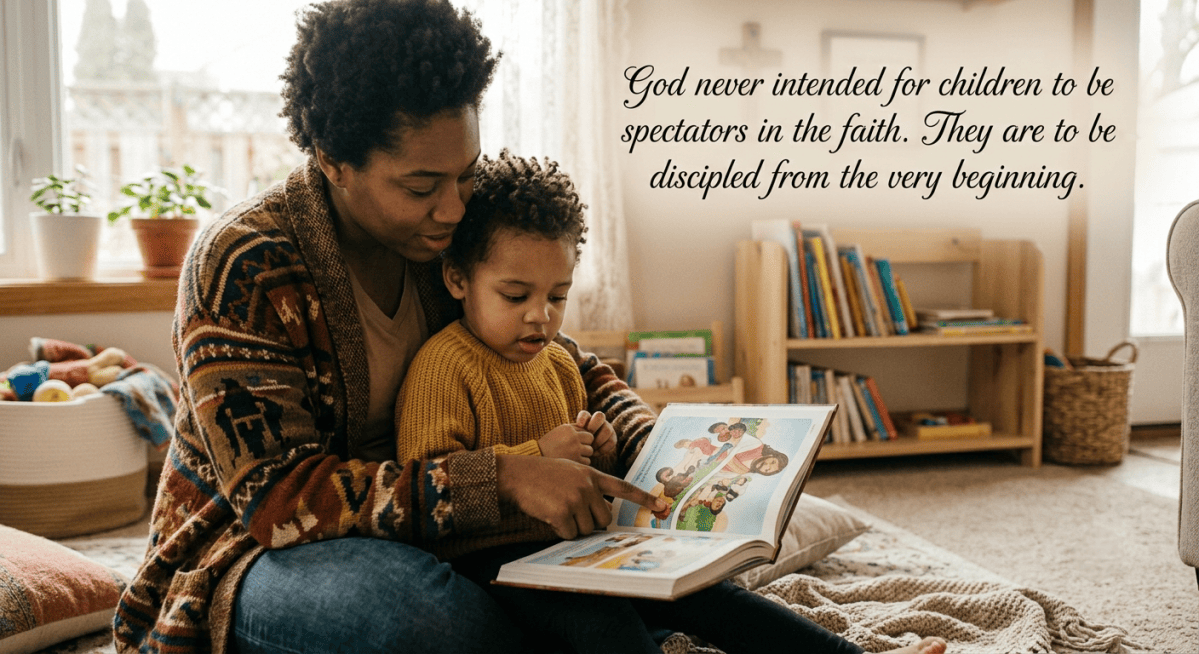
God never intended children to be spectators in the faith. Discover why Moses refused to leave the children behind and how Scripture teaches parents to disciple their children from the very beginning.
Exodus 10:9 (KJV)
“And Moses said, We will go with our young and with our old, with our sons and with our daughters, with our flocks and with our herds will we go; for we must hold a feast unto the Lord.”
One of the most overlooked lessons in the story of Israel’s deliverance from Egypt is Moses’ refusal to leave the children behind.
As Pharaoh’s heart grew harder, he began to negotiate with God’s command. At one point, he was willing to let the adults go but wanted the children to remain in Egypt. It sounded like a reasonable compromise. Yet Moses refused.
He boldly declared:
“We will go with our young and with our old, with our sons and with our daughters, with our flocks and with our herds will we go…”
Why?
Because worship is not only for adults. Serving God is not something children should discover later in life. They are to be part of God’s people from the very beginning.
This truth is echoed throughout Scripture.
Train Them Early
Proverbs 22:6 (KJV)
“Train up a child in the way he should go: and when he is old, he will not depart from it.”
Notice that Scripture says train up a child, not an adult. God places the responsibility on parents and guardians to begin early, laying a biblical foundation before the world lays its own.
Every child is a gift from God and should be introduced to God’s Word from the earliest years.
God Knows Every Child Before Birth
God’s purpose for our children does not begin when they become adults. It begins with Him.
Jeremiah 1:5 (KJV)
“Before I formed thee in the belly I knew thee; and before thou camest forth out of the womb I sanctified thee…”
If God knows a child before birth, then parents should recognise that raising a child is a sacred stewardship. We are nurturing lives that God already knows and has a purpose for.
Timothy Learned the Scriptures from Childhood
Timothy became a faithful servant of Christ, but that did not happen by accident.
Paul reminded him:
2 Timothy 3:15 (KJV)
“And that from a child thou hast known the holy scriptures, which are able to make thee wise unto salvation through faith which is in Christ Jesus.”
Timothy’s spiritual strength was built on a foundation laid in childhood. Someone took the time to teach him God’s Word while he was still young.
What an encouragement to every parent, grandparent, guardian, and teacher.
Jesus Was Brought Up in the Things of God
Even our Lord Jesus Christ gives us an example.
The Scriptures tell us that His earthly parents faithfully took Him to Jerusalem every year according to the Feast of the Passover.
Luke 2:41 (KJV)
“Now his parents went to Jerusalem every year at the feast of the passover.”
By the age of twelve, Jesus was found in the temple, listening, asking questions, and speaking with understanding.
Although He was the Son of God, His parents still raised Him in a home where worship, obedience, and the things of God were part of everyday life.
Godly parenting is not simply providing food, clothing, and education. It is intentionally surrounding our children with God’s Word until His truth becomes the foundation of their lives.
Don’t Leave the Children Behind
Today’s world has many attractions competing for the hearts of our children.
The greatest mistake parents can make is assuming children are too young to know God.
Moses understood something every parent should remember: the whole family belongs before God.
When we pray, let them pray with us.
When we study God’s Word, let them study with us.
When we worship, let them worship with us.
When we serve the Lord, let them serve alongside us.
Don’t leave the children behind.
Bring them into God’s presence while their hearts are still tender.
Prayer
Heavenly Father, thank You for the children You have entrusted to us. Give us grace to faithfully teach them Your Word from their earliest years. Help us never to leave them behind but to lead them into a genuine relationship with You. May they grow to love, obey, and serve You all the days of their lives. In the name Jesus the Christ, Amen.
Please Note:
The best inheritance we can leave our children is not wealth or success, but a life firmly rooted in God’s Word. Start early. Walk with them. Worship with them. Teach them faithfully, and trust God to establish them in His perfect will.
I pray that God empowers every parent, every guardian, every teacher, and everyone entrusted with the responsibility of raising children to faithfully train them in the way of the Lord. May He grant us wisdom, patience, discernment, and grace to lead the next generation into a genuine relationship with Jesus Christ.
May God help every parent in the name of Jesus the Christ. Amen.
Grace and peace. Keep building godly homes, one Scripture at a time. Remain ever blessed.
Discover why godly parenting is a deliberate choice, not luck. Learn from Deuteronomy 6:6–9 how to build a faith-filled home through daily intentionality and grace.
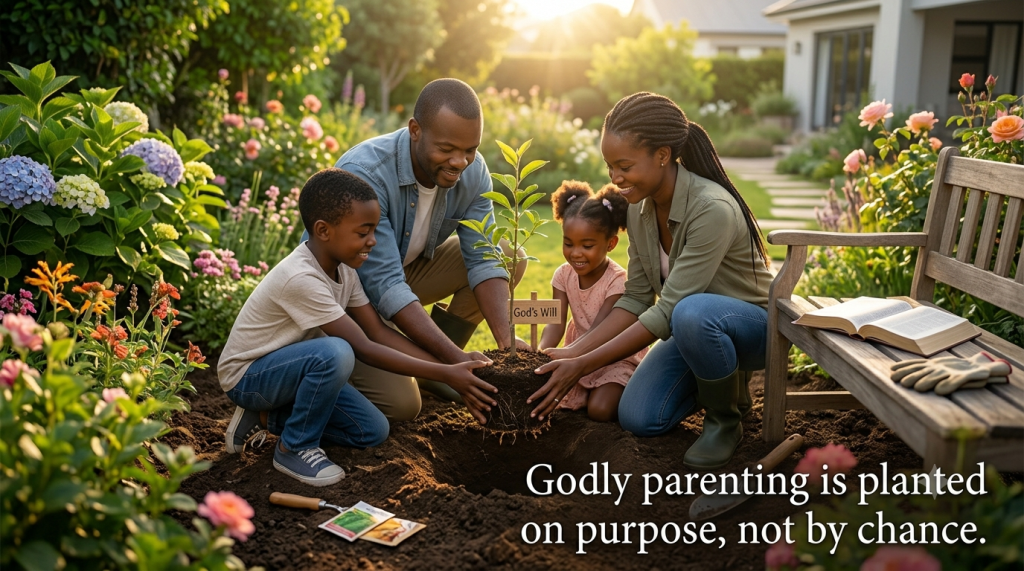
We don’t stumble into strong, faith-filled families.
Nobody wakes up one day and discovers they’ve accidentally raised children grounded in wisdom, grace, and purpose. Great structures don’t build themselves, and a solid foundation isn’t laid by chance.
Godly parenting is a deliberate choice, made every single day.
The Blueprint: Deuteronomy 6:6–9
Deuteronomy 6:6–9 (KJV)
“And these words, which I command thee this day, shall be in thine heart: And thou shalt teach them diligently unto thy children, and shalt talk of them when thou sittest in thine house, and when thou walkest by the way, and when thou liest down, and when thou risest up. And thou shalt bind them for a sign upon thine hand, and they shall be as frontlets between thine eyes. And thou shalt write them upon the posts of thy house, and on thy gates.”
Notice the environment God describes. It’s not just a Sunday morning routine, it’s the fabric of everyday life:
When you sit at the dining table.
When you walk (or drive) through the day.
When you lie down at night.
When you wake up to a new morning.
Godly parenting is never meant to be confined to a church building. It is meant to be woven into every moment, every conversation, and every interaction within the home.
Intentionality Over Luck
It takes more than hope to raise children who love God. It takes intention.
Built stone by stone: Laid with daily prayer, grace, discipline, and love.
Planted with care: Rooted deeply in Scripture so it can weather life’s storms.
Led by design: Driven by parents who choose to model the way before asking their children to follow it.
When you bring God’s Word off the shelf and write it onto the heart of your home, you aren’t just raising kids, you are building a generation.
The Bottom Line
Don’t leave your family’s spiritual future to chance. Choose the path of intention today. Talk about His Word, live His grace, and build your home on the ultimate foundation.
Godly parenting isn’t an accident, it’s built on purpose, powered by prayer, and sustained by God’s grace.
Prayer
Heavenly Father, thank You for the privilege of raising children. Give us wisdom to train them in Your ways, patience to correct them with love, and grace to model Christ in our homes. Help us to be intentional every single day. May our children rise up and call You blessed. In Jesus’ mighty name, Amen.
Key Takeaway: Intentional parenting today builds a godly legacy for generations to come. Parents who faithfully teach, model, and pray over their children are shaping the future of God’s Kingdom.
I pray that God empowers every parent, every guardian, every teacher, and everyone entrusted with the responsibility of raising children to faithfully train them in the way of the Lord. May He grant us wisdom, patience, discernment, and love as we shape the next generation for His glory.
May God help every parent in the mighty name of Jesus.
Grace and peace. Keep building godly homes, one Scripture at a time. Remain ever blessed.
Discover two biblical benefits of godly parenting and learn why every prayer, every Scripture taught, and every loving correction is an investment that brings tomorrow’s rest and a lasting harvest for generations to come.
Every seed planted today determines tomorrow’s harvest. Parenting is no different. God’s Word reminds us that raising children is not merely a responsibility but an investment with eternal rewards. Every prayer, every Scripture shared, every act of love and correction according to God’s Word is a seed that will produce fruit in due season.
1. Godly Parenting Guarantees Your Rest Tomorrow
When you faithfully train your children in God’s ways, you are laying a foundation that brings peace in the years ahead.
Proverbs 22:6 (KJV)
“Train up a child in the way he should go: and when he is old, he will not depart from it.”
Just a few days ago, I witnessed a beautiful example of this truth while visiting my sister’s home. Her eldest son was chatting with a friend from school who admitted that he had not copied his notes and hoped someone would help him during the examination by allowing him to cheat. My sister overheard the conversation.
What impressed me was not merely that she corrected her son, but how she did it. She lovingly explained the dangers of surrounding himself with friends who depend on examination malpractice instead of diligence and integrity. She reminded him that wrong choices today can lead to serious consequences tomorrow, even affecting his future and influencing his younger brother to follow the same path. Her correction was firm, loving, and rooted in godly wisdom.
That moment reminded me that parents who sacrifice the time to lovingly correct their children today are securing their future tomorrow. Godly correction may be uncomfortable for a moment, but it produces a harvest of righteousness that brings peace and joy in years to come.
A child grounded in God’s Word becomes a source of joy rather than sorrow. Although every child must personally choose to follow God, faithful, biblical parenting provides a strong foundation that blesses both parents and generations to come.
2. Investing in God’s Word Secures Tomorrow’s Harvest
Every moment spent teaching Scripture, praying with your children, and living as an example of Christ is a seed sown into fertile soil.
Galatians 6:9 (KJV)
“And let us not be weary in well doing: for in due season we shall reap, if we faint not.”
Every investment in God’s Word becomes tomorrow’s harvest. Whether the fruit appears in your lifetime or in the next generation, God never wastes a seed planted in faith. His Word never returns empty, and every investment made in raising children according to His truth will bear fruit in His perfect time.
Prayer
Lord, help me faithfully sow Your Word into the hearts of my children. Give me grace to persevere, trusting You for a harvest that brings glory to Your name. In Jesus’ name, Amen.
Key Takeaway: Godly parenting is never a wasted investment. Train your children according to God’s Word today, trust Him with the process, and look forward to the harvest He has promised.
I pray that God empowers every parent, every guardian, every teacher, and everyone entrusted with the responsibility of raising children to faithfully train them in the way of the Lord. May He grant us wisdom, patience, grace, and courage to lovingly correct, faithfully teach, and consistently model His Word before them.
May God help every parent in the mighty name of Jesus.
Grace and peace.
Keep building godly homes, one Scripture at a time.
A spiritual guide revealing how true parenting success is rooted not in school achievement, but in Word and prayer investment.
We do not secure a great destiny via school, but through conscious spiritual investment.
Parents invest millions of money and time ensuring their children attend the best schools. They pay for extra moral classes outside school hours to ensure success, while little or no time, money, or effort is made toward their spiritual well-being.
I have seen this error repeated time and time again. The rich, the poor, the famous, and people of different walks and stations in life repeat this error and end up with the same result: “children with lost destiny.”
Parents spending millions on academics is not wrong. Clothes, gadgets, don’t get me wrong these are not wrong. Extra moral lessons, attending school meetings, even driving miles against tight work schedules, you can name them.
Yet, some parents cannot be bothered to get a Bible for their children or other spiritual materials. They do not invest in tutors for spiritual growth, attend church gatherings with their children, or sponsor them in spiritual matters. They cite excuses, yet they demand excellence in school.
Like the saying goes, “When the purpose of a thing is not known, abuse is inevitable.”
In “1 John 5:4” (paraphrased): I wish above all things that you prosper at the level of your spiritual prosperity. This means your spiritual buoyancy determines the level of success you can attain in other areas of life. The spiritual controls the physical.
We pray, we wish, and invest time and money for a great destiny for our children, doing the wrong things.
The Bible says, “The labour of the foolish wearieth every one of them, because he knoweth not how to go to the city.” (Ecclesiastes 10:15)
BIBLICAL EXAMPLES
Aaron, though a priest, did not pay close attention to his children, and he lost them. David, a man after God’s own heart, was lenient with his son Absalom, and it cost him dearly.
These were not ordinary men; they were spiritually significant figures, yet their lapses in intentional parenting produced painful consequences. This shows that spiritual position does not replace parental responsibility.
Now the big question is: How much time and resources have I, as a parent, productively and intentionally invested in my child?
THE TWO WINGS OF INVESTMENT
In Revelation 12:14, the Bible says:
“And to the woman were given two wings of a great eagle, that she might fly into the wilderness… from the face of the serpent.”
The woman who gave birth was given wings for safety, so the devil would not carry her away or take the child. The devil is after the destiny of both the child and the mother.
These two wings represent:
• The Wing of the Word (Word application)
• The Wing of Prayer (Communion with God)
Like breathing in and breathing out, both must work together. One gives life in, the other releases life out. Without rhythm, survival becomes struggle.
WORD INVESTMENT
Word investment is Word application: reading, studying, meditating, and practicing the Word.
“This book of the law shall not depart out of thy mouth; but thou shalt meditate therein day and night…” (Joshua 1:8)
“…that thou mayest know how thou oughtest to behave thyself in the house of God…” (1 Timothy 3:15)
You cannot give what you do not have. Let the Word of God dwell richly in you.
Practice the Word. Be an addicted practitioner of the Word. Children are influenced more by what they see you do than what you say.
The first step to every provision of Scripture including investing in our children’s destiny starts with a valid experience of new birth, 2 Corinthians 5:17.
Repeat this word with me:
Lord Jesus, I come to You. I believe You are the Son of God. I believe You died and rose again for me. I receive You as my Lord and Savior. Amen.
CONCLUSION
A great destiny is not secured by a great school, but by conscious spiritual investment.
I see God empowering every parent and guardian as you take daily, intentional spiritual steps toward securing the destiny of your children.
Learn practical, biblical ways to apply wisdom and understanding in godly parenting and raise children according to God’s design.
In a world full of parenting advice, opinions, and endless noise, one truth remains steady and unshaken: God’s way is still the best way.
But here’s the question many parents wrestle with quietly… How do I actually raise my child in a godly way?
The answer is found in two powerful companions that must never be separated: wisdom and understanding. If you’re navigating modern challenges, you may also find this helpful: Raising Godly Children in a Digital Age.
“Wisdom is the principal thing; therefore get wisdom: and with all thy getting get understanding.” — Proverbs 4:7
Wisdom: More Than Knowing—It’s Doing
Wisdom is knowing what to do and actually doing it. It is bringing God’s Word into everyday parenting moments—the noise, the mess, the discipline, and the love.
Knowledge is having a map. Wisdom is walking the road. And sometimes, that journey is shaped by what we say—see The Power of Words in Parenting.
“Wisdom in parenting is intentional obedience to God’s Word.”
Wisdom Makes a Demand
Wisdom calls for action. God does not give wisdom for decoration, but for application.
In parenting, this means choosing consistency, doing what is right even when it is hard, and seeking God daily. This connects closely with raising children through intentional discipleship, not just discipline.
“Do what God says, the way God says it, no matter how you feel.”
“Wisdom is proven by action, not knowledge alone.”
Understanding: The Missing Link
If wisdom tells you what to do, understanding teaches you how to do it.
Understanding helps you apply wisdom correctly, especially when dealing with different children and situations. It also plays a vital role in shaping how children receive correction and guidance.
“Understanding helps you apply wisdom correctly and effectively.”
Putting It Into Practice
Teach God’s Word daily
Live what you teach
Discipline with love
Know your child
Pray always
Be patient
Build a godly environment
“Wisdom shows you what to do. Understanding shows you how to do it. Consistency makes it fruitful.”
In a world that redefines love, Scripture provides a clear blueprint for parenting rooted in God’s unconditional love and obedience to His Word. Discover how Proverbs 22:6, John 14:15, and other key Scriptures guide parents to raise children in truth, grace, and Faith, beginning with a personal relationship with Christ.
The Foundation: God’s Unconditional Love
Scripture makes it clear that God’s love is not based on our performance. As it is written in Romans 5:8:
“But God commendeth his love toward us, in that, while we were yet sinners, Christ died for us.”
This is the model: a love that is given freely, not earned. It is a perfect love that, as 1 John 4:18 tells us:
“There is no fear in love; but perfect love casteth out fear: because fear hath torment. He that feareth is not made perfect in love.”
This truth directly addresses the anxieties of parenting. When we are gripped by fear and doubt about our children’s future or our own abilities, the answer is to place our absolute, unreserved trust in the God who loves us and our children perfectly. This trust in Him is the very evidence of that perfect love at work in us.
The Definition: Love is Obedience
Jesus gave us a clear definition of love in action. In John 14:15, He said:
“If ye love me, keep my commandments.”
This moves love from a sentiment to a commitment. Our love for God is proven by our willingness to follow His Word. This is the hinge upon which everything else swings. We cannot claim to love God while ignoring the instructions He has given us for every area of life, including the raising of our children. The Apostle John reiterates this in 1 John 5:3:
“For this is the love of God, that we keep his commandments: and his commandments are not grievous.”
The Command: Train Up a Child
So, if our love for God is shown by obeying His Word, we must ask: What does His Word command regarding our children? Proverbs 22:6 gives us the clear directive:
“Train up a child in the way he should go: and when he is old, he will not depart from it.”
This training is not merely academic instruction; it is the daily, intentional work of:
Imparting God’s Word: Teaching them Scripture, His commands, and His promises, as Deuteronomy 6:6-7 instructs:
“And these words, which I command thee this day, shall be in thine heart: And thou shalt teach them diligently unto thy children.”
Modeling God’s Ways: Living out that Word authentically in front of them—demonstrating forgiveness, grace, honesty, and kindness.
Guiding with Truth: Using God’s Word as the standard for right and wrong.
This active training is the tangible expression of our love for our children.
The Result: A Light Burden
The world offers countless methods, philosophies, and “software” for raising children. But these human systems are flawed and often leave parents exhausted, anxious, and burdened. In contrast, God’s way is simple and straightforward. As we read in Matthew 11:30:
“For my yoke is easy, and my burden is light.”
When we parent according to His Word, the impossible weight of being God to our children is lifted. We are responsible for our obedience—to train them in His love. He is responsible for the outcome.
The Promise: He is Faithful
Parenting can be daunting. The path is not always rosy. But there is no software or worldly philosophy that can produce godliness in a child. Godliness is the fruit of a relationship with God, cultivated in a home where parents love God by obeying His Word and love their children by training them in it.
Therefore, in this season of love and always, the call to every parent is clear:
Go to the Scriptures. As 2 Timothy 3:16-17 reminds us:
“All scripture is given by inspiration of God, and is profitable for doctrine, for reproof, for correction, for instruction in righteousness: That the man of God may be perfect, thoroughly furnished unto all good works.”
Meditate on God’s Word. Let it shape your heart and calm your fears, just as Joshua 1:8 commands:
“This book of the law shall not depart out of thy mouth; but thou shalt meditate therein day and night, that thou mayest observe to do according to all that is written therein: for then thou shalt make thy way prosperous, and then thou shalt have good success.”
Ask Him in prayer. As James 1:5 promises:
“If any of you lack wisdom, let him ask of God, that giveth to all men liberally, and upbraideth not; and it shall be given him.”
Pray:
“God, what do you want me to do concerning this child? Show me the way.”
When we do this—when we place our absolute trust in Him and parent the way He has commanded—we can rest in the promise that He is ever faithful. As Lamentations 3:22-23 declares:
“It is of the Lord’s mercies that we are not consumed, because his compassions fail not. They are new every morning: great is thy faithfulness.”
This is the easiest way to parent, not because it requires no work, but because we are no longer carrying the burden alone. We are walking in step with the God whose love never fails, and whose commandments lead to life.
The First Step: A Prayer for Salvation
Before we can parent in God’s love, we must first know His love personally. The foundation of everything we have discussed begins with a relationship with Jesus Christ. If you have never invited Him into your life, or if you want to recommit your heart to Him today, the first step is accepting Jesus Christ as your Lord and Savior. His Word assures us in Romans 10:9-10:
“That if thou shalt confess with thy mouth the Lord Jesus, and shalt believe in thine heart that God hath raised him from the dead, thou shalt be saved. For with the heart man believeth unto righteousness; and with the mouth confession is made unto salvation.”
If you want Jesus in your life, pray this prayer from your heart:
Lord Jesus, I come to You today just as I am. I believe that You died for me on the cross and rose again from the dead. I confess with my mouth that You are Lord, and I believe in my heart that God raised You from the dead. I ask You to forgive me of all my sins. Come into my heart and be my personal Lord and Savior. Take control of my life and help me to walk in Your ways from this day forward. Teach me to love You through obedience to Your Word, and guide me as I seek to raise my children in Your love. Thank You for Your unconditional love and Your faithfulness. In Jesus’ name, Amen.
If you prayed that prayer and meant it in your heart, welcome to the family of God! 2 Corinthians 5:17 says:
“Therefore if any man be in Christ, he is a new creature: old things are passed away; behold, all things are become new.”
You are now a child of God, and He will never leave you nor forsake you. Now, go forth and parent in the power of His perfect love.
May this truth bring freedom, peace, and salvation to every parent who reads it.
In Genesis 18:19, God made a powerful statement about Abraham:
“For I know him, that he will command his children and his household after him, and they shall keep the way of the Lord…”
This was not a casual comment; God was testifying of Abraham’s parenting.
Abraham received God’s approval because he took responsibility for raising his household in the fear of God. He didn’t just love his children, he trained them.
So let’s reflect today:
If God examined your parenting, mentoring, or guidance:
Would He find:
Consistency?
Prayer?
Discipline with love?
Patience?
Example, not just instruction?
Or would He find:
Neglect?
Outsourcing parenting to schools and churches?
Silent hopes but no intentional training?
The Honest Question
On a scale of 1–10, how are you raising the children God placed in your care?
Not just feeding them. Not just clothing them. But forming their hearts.
You may not be a biological parent yet. You may be a teacher, youth leader, aunt, uncle, or mentor.
Still, the question stands.
Because every child around you is learning something from you.
A Gentle Call to Refocus
Growth begins with honesty.
Where you are is not where you have to remain.
Ask the Holy Spirit to strengthen your:
Consistency
Patience
Discipline
Example
Prayer life
Because the destiny of a child is shaped one seed at a time.
Reflection Question
On a scale of 1–10, how are you doing? Let your answer lead you to growth, not guilt.
Every parent dreams of raising a godly, grounded child, but that dream starts with you. Your spiritual nourishment comes first, because your walk with God becomes the very foundation your child stands on.
Every parent wants to raise godly, grounded children, but you can’t give what you don’t have. This post reminds parents that spiritual nourishment begins with you. Before you feed your child, make sure your own spirit is full. Your example becomes their foundation.
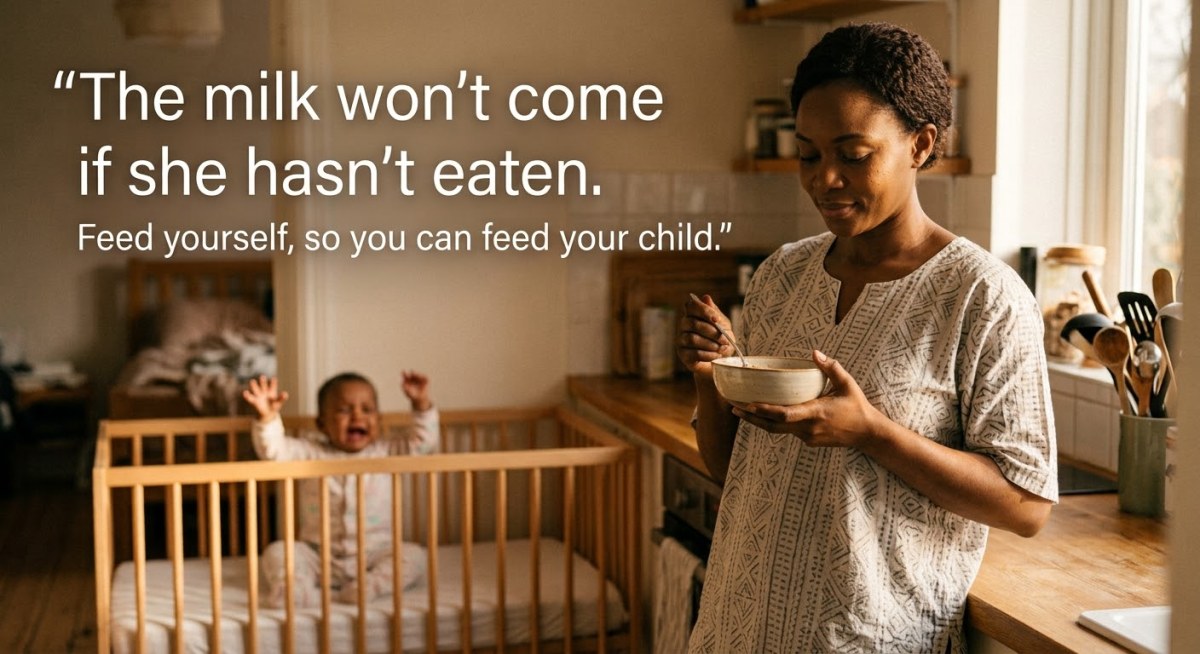
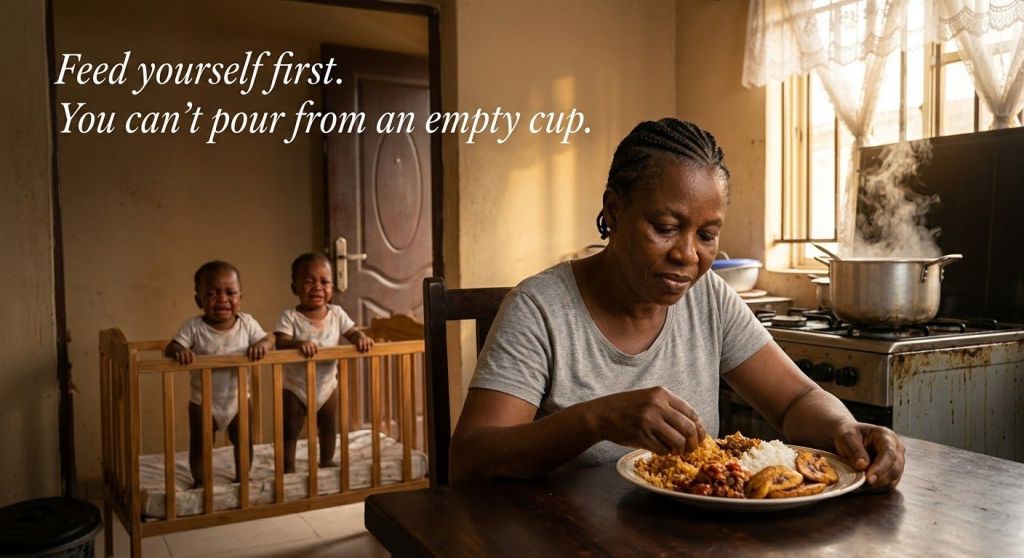
I once visited a friend, and while I was in her house, her baby began to cry. At that moment, she was in the kitchen preparing food for herself. Out of concern, I asked, “Won’t you go and attend to your baby first?”
But she said something I didn’t understand at first: “I have to eat first before I feed my baby.”
She kept eating her own food while her babies cried.
I kept reminding her because the baby was still crying, but she calmly replied, “I’m not wicked to my baby. I’m only trying to help myself, because without eating, I cannot feed my baby. The milk won’t come out if I haven’t eaten.”
That statement stayed with me. It taught me a big lesson.
Later, as I reflected, I realized something profound, God’s Word is also food. The Bible says,
“Man shall not live by bread alone, but by every word that proceeds from the mouth of God.” (Matthew 4:4)
In the same way, a parent must be nourished with the Word of God before they can nourish their child spiritually. You cannot give what you don’t have. You must feed yourself before you can feed your child.
So the big question is: What have you been feeding on? Because what you feed on determines what your child will eventually feed on.
The Bible says,
“Let the Word of Christ dwell in you richly.” (Colossians 3:16)
That means, as parents, we must let God’s Word fill our hearts daily. Parenting begins with personal growth.
Filling up a child is vital, but it starts with a parent who takes responsibility to be word-loaded. Even if you’re not perfect or naturally godly, start somewhere. Let your children see you reading your Bible, praying, or speaking faith. Even if it feels like you’re pretending at first, keep doing it. Because what they see, they will imitate.
A Personal Example
I remember when I was younger, my mom would pray almost every night. You’d see her burning the midnight candle, praying earnestly in the quiet hours. She never told me to do that. She never sat me down to instruct me, saying, “You have to pray.” But guess what? I grew up loving it. I grew up doing what I saw her do.
Just like my father too, he loved reading the Bible quietly at night, using a small table lamp. He didn’t command me to do the same, but I found myself following in his footsteps.
They both fed themselves with the Word, and because of that, it was easy for me to be nourished. They gave me what they already had, a living example of faith.
And that’s what parenting is all about. That’s what godly parenting truly means.
Children learn more by what they see than by what they hear. When parents feed on the Word, their children will naturally grow hungry for it too.
So remember:
A nourished parent raises a nourished child.
A Word-filled heart produces a Word-filled home.
A Deeper Scripture Reflection: Spiritual Maturity
This same truth is echoed sharply in Hebrews:
“For when for the time ye ought to be teachers, ye have need that one teach you again which be the first principles of the oracles of God.” (Hebrews 5:12)
By the time many parents have children, they ought to have grown enough in their walk with God to be teachers, able to instruct their own children in the faith. Instead, some find themselves needing to be taught the basic elements of God’s Word all over again. Spiritual growth was paused somewhere along the way.
This is why Peter’s instruction matters so much:
“As newborn babes, desire the sincere milk of the word, that ye may grow thereby.” (1 Peter 2:2)
Craving the milk of the Word is right and good, for a new believer. But that craving is meant to lead somewhere: growth. Remaining an infant in the faith long after we should have matured is not humility; it’s stagnation. And a parent who has stopped growing has little to hand down. This is the heart of feeding yourself first, not just to have a snack of faith, but to actually grow up in it, so that when your child looks to you, they find a teacher and not just another infant needing milk.
Feed yourself, so you can feed your child.
Remain Ever Blessed.
Loading Comments...
Create your own website, free on WordPress.com.Create your own website.