Feed Yourself Before You Feed the Child

Every parent wants to raise godly, grounded children, but you can’t give what you don’t have. This post reminds parents that spiritual nourishment begins with you. Before you feed your child, make sure your own spirit is full. Your example becomes their foundation.

Discover a powerful lesson on godly parenting, why you must first be spiritually nourished before you can effectively nourish your children. Learn how your walk with God shapes the faith of your child.

I once visited a friend, and while I was in her house, her baby began to cry. At that moment, she was in the kitchen preparing food for herself.Out of concern, I asked, “Won’t you go and attend to your baby first?”

But she said something I didn’t understand at first:
“I have to eat first before I feed my baby.”

I kept reminding her because the baby was still crying, but she calmly replied,
“I’m not wicked to mty baby. I’m only trying to help myself, because without eating, I cannot feed my baby. The milk won’t come out if I haven’t eaten.”

That statement stayed with me. It taught me a big lesson.

Later, as I reflected, I realized something profound — God’s Word is also food.
The Bible says,

“Man shall not live by bread alone, but by every word that proceeds from the mouth of God.” (Matthew 4:4)
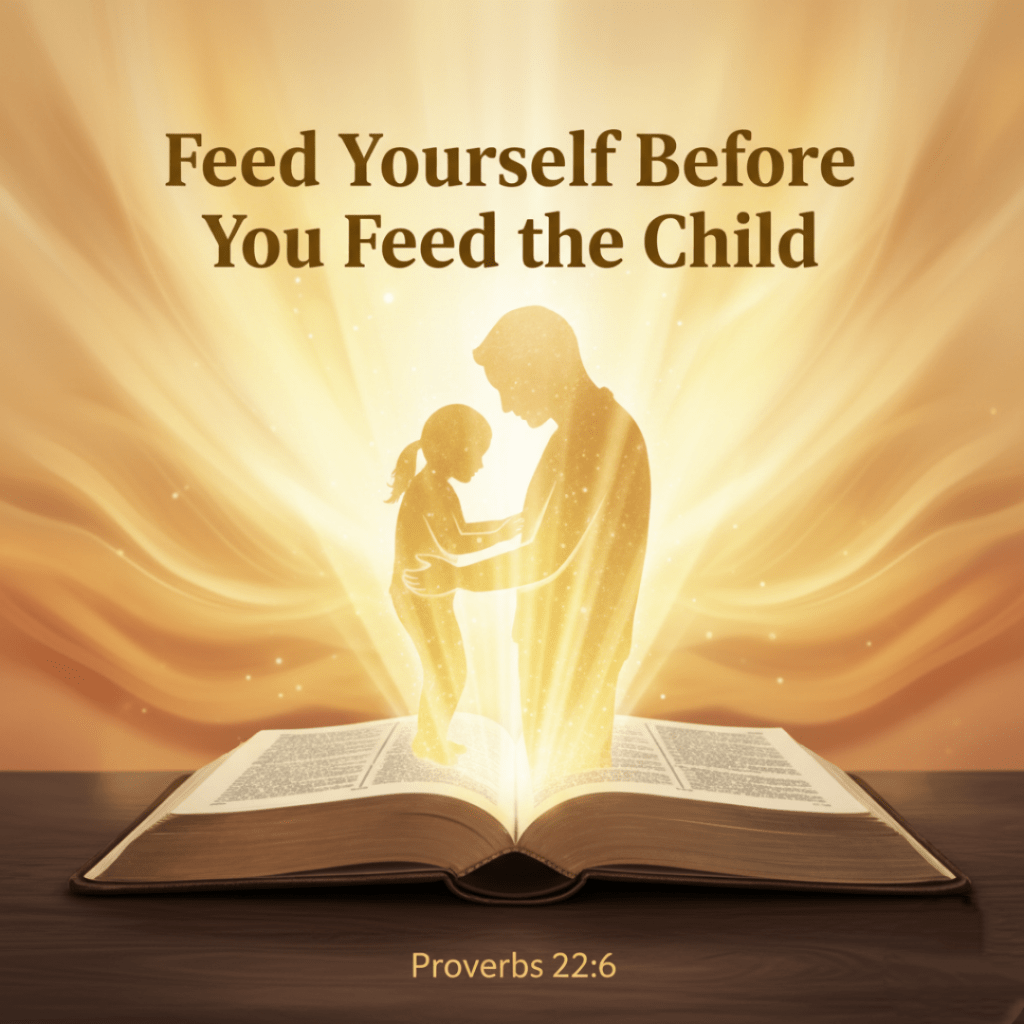
An open Bible with light rays shining upward, forming the shape of a parent and child silhouet.

In the same way, a parent must be nourished with the Word of God before they can nourish their child spiritually.
You cannot give what you don’t have.
You must feed yourself before you can feed your child.

So the big question is: What have you been feeding on?
Because what you feed on determines what your child will eventually feed on.

The Bible says,

“Let the Word of Christ dwell in you richly.” (Colossians 3:16)


That means, as parents, we must let God’s Word fill our hearts daily. Parenting begins with personal growth.

Filling up a child is vital, but it starts with a parent who takes responsibility to be word-loaded.
Even if you’re not perfect or naturally godly, start somewhere. Let your children see you reading your Bible, praying, or speaking faith.
Even if it feels like you’re pretending at first, keep doing it. Because what they see, they will imitate.


A Personal Example

I remember when I was younger, my mom would pray almost every night. You’d see her burning the midnight candle, praying earnestly in the quiet hours. She never told me to do that. She never sat me down to instruct me, saying, “You have to pray.”
But guess what? I grew up loving it. I grew up doing what I saw her do.

Just like my father too, he loved reading the Bible quietly at night, using a small table lamp. He didn’t command me to do the same, but I found myself following in his footsteps.

They both fed themselves with the Word, and because of that, it was easy for me to be nourished.
They gave me what they already had, a living example of faith.

And that’s what parenting is all about.
That’s what godly parenting truly means.

Children learn more by what they see than by what they hear.
When parents feed on the Word, their children will naturally grow hungry for it too.

So remember:

  • A nourished parent raises a nourished child.
  • A Word-filled heart produces a Word-filled home.

Feed yourself, so you can feed your child.

Remain Ever Blessed.

Travailing in Prayer: Shaping Your Child’s Destiny Before Birth

Every destiny is first birthed in prayer before it manifests in life. Discover how to shape your child’s future through travailing prayer, declarations, and scriptural wisdom — using examples from Hannah, Manoah, Mary, and Jabez. Learn how your words and prayers can shape your child’s destiny even before birth.

The Labour Room of Destiny

Before a mother brings forth her child, she must enter the labour room — a place of groaning, pain, and perseverance. The process is never easy, yet it’s in that very travail that life emerges. In the same way, every godly parent must enter the spiritual labour room to birth the destiny of their children before they are even born.

Isaiah 26:17 paints this vivid image:

“As a woman with child is in pain and cries out in her pangs, so have we been in Your sight, O Lord.”

And Isaiah 66:7–8 declares:

“Before she travailed, she brought forth; before her pain came, she was delivered of a man child… for as soon as Zion travailed, she brought forth her children.”

These verses reveal a spiritual truth: destiny is first birthed in prayer before it manifests in reality.


The Power of Travailing Prayer

A glowing silhouette of a mother praying with her hands on her belly, with light forming the image of a baby

In the spiritual realm, prayer is not just a religious act — it is travailing, a groaning that shapes the future. Many parents prepare for the arrival of their babies by decorating nurseries or shopping for clothes. But how many prepare the spiritual environment their children will grow into?

Travailing prayer is the place where you create that atmosphere. It is the altar where destinies are shaped, where God’s plan for your child is aligned before their first cry.

Every parent has a divine mandate to stand in the gap — to birth, protect, and nurture the destinies of their children through intercession.


Biblical Examples of Travailing Parents

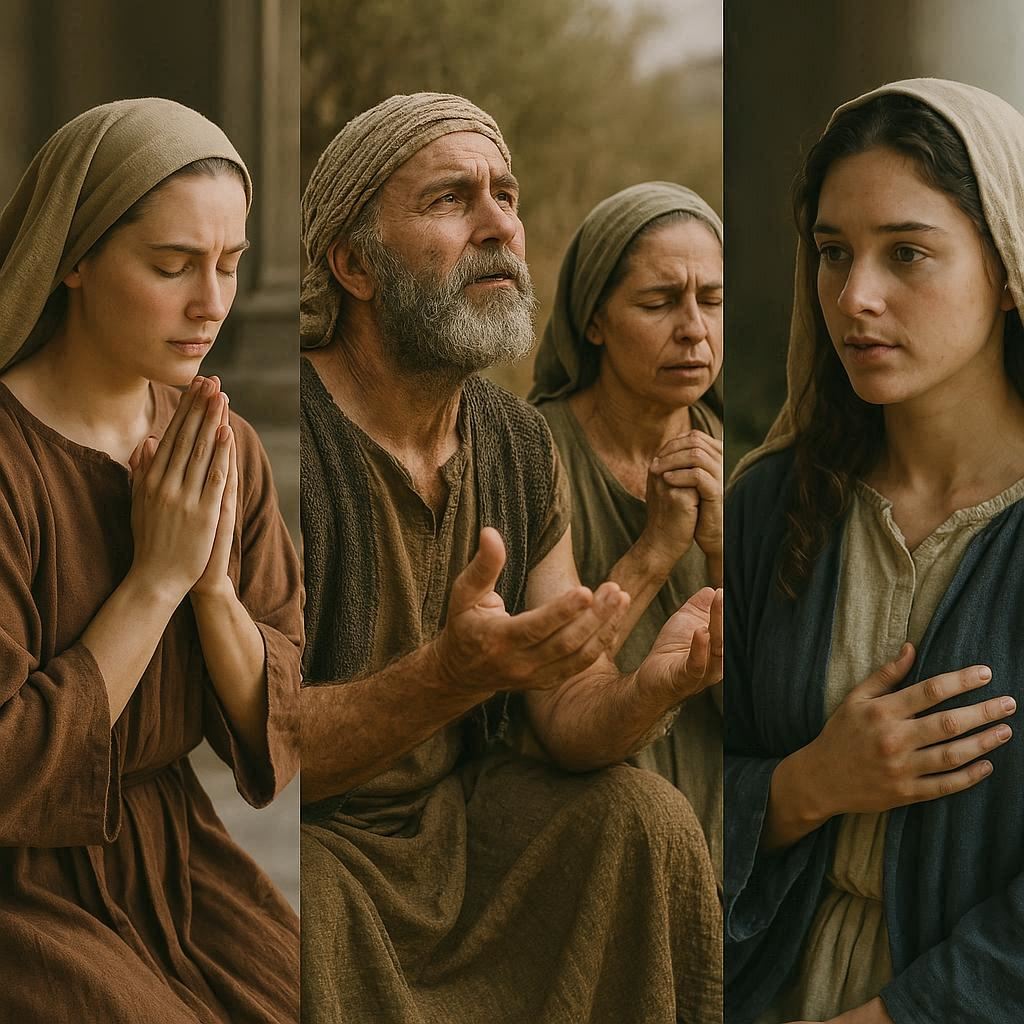
Biblical parents — Hannah praying in the temple, Manoah and his wife seeking God for Samson, and Mary pondering after angelic visitation.

Let’s look at some examples of parents who travailed before God for the destinies of their children:

Hannah travailed in prayer for Samuel (1 Samuel 1:10–11). Her prayers didn’t just bring forth a child — they birthed a prophet.

Manoah and his wife sought divine instruction on how to raise Samson before he was born (Judges 13:8). They understood that destiny requires guidance, not assumption.

Mary, after the angelic visitation, pondered those words in her heart and cooperated with God’s plan for Jesus (Luke 2:19).

Each of these examples reveals a pattern — destiny is not left to chance; it is birthed, nurtured, and protected in prayer.


The Tongue — The Pain or Power of Destiny

Proverbs 18:21 says:

“Death and life are in the power of the tongue, and those who love it shall eat the fruit thereof.”

Your tongue is a birthing tool. You either mold your child’s destiny on the altar of prayer — or you shape it through careless words.

Take the example of Jabez. His mother named him Jabez, saying, “Because I bore him in sorrow” (1 Chronicles 4:9). Her words became a limitation in his life — until Jabez himself reversed it through prayer:

“Oh that You would bless me indeed, and enlarge my coast…” (1 Chronicles 4:10).

This teaches us that even silence is not neutral — if you don’t speak life, you unconsciously allow negative forces to fill the vacuum.

Every time you pray over your unborn or living child, you are building a prophetic wall around their destiny. Every declaration you make — “You will fulfill purpose,” “You are a light to your generation,” “You will walk in wisdom and favor” — becomes a seed of destiny.


Practical Steps for Parents

 An African praying family in a peaceful room, Bible open, with a warm heavenly glow.

Here are simple ways to begin shaping your child’s destiny before birth and beyond:

  1. Pray with understanding. Use scripture as your foundation. (Jeremiah 1:5, Psalm 139:13–16).
  2. Declare life daily. Speak blessings into your child’s life — even while in the womb.
  3. Ask for divine guidance. Like Manoah, seek God for how to raise each child uniquely.
  4. Model what you pray. Your words and actions must agree.
  5. Be consistent. Travailing isn’t a one-time prayer — it’s a lifestyle of intercession and confession.

What words are shaping my child’s destiny today? Am I praying ahead of them or reacting behind them?


Closing Thought: Prayer, the Womb of Destiny

Travailing in prayer is not for mothers alone — it is for every parent, every guardian, every believer entrusted with the life of another soul. The womb of destiny opens on the altar of prayer.

You have the power to shape your child’s path before they take their first breath. Don’t wait for trouble to arise; create their future in the Spirit through prayer, confession, and alignment with God’s Word.


A Call to Salvation

The first step to godly parenting is becoming a child of God yourself. You cannot guide a destiny you haven’t surrendered to the Creator of destinies.

Jesus is the Word (John 1:1–5), the Rod of Correction (Isaiah 11:1), and the Great Shepherd who leads us in the way we should go (Psalm 23:1–3).
Let Him be the Shepherd of your life today.

Say this prayer:

“Lord Jesus, I come to You today. I believe You died for me and rose again. I confess You as my Lord and Saviour. Come into my heart, forgive my sins, and make me a child of God. Help me to walk in Your will and raise my children in Your way. Amen.”


Engage With This Post

💬 What prayers are you praying over your children today?
📖 Share your favorite scripture promises for your child in the comments!
📲 Read more faith-based parenting posts at godlyparent.blogspot.com


Is Your Parenting Manual Alive or Collecting Dust?

We fill our shelves with books. We save countless Instagram posts. We search for the perfect method, the one key that will unlock peaceful, effective, and godly parenting.

But what if the most powerful parenting guide wasn’t a static set of rules, but a living, breathing source of wisdom that adapts to every unique challenge?

The writer of Hebrews gives us a breathtaking description of the tool we often overlook:

“For the word of God is alive and active. Sharper than any double-edged sword, it penetrates even to dividing soul and spirit, joints and marrow; it judges the thoughts and attitudes of the heart.” – Hebrews 4:12 (NIV)

A sharp double-edged sword made of light, point down, cleanly dividing a dark, chaotic scribble from a bright, ordered pattern.

This isn’t a description of a dusty reference book. This is the profile of the ultimate parenting resource.

Why a “Living” Word Makes All the Difference

Unlike any best-selling parenting book, God’s Word possesses three dynamic qualities that make it uniquely suited for the complex task of raising children.

  1. It’s ALIVE: The Personalized Parenting Guide

A printed book gives the same advice to every reader. But God’s Word is alive. It breathes fresh, specific wisdom for your child, in your situation, at this exact moment.

· When you’re facing a tantrum, it can bring to mind the perfect verse about patience (Ephesians 4:2).
· When your child lies, it can guide you to a story about honesty (Acts 5:1-11) and the restoration that follows confession.
· When you feel inadequate, it whispers the promise that His grace is sufficient (2 Corinthians 12:9).

It doesn’t offer a one-size-fits-all solution because it knows the unique heart of your child, and you.

  1. It’s ACTIVE: The Heart-Transforming Agent

Human parenting strategies often focus on modifying outward behavior. God’s Word goes deeper. It is active, meaning it doesn’t just inform; it transforms from the inside out.

It works in your child’s spirit long after you’ve closed the Bible. A simple verse about kindness, planted in their heart during a calm moment, can become the Holy Spirit’s tool to convict them after they’ve been cruel to a sibling. It does the work we cannot.

  1. It’s SURGICALLY PRECISE: The Ultimate Diagnostic Tool

Parenting often involves guessing: “Is this a willful spirit or a wounded soul? Is this a phase or a character issue?”

The Word of God is “sharper than any double-edged sword.” It performs spiritual surgery, precisely dividing soul (the mind, will, and emotions) from spirit (the part that connects with God). It can judge the “thoughts and attitudes of the heart,” revealing the true root of the behavior, whether it’s fear, pride, or a simple need for connection.

Your Move: From Static Strategies to Dynamic Truth

So, how do we trade our dependence on static methods for this dynamic resource?

Your challenge is simple but powerful: The Next-Time Principle.

"A parent's hand resting on a child's shoulder, with a subtle, soft glow connecting them.

The next time you face a parenting struggle, defiance, back-talk, fear, sibling rivalry, make a conscious choice.

  1. Pause before you react.
  2. Trade 10 minutes of frantic scrolling for 5 minutes in Scripture.
  3. Ask: “Holy Spirit, what truth from Your Word applies to this situation?”

Open the Bible, use a concordance, or search a keyword in a Bible app. Look for a story, a proverb, or a teaching of Jesus that speaks to the heart of the matter.

The Promise of the Living Word

Your role as a godly parent is not to have all the answers. It is to be the faithful assistant to the Great Physician, handing Him the one tool, His Word, that can perform the heart-level surgery your child needs.

Stop relying on manuals that collect dust. Start leaning on the Word that is alive, active, and sharper than any tool you will ever own. It is fully equipped to handle any situation, for it is the very voice of the One who created your child’s heart.


Let’s Connect:
What’s ONE situation where you need the’alive and active’ power of God’s Word this week?

Share in the comments on my latest LinkedIn post, let’s cover each other’s children in prayer.

#LivingWord

The Steward Parent: Partnering with God to Uncover Your Child’s Calling

The weight of parenting can feel immense. We worry about grades, friendships, and safety. But Scripture invites us into a far grander vision: we are not owners, but stewards of the children God has entrusted to us.

The psalmist declares a truth that frames every life:

“For you created my inmost being; you knit me together in my mother’s womb. I praise you because I am fearfully and wonderfully made; your works are wonderful, I know that full well.” (Psalm 139:13-14, NIV)

Your child was known and purposefully designed by God before their first breath. Our job is not to assign them a purpose, but to help uncover the one God has already written on their heart. We see this in the calling of Jeremiah:

“Before I formed you in the womb I knew you, before you were born I set you apart; I appointed you as a prophet to the nations.” (Jeremiah 1:5, NIV)

So, how do we, as steward parents, collaborate with God?

  • Nurture Their Unique Design: Pay attention. What makes their eyes light up? Are they naturally compassionate, drawn to music, or incessantly curious? These are clues.

“Train up a child in the way he should go [and in keeping with his individual gift or bent], and when he is old he will not depart from it.” (Proverbs 22:6, AMP).

This isn’t just about discipline; it’s about discerning their “bent” or God-given inclination.

  • Equip Them with Godly Wisdom: Education is vital, but it’s a tool for the mission, not the mission itself. Like Moses, who was

“learned in all the wisdom of the Egyptians” (Acts 7:22, NKJV),

knowledge becomes powerful when directed by God. Pray that they are

“rooted and built up in [Christ], strengthened in the faith as you were taught, and overflowing with thankfulness.” (Colossians 2:7, NIV).

  • Point Them to the Ultimate Purpose: Our primary goal is not their temporal happiness, but their eternal impact for the Kingdom. Teach them that their greatest calling is to

“love the Lord your God with all your heart and with all your soul and with all your mind” and to “love your neighbor as yourself.” (Matthew 22:37, 39, NIV).

Every other purpose flows from this.

Remember, they are His.

“Children are a heritage from the Lord, offspring a reward from him.” (Psalm 127:3, NIV).

We have the sacred honor of stewarding this heritage, not for our own glory, but for His.


Reflection & Conversation 💬

This journey of stewardship is a constant balancing act. It’s about weaving together firm boundaries with boundless grace, much like our Heavenly Father does with us.

“My son, do not make light of the Lord’s discipline, and do not lose heart when he rebukes you, because the Lord disciplines the one he loves.” (Hebrews 12:5-6, NIV).

I’d also love to hear from you! Drop a comment below:

What’s one area of parenting where you’ve struggled with balancing discipline and love?

Is it setting screen time limits? Handling sibling conflicts? Enforcing homework? Share your experience—your story might be the encouragement another parent needs today.

Remain Ever Blessed.

Design a site like this with WordPress.com
Get started